

7. MONOSACCHARIDES AND OLIGOSACCHARIDES
315
(LXIII)
IV. Aminodeoxy Monosaccharides, "Amino Sugars" (50)
Two sugars, widely distributed especially in the animal kingdom,
are structurally derived from D-glucose and D-galactose by replacement
of the hydroxyl of C-2 by the amino group. The sugars, which have not
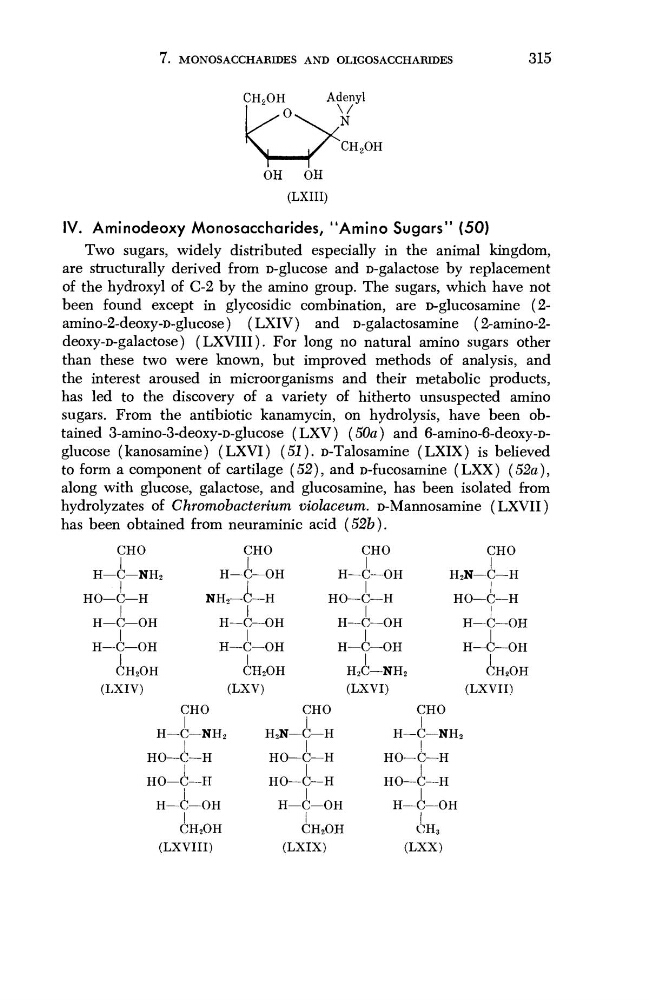
been found except in glycosidic combination, are D-glucosamine (2amino-2-deoxy-D-glucose) (LXIV) and D-galactosamine (2-amino-2deoxy-D-galactose) (LXVIII). For long no natural amino sugars other
than these two were known, but improved methods of analysis, and
the interest aroused in microorganisms and their metabolic products,
has led to the discovery of a variety of hitherto unsuspected amino
sugars. From the antibiotic kanamycin, on hydrolysis, have been obtained 3-amino-3-deoxy-D-glucose (LXV) (50a) and 6-amino-6-deoxy-Dglucose (kanosamine) (LXVI) (52). D-Talosamine (LXIX) is believed
to form a component of cartilage (52), and D-fucosamine (LXX) (52a),
along with glucose, galactose, and glucosamine, has been isolated from
hydrolyzates of Chromobacterium viohceum. D-Mannosamine (LXVII)
has been obtained from neuraminic acid (52b).
(LXIV)
(LXV)
(LXVI)
(LXVII)
(LXVIII)
(LXIX)
(LXX)
315
(LXIII)
IV. Aminodeoxy Monosaccharides, "Amino Sugars" (50)
Two sugars, widely distributed especially in the animal kingdom,
are structurally derived from D-glucose and D-galactose by replacement
of the hydroxyl of C-2 by the amino group. The sugars, which have not
been found except in glycosidic combination, are D-glucosamine (2amino-2-deoxy-D-glucose) (LXIV) and D-galactosamine (2-amino-2deoxy-D-galactose) (LXVIII). For long no natural amino sugars other
than these two were known, but improved methods of analysis, and
the interest aroused in microorganisms and their metabolic products,
has led to the discovery of a variety of hitherto unsuspected amino
sugars. From the antibiotic kanamycin, on hydrolysis, have been obtained 3-amino-3-deoxy-D-glucose (LXV) (50a) and 6-amino-6-deoxy-Dglucose (kanosamine) (LXVI) (52). D-Talosamine (LXIX) is believed
to form a component of cartilage (52), and D-fucosamine (LXX) (52a),
along with glucose, galactose, and glucosamine, has been isolated from
hydrolyzates of Chromobacterium viohceum. D-Mannosamine (LXVII)
has been obtained from neuraminic acid (52b).
(LXIV)
(LXV)
(LXVI)
(LXVII)
(LXVIII)
(LXIX)
(LXX)