

314
D. J. BELL
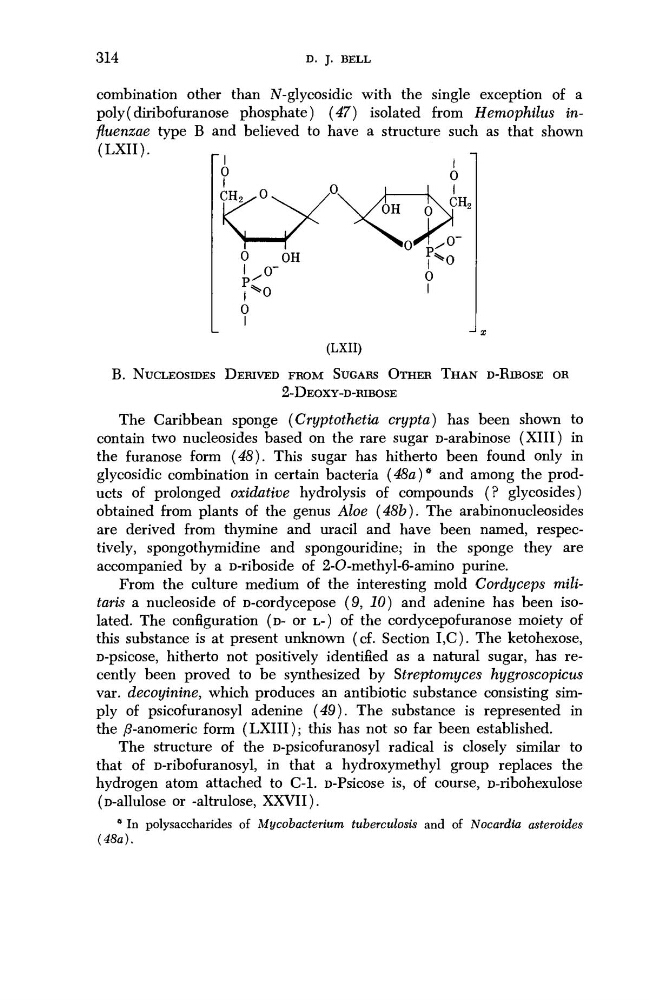
combination other than N-glycosidic with the single exception of a
poly(diribofuranose phosphate) (47) isolated from Hemophilus influenzae type B and believed to have a structure such as that shown
(LXII).
(LXII)
B. NUCLEOSIDES DERIVED FROM SUGARS OTHER THAN D-RIBOSE OR
2-DEOXY-D-RIBOSE
The Caribbean sponge (Cryptothetia crypto) has been shown to
contain two nucleosides based on the rare sugar D-arabinose (XIII) in
the furanose form (48). This sugar has hitherto been found only in
glycosidic combination in certain bacteria (48a)* and among the products of prolonged oxidative hydrolysis of compounds (? glycosides)
obtained from plants of the genus Aloe (48b). The arabinonucleosides
are derived from thymine and uracil and have been named, respectively, spongothymidine and spongouridine; in the sponge they are
accompanied by a D-riboside of 2-0-methyl-6-amino purine.
From the culture medium of the interesting mold Cordyceps militaris a nucleoside of D-cordycepose (9, 10) and adenine has been isolated. The configuration (D- or L-) of the cordycepofuranose moiety of
this substance is at present unknown (cf. Section I,C). The ketohexose,
D-psicose, hitherto not positively identified as a natural sugar, has recently been proved to be synthesized by Streptomyces
hygroscopicus
var. decoyinine, which produces an antibiotic substance consisting simply of psicofuranosyl adenine (49). The substance is represented in
the ß-anomeric form (LXIII); this has not so far been established.
The structure of the D-psicofuranosyl radical is closely similar to
that of D-ribofuranosyl, in that a hydroxymethyl group replaces the
hydrogen atom attached to C-l. D-Psicose is, of course, D-ribohexulose
(D-allulose or -altrulose, XXVII).
* In polysaccharides of Mycobacterium tuberculosis and of Nocardia asteroides
(48a).
D. J. BELL
combination other than N-glycosidic with the single exception of a
poly(diribofuranose phosphate) (47) isolated from Hemophilus influenzae type B and believed to have a structure such as that shown
(LXII).
(LXII)
B. NUCLEOSIDES DERIVED FROM SUGARS OTHER THAN D-RIBOSE OR
2-DEOXY-D-RIBOSE
The Caribbean sponge (Cryptothetia crypto) has been shown to
contain two nucleosides based on the rare sugar D-arabinose (XIII) in
the furanose form (48). This sugar has hitherto been found only in
glycosidic combination in certain bacteria (48a)* and among the products of prolonged oxidative hydrolysis of compounds (? glycosides)
obtained from plants of the genus Aloe (48b). The arabinonucleosides
are derived from thymine and uracil and have been named, respectively, spongothymidine and spongouridine; in the sponge they are
accompanied by a D-riboside of 2-0-methyl-6-amino purine.
From the culture medium of the interesting mold Cordyceps militaris a nucleoside of D-cordycepose (9, 10) and adenine has been isolated. The configuration (D- or L-) of the cordycepofuranose moiety of
this substance is at present unknown (cf. Section I,C). The ketohexose,
D-psicose, hitherto not positively identified as a natural sugar, has recently been proved to be synthesized by Streptomyces
hygroscopicus
var. decoyinine, which produces an antibiotic substance consisting simply of psicofuranosyl adenine (49). The substance is represented in
the ß-anomeric form (LXIII); this has not so far been established.
The structure of the D-psicofuranosyl radical is closely similar to
that of D-ribofuranosyl, in that a hydroxymethyl group replaces the
hydrogen atom attached to C-l. D-Psicose is, of course, D-ribohexulose
(D-allulose or -altrulose, XXVII).
* In polysaccharides of Mycobacterium tuberculosis and of Nocardia asteroides
(48a).