

310
D. J. BELL
shown, based on L-lyxose (45). The highest-numbered asymmetric
center is C-4 (marked by an asterisk).
CHO
H—C—C
I
-OH
H—C—OH
CH 3 0—C*—H
A
CH3 OHCH3
Noviose
5,5-Di-C-methyl-4-0-methyl-L-lyxose
II. Intersugar Glycosidic Compounds: Disaccharides and
Oligosaccharides
Although a vast company of aryl, and other glycosides is known at
the present time, the biochemist usually has greater interest in those
glycosides in which a monosaccharide takes the place of the customary
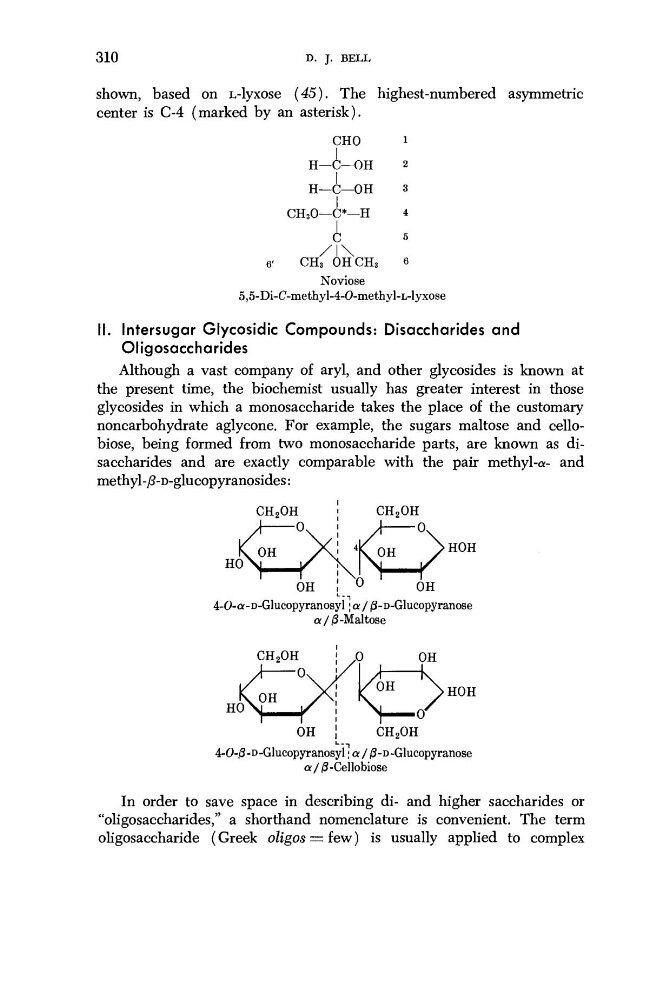
noncarbohydrate aglycone. For example, the sugars maltose and cellobiose, being formed from two monosaccharide parts, are known as disaccharides and are exactly comparable with the pair methyl-«- and
methyl-/?-D-glucopyranosides:
CHoOH
CH 2 OH
HOH
4-O-a-D-Glucopyranosyl;a/ 0-D-Glucopyranose
a / ß -Maltose
CH,OH
HOH
CHoOH
4-0-0-D-Glucopyranosyl j cx//3-D-Glucopyranose
a/ß-Cellobiose
In order to save space in describing di- and higher saccharides or
"oligosaccharides," a shorthand nomenclature is convenient. The term
oligosaccharide (Greek oligos = iew) is usually applied to complex
D. J. BELL
shown, based on L-lyxose (45). The highest-numbered asymmetric
center is C-4 (marked by an asterisk).
CHO
H—C—C
I
-OH
H—C—OH
CH 3 0—C*—H
A
CH3 OHCH3
Noviose
5,5-Di-C-methyl-4-0-methyl-L-lyxose
II. Intersugar Glycosidic Compounds: Disaccharides and
Oligosaccharides
Although a vast company of aryl, and other glycosides is known at
the present time, the biochemist usually has greater interest in those
glycosides in which a monosaccharide takes the place of the customary
noncarbohydrate aglycone. For example, the sugars maltose and cellobiose, being formed from two monosaccharide parts, are known as disaccharides and are exactly comparable with the pair methyl-«- and
methyl-/?-D-glucopyranosides:
CHoOH
CH 2 OH
HOH
4-O-a-D-Glucopyranosyl;a/ 0-D-Glucopyranose
a / ß -Maltose
CH,OH
HOH
CHoOH
4-0-0-D-Glucopyranosyl j cx//3-D-Glucopyranose
a/ß-Cellobiose
In order to save space in describing di- and higher saccharides or
"oligosaccharides," a shorthand nomenclature is convenient. The term
oligosaccharide (Greek oligos = iew) is usually applied to complex