

7. MONOSACCHARIDES AND OLIGOSACCHARIDES
311
sugars containing a known number of monosaccharide units. Since there
are various modifications of such shorthand descriptions, it is usually
necessary to provide a clue for the reader. The following examples will
suffice to explain the system used in this chapter.
a. Shorthand descriptions for ß-maltose and a-cellobiose: ß-Maltose
is 4-0-a-D-glucopyranosyl-/?-D-glucopyranose, or
Ga4Gß
where G = D-glucopyranose and α, ß, and the numbers have their usual
significance. α-Cellobiose is 4-O-ß-D-glucopyranosyl-a-D-glucopyranose, or
Gß4Ga
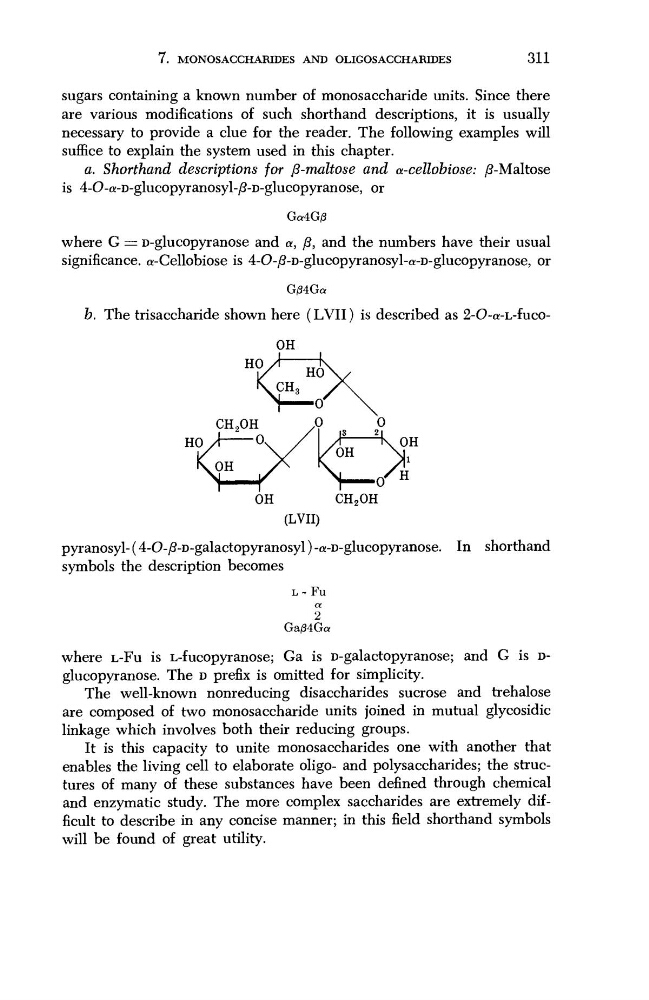
b. The trisaccharide shown here (LVII) is described as 2-O-a-L-fucoCH 2 OH
X>
0
OH
CH 2 OH
(LVII)
pyranosyl- (4-0-/?-D-galactopyranosyl) -α-D-glucopyranose. In shorthand
symbols the description becomes
L-FU
a
2
Ga^Ga
where L-FU is L-fucopyranose; Ga is D-galactopyranose; and G is Dglucopyranose. The D prefix is omitted for simplicity.
The well-known nonreducing disaccharides sucrose and trehalose
are composed of two monosaccharide units joined in mutual glycosidic
linkage which involves both their reducing groups.
It is this capacity to unite monosaccharides one with another that
enables the living cell to elaborate oligo- and polysaccharides; the structures of many of these substances have been defined through chemical
and enzymatic study. The more complex saccharides are extremely difficult to describe in any concise manner; in this field shorthand symbols
will be found of great utility.
311
sugars containing a known number of monosaccharide units. Since there
are various modifications of such shorthand descriptions, it is usually
necessary to provide a clue for the reader. The following examples will
suffice to explain the system used in this chapter.
a. Shorthand descriptions for ß-maltose and a-cellobiose: ß-Maltose
is 4-0-a-D-glucopyranosyl-/?-D-glucopyranose, or
Ga4Gß
where G = D-glucopyranose and α, ß, and the numbers have their usual
significance. α-Cellobiose is 4-O-ß-D-glucopyranosyl-a-D-glucopyranose, or
Gß4Ga
b. The trisaccharide shown here (LVII) is described as 2-O-a-L-fucoCH 2 OH
X>
0
OH
CH 2 OH
(LVII)
pyranosyl- (4-0-/?-D-galactopyranosyl) -α-D-glucopyranose. In shorthand
symbols the description becomes
L-FU
a
2
Ga^Ga
where L-FU is L-fucopyranose; Ga is D-galactopyranose; and G is Dglucopyranose. The D prefix is omitted for simplicity.
The well-known nonreducing disaccharides sucrose and trehalose
are composed of two monosaccharide units joined in mutual glycosidic
linkage which involves both their reducing groups.
It is this capacity to unite monosaccharides one with another that
enables the living cell to elaborate oligo- and polysaccharides; the structures of many of these substances have been defined through chemical
and enzymatic study. The more complex saccharides are extremely difficult to describe in any concise manner; in this field shorthand symbols
will be found of great utility.