

7. MONOSACCHARIDES AND OLIGOSACCHARIDES
309
CHO
Λ
1
• 1
CH 2
1—*
1—·
CH 3
Tyvelose
(O-threo-L-Glycero3,6-dideoxy hexose)
CHO
1
m
1—·
CH 2
•—1
•—1 CH 3
Ascarylose
(L-en/2/?ro-D-Glycero3,6-dideoxyhexose)
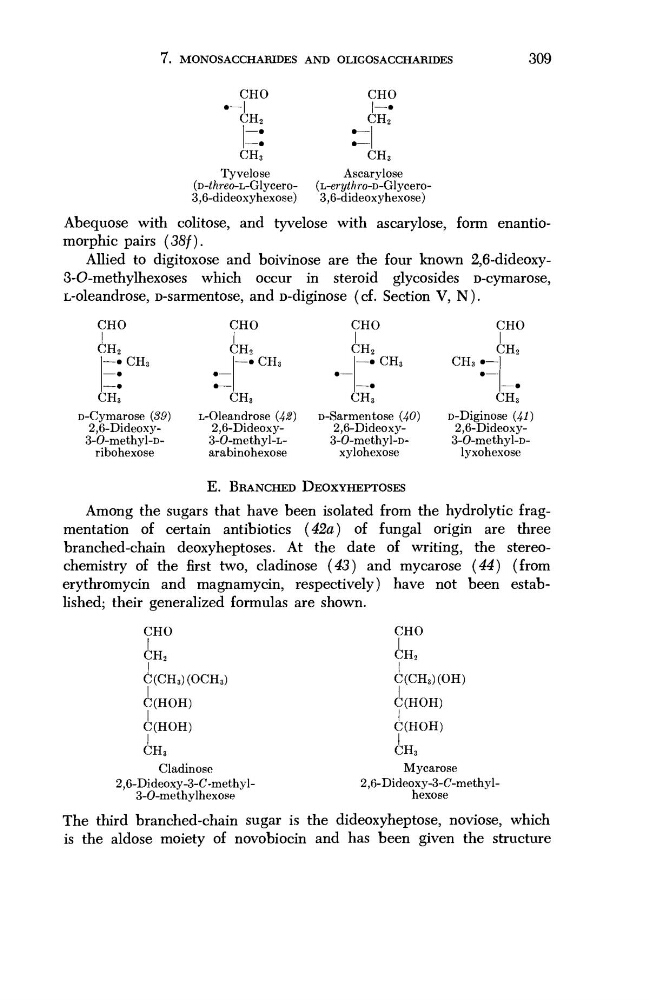
Abequose with colitose, and tyvelose with ascarylose, form enantiomorphic pairs (38f).
Allied to digitoxose and boivinose are the four known 2,6-dideoxy3-O-methylhexoses which occur in steroid glycosides D-cymarose,
L-oleandrose, D-sarmentose, and D-diginose (cf. Section V, N).
CHO
I
CH 2
—»CHa
CH 3
D-Cymarose (39)
3-O-methyl-Dribohexose
CHO
I
CH 2
"—· CH 3
CH 3
L-Oleandrose (42
3-O-methyl-Larabinohexose
CHO
I
CH 2
—•CU 3
CH 3
D-Sarmentose (40)
3-O-methyl-Dxylohexose
CHO
I
CH 2
CH 3 —I
CH 3
D-Diginose (41)
3-O-methyl-Dlyxohexose
E. BRANCHED DEOXYHEPTOSES
Among the sugars that have been isolated from the hydrolytic fragmentation of certain antibiotics (42a) of fungal origin are three
branched-chain deoxyheptoses. At the date of writing, the stereochemistry of the first two, cladinose (43) and mycarose (44) (from
erythromycin and magnamycin, respectively) have not been established; their generalized formulas are shown.
CHO
I
CH 2
I
C(CH 3 )(OCH 3 )
I
C(HOH)
I
C(HOH)
I
CH 3
Cladinose
2,6-Dideoxy-3-C-methyl3-O-methylhexose
CHO
I
CH 2
C(CH 3 )(OH)
I
C(HOH)
I
C(HOH)
CH 3
Mycarose
2,6-Dideoxy-3-C-methylhexose
The third branched-chain sugar is the dideoxyheptose, noviose, which
is the aldose moiety of novobiocin and has been given the structure
309
CHO
Λ
1
• 1
CH 2
1—*
1—·
CH 3
Tyvelose
(O-threo-L-Glycero3,6-dideoxy hexose)
CHO
1
m
1—·
CH 2
•—1
•—1 CH 3
Ascarylose
(L-en/2/?ro-D-Glycero3,6-dideoxyhexose)
Abequose with colitose, and tyvelose with ascarylose, form enantiomorphic pairs (38f).
Allied to digitoxose and boivinose are the four known 2,6-dideoxy3-O-methylhexoses which occur in steroid glycosides D-cymarose,
L-oleandrose, D-sarmentose, and D-diginose (cf. Section V, N).
CHO
I
CH 2
—»CHa
CH 3
D-Cymarose (39)
3-O-methyl-Dribohexose
CHO
I
CH 2
"—· CH 3
CH 3
L-Oleandrose (42
3-O-methyl-Larabinohexose
CHO
I
CH 2
—•CU 3
CH 3
D-Sarmentose (40)
3-O-methyl-Dxylohexose
CHO
I
CH 2
CH 3 —I
CH 3
D-Diginose (41)
3-O-methyl-Dlyxohexose
E. BRANCHED DEOXYHEPTOSES
Among the sugars that have been isolated from the hydrolytic fragmentation of certain antibiotics (42a) of fungal origin are three
branched-chain deoxyheptoses. At the date of writing, the stereochemistry of the first two, cladinose (43) and mycarose (44) (from
erythromycin and magnamycin, respectively) have not been established; their generalized formulas are shown.
CHO
I
CH 2
I
C(CH 3 )(OCH 3 )
I
C(HOH)
I
C(HOH)
I
CH 3
Cladinose
2,6-Dideoxy-3-C-methyl3-O-methylhexose
CHO
I
CH 2
C(CH 3 )(OH)
I
C(HOH)
I
C(HOH)
CH 3
Mycarose
2,6-Dideoxy-3-C-methylhexose
The third branched-chain sugar is the dideoxyheptose, noviose, which
is the aldose moiety of novobiocin and has been given the structure