

308
D. J. BELL
occur in nature; in these a secondary alcoholic group is reduced to
—CH 2 — while C-6 is also —CH 3 . No deoxy sugar has been found in an
unsubstituted state except in traces; all occur in glycosidic linkage in
one type of compound or another. With the exceptions of L-fucose
(6-deoxy-L-galactose) and L-rhamnose,* which occur in many other
situations, the monodeoxyhexoses are found only in the so-called
cardiac glycosides and their chemical relatives in which the aglycones
are polycyclic. Some of the deoxyhexoses occur as monomethyl ethers
where a secondary hydroxyl has become methylated. The structural relationships of the 6-deoxyhexoses are illustrated in Scheme I; the diagram must on no account be taken to indicate any biological routes by
which these sugars might be produced. The simplified formulas of
Reichstein are used and are self-explanatory. Compounds within square
brackets have not been found in a biological environment.
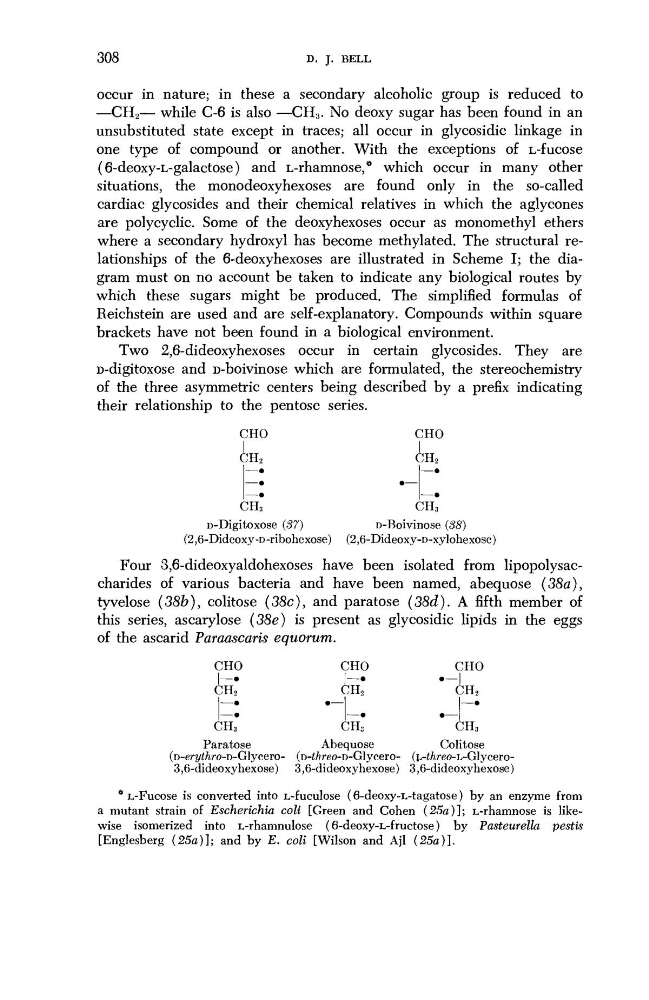
Two 2,6-dideoxyhexoses occur in certain glycosides. They are
D-digitoxose and D-boivinose which are formulated, the stereochemistry
of the three asymmetric centers being described by a prefix indicating
their relationship to the pen tose series.
CHO
CHO
I
I
CH2
CH2
CH3
CH3
D-Digitoxose (37)
D-Boivinose (38)
(2,6-Dideoxy-D-ribohexose)
(2,6-Dideoxy-D-xylohexose)
Four 3,6-dideoxyaldohexoses have been isolated from lipopolysaccharides of various bacteria and have been named, abequose (38a),
tyvelose (38b), colitose (38c), and paratose (38d). A fifth member of
this series, ascarylose (38e) is present as glycosidic lipids in the eggs
of the ascarid Paraascaris equorum.
CHO
CHO
CHO
I—
I—
—I
CH2
CH2
CH2
1 — *
*—1
1—*
I—·
1—·
·—I
CH3
CH3
CH3
Paratose
Abequose
Colitose
(D-er^/iro-D-Glycero- (D-^reo-D-Glycero- (jr-//?reo-L-Glycero3,6-dideoxyhexose)
3,6-dideoxyhexose) 3,6-dideoxyhexose)
* L-Fucose is converted into L-fuculose (6-deoxy-L-tagatose) by an enzyme from
a mutant strain of Escherichia coli [Green and Cohen (25a)]; L-rhamnose is likewise isomerized into L-rhamnulose (6-deoxy-L-fructose) by Pasteurelh
pestis
[Englesberg (25a)]; and by E. coli [Wilson and Ajl (25a)].
D. J. BELL
occur in nature; in these a secondary alcoholic group is reduced to
—CH 2 — while C-6 is also —CH 3 . No deoxy sugar has been found in an
unsubstituted state except in traces; all occur in glycosidic linkage in
one type of compound or another. With the exceptions of L-fucose
(6-deoxy-L-galactose) and L-rhamnose,* which occur in many other
situations, the monodeoxyhexoses are found only in the so-called
cardiac glycosides and their chemical relatives in which the aglycones
are polycyclic. Some of the deoxyhexoses occur as monomethyl ethers
where a secondary hydroxyl has become methylated. The structural relationships of the 6-deoxyhexoses are illustrated in Scheme I; the diagram must on no account be taken to indicate any biological routes by
which these sugars might be produced. The simplified formulas of
Reichstein are used and are self-explanatory. Compounds within square
brackets have not been found in a biological environment.
Two 2,6-dideoxyhexoses occur in certain glycosides. They are
D-digitoxose and D-boivinose which are formulated, the stereochemistry
of the three asymmetric centers being described by a prefix indicating
their relationship to the pen tose series.
CHO
CHO
I
I
CH2
CH2
CH3
CH3
D-Digitoxose (37)
D-Boivinose (38)
(2,6-Dideoxy-D-ribohexose)
(2,6-Dideoxy-D-xylohexose)
Four 3,6-dideoxyaldohexoses have been isolated from lipopolysaccharides of various bacteria and have been named, abequose (38a),
tyvelose (38b), colitose (38c), and paratose (38d). A fifth member of
this series, ascarylose (38e) is present as glycosidic lipids in the eggs
of the ascarid Paraascaris equorum.
CHO
CHO
CHO
I—
I—
—I
CH2
CH2
CH2
1 — *
*—1
1—*
I—·
1—·
·—I
CH3
CH3
CH3
Paratose
Abequose
Colitose
(D-er^/iro-D-Glycero- (D-^reo-D-Glycero- (jr-//?reo-L-Glycero3,6-dideoxyhexose)
3,6-dideoxyhexose) 3,6-dideoxyhexose)
* L-Fucose is converted into L-fuculose (6-deoxy-L-tagatose) by an enzyme from
a mutant strain of Escherichia coli [Green and Cohen (25a)]; L-rhamnose is likewise isomerized into L-rhamnulose (6-deoxy-L-fructose) by Pasteurelh
pestis
[Englesberg (25a)]; and by E. coli [Wilson and Ajl (25a)].