

302
D. J. BELL
R'-O \
/H
C< OH+ HO-R"
R
Hemiacetal + Alcohol
R'-O v
\
H
fl'
+
H0H
(5)
R
Acetal + Water
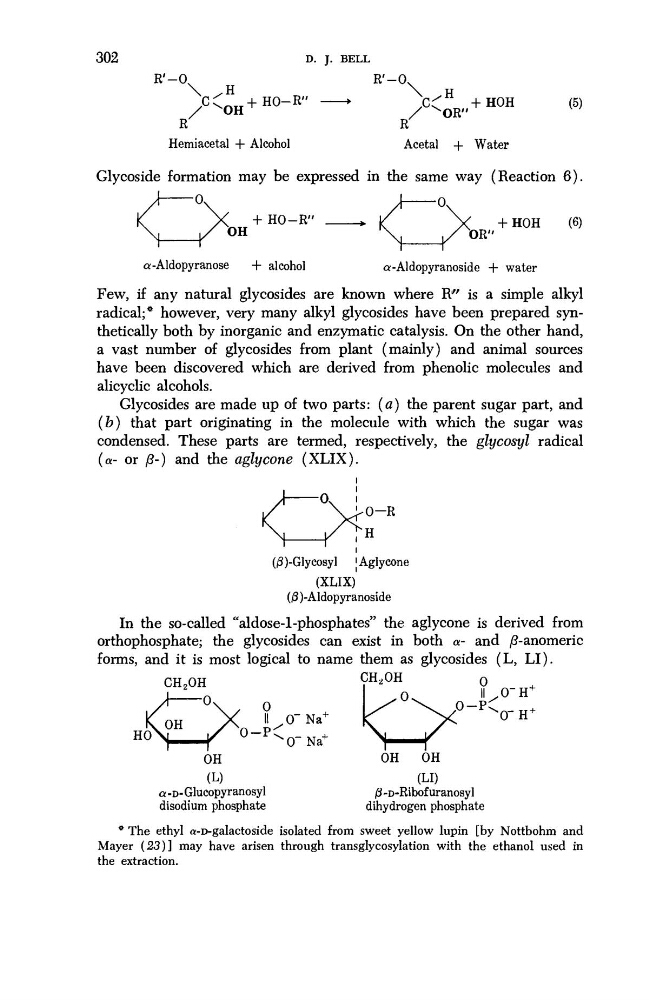
Glycoside formation may be expressed in the same way (Reaction 6).
OH
+ HO-R"
OR"
+ H0H
(6)
α-Aldopyranose
+ alcohol
α-Aldopyranoside + water
Few, if any natural glycosides are known where R" is a simple alkyl
radical;* however, very many alkyl glycosides have been prepared synthetically both by inorganic and enzymatic catalysis. On the other hand,
a vast number of glycosides from plant (mainly) and animal sources
have been discovered which are derived from phenolic molecules and
alicyclic alcohols.
Glycosides are made up of two parts: (a) the parent sugar part, and
(b) that part originating in the molecule with which the sugar was
condensed. These parts are termed, respectively, the glycosyl radical
(a- or /?-) and the aglycone (XLIX).
O-R
(ß )-Glycosyl ' Aglycone
(XLIX)
(ß )-Aldopyranoside
In the so-called "aldose-1-phosphates" the aglycone is derived from
orthophosphate; the glycosides can exist in both a- and ß-anomeric
forms, and it is most logical to name them as glycosides (L, LI).
CH 2 0H
CH 2 0H
.0
0
II
P-PC
,0'H
+
Ό"Η
+
OH
(L)
a -D- Glucopy ranosyl
disodium phosphate
OH
OH
(LI)
β -D-Ribof uranosyl
dihydrogen phosphate
* The ethyl α-D-galactoside isolated from sweet yellow lupin [by Nottbohm and
Mayer (23)] may have arisen through transglycosylation with the ethanol used in
the extraction.
D. J. BELL
R'-O \
/H
C< OH+ HO-R"
R
Hemiacetal + Alcohol
R'-O v
\
H
fl'
+
H0H
(5)
R
Acetal + Water
Glycoside formation may be expressed in the same way (Reaction 6).
OH
+ HO-R"
OR"
+ H0H
(6)
α-Aldopyranose
+ alcohol
α-Aldopyranoside + water
Few, if any natural glycosides are known where R" is a simple alkyl
radical;* however, very many alkyl glycosides have been prepared synthetically both by inorganic and enzymatic catalysis. On the other hand,
a vast number of glycosides from plant (mainly) and animal sources
have been discovered which are derived from phenolic molecules and
alicyclic alcohols.
Glycosides are made up of two parts: (a) the parent sugar part, and
(b) that part originating in the molecule with which the sugar was
condensed. These parts are termed, respectively, the glycosyl radical
(a- or /?-) and the aglycone (XLIX).
O-R
(ß )-Glycosyl ' Aglycone
(XLIX)
(ß )-Aldopyranoside
In the so-called "aldose-1-phosphates" the aglycone is derived from
orthophosphate; the glycosides can exist in both a- and ß-anomeric
forms, and it is most logical to name them as glycosides (L, LI).
CH 2 0H
CH 2 0H
.0
0
II
P-PC
,0'H
+
Ό"Η
+
OH
(L)
a -D- Glucopy ranosyl
disodium phosphate
OH
OH
(LI)
β -D-Ribof uranosyl
dihydrogen phosphate
* The ethyl α-D-galactoside isolated from sweet yellow lupin [by Nottbohm and
Mayer (23)] may have arisen through transglycosylation with the ethanol used in
the extraction.