

7. MONOSACCHARIDES AND OLIGOSACCHARIDES
301
> HOH
(3)
HOH 2 CT "
OH
OH
a I ß - L-Arabof uranose
a / 0-L-Arabopyranose
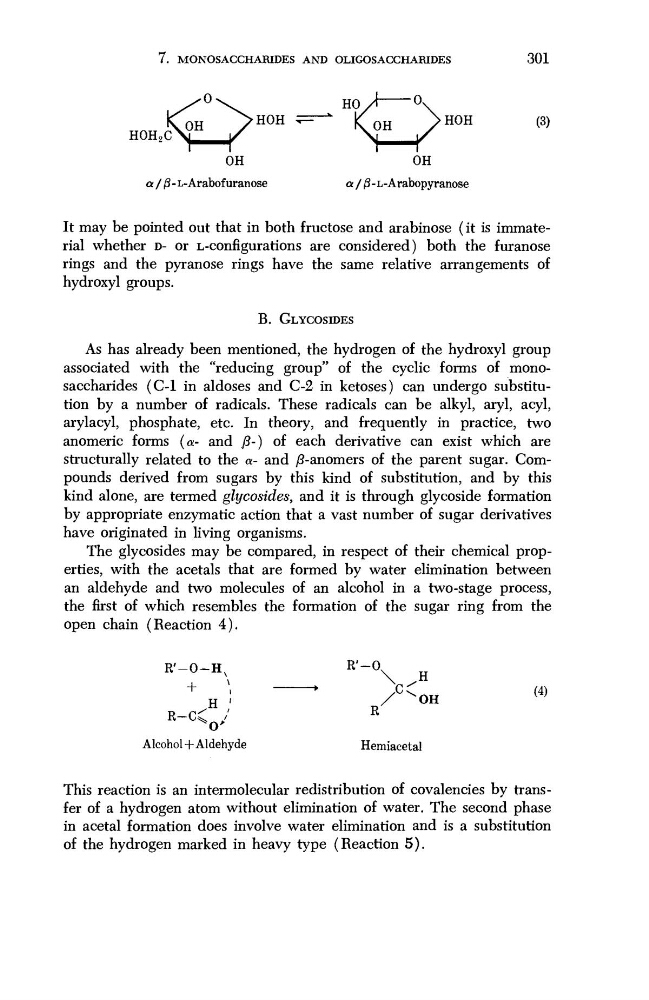
It may be pointed out that in both fructose and arabinose (it is immaterial whether D- or L-configurations are considered) both the furanose
rings and the pyranose rings have the same relative arrangements of
hydroxyl groups.
B. GLYCOSIDES
As has already been mentioned, the hydrogen of the hydroxyl group
associated with the "reducing group" of the cyclic forms of monosaccharides (C-l in aldoses and C-2 in ketoses) can undergo substitution by a number of radicals. These radicals can be alkyl, aryl, acyl,
arylacyl, phosphate, etc. In theory, and frequently in practice, two
anomeric forms (a- and ,/?-) of each derivative can exist which are
structurally related to the a- and β-anomers of the parent sugar. Compounds derived from sugars by this kind of substitution, and by this
kind alone, are termed glycosides, and it is through glycoside formation
by appropriate enzymatic action that a vast number of sugar derivatives
have originated in living organisms.
The glycosides may be compared, in respect of their chemical properties, with the acetals that are formed by water elimination between
an aldehyde and two molecules of an alcohol in a two-stage process,
the first of which resembles the formation of the sugar ring from the
open chain (Reaction 4).
R'-O-H
R'-O
H
+
"
)
C -OH
(4)
R-c< 0 >'
R
Alcohol + Aldehyde
Hemiacetal
This reaction is an intermolecular redistribution of covalencies by transfer of a hydrogen atom without elimination of water. The second phase
in acetal formation does involve water elimination and is a substitution
of the hydrogen marked in heavy type (Reaction 5).
301
> HOH
(3)
HOH 2 CT "
OH
OH
a I ß - L-Arabof uranose
a / 0-L-Arabopyranose
It may be pointed out that in both fructose and arabinose (it is immaterial whether D- or L-configurations are considered) both the furanose
rings and the pyranose rings have the same relative arrangements of
hydroxyl groups.
B. GLYCOSIDES
As has already been mentioned, the hydrogen of the hydroxyl group
associated with the "reducing group" of the cyclic forms of monosaccharides (C-l in aldoses and C-2 in ketoses) can undergo substitution by a number of radicals. These radicals can be alkyl, aryl, acyl,
arylacyl, phosphate, etc. In theory, and frequently in practice, two
anomeric forms (a- and ,/?-) of each derivative can exist which are
structurally related to the a- and β-anomers of the parent sugar. Compounds derived from sugars by this kind of substitution, and by this
kind alone, are termed glycosides, and it is through glycoside formation
by appropriate enzymatic action that a vast number of sugar derivatives
have originated in living organisms.
The glycosides may be compared, in respect of their chemical properties, with the acetals that are formed by water elimination between
an aldehyde and two molecules of an alcohol in a two-stage process,
the first of which resembles the formation of the sugar ring from the
open chain (Reaction 4).
R'-O-H
R'-O
H
+
"
)
C -OH
(4)
R-c< 0 >'
R
Alcohol + Aldehyde
Hemiacetal
This reaction is an intermolecular redistribution of covalencies by transfer of a hydrogen atom without elimination of water. The second phase
in acetal formation does involve water elimination and is a substitution
of the hydrogen marked in heavy type (Reaction 5).