

300
D. J. BELL
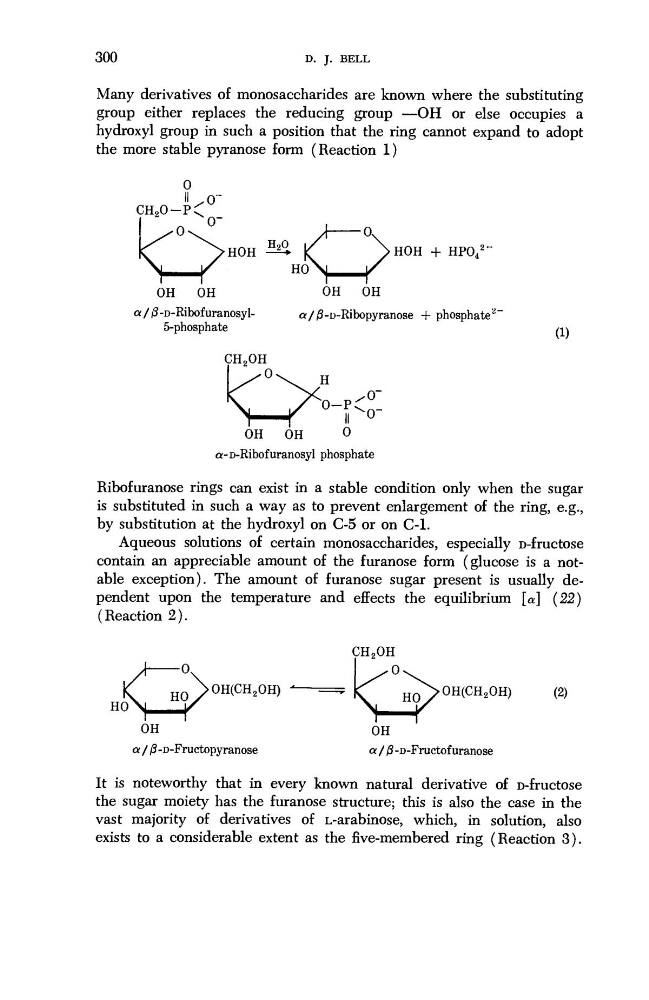
Many derivatives of monosaccharides are known where the substituting
group either replaces the reducing group —OH or else occupies a
hydroxyl group in such a position that the ring cannot expand to adopt
the more stable pyranose form (Reaction 1)
HOH
H 2 o
HOH + HP0 4
2
OH
OH
OH
OH
α/0-D-Ribofuranosylα/0-D-Ribopyranose + phosphate
2
5-phosphate
(1)
O-P:
.0"
*0"
OH
OH
0
a - D-Ribof uranosyl phosphate
Ribofuranose rings can exist in a stable condition only when the sugar
is substituted in such a way as to prevent enlargement of the ring, e.g.,
by substitution at the hydroxyl on C-5 or on C-l.
Aqueous solutions of certain monosaccharides, especially D-fructose
contain an appreciable amount of the furanose form (glucose is a notable exception). The amount of furanose sugar present is usually dependent upon the temperature and eifects the equilibrium [a] (22)
(Reaction 2).
CH 2 0H
OH
a / jS-D-Fructopyranose
OH(CH 2 OH) "
=? |T
R0 ^OH(CH 2 OH)
(2)
OH
a / jS-D-Fructof uranose
It is noteworthy that in every known natural derivative of D-fructose
the sugar moiety has the furanose structure; this is also the case in the
vast majority of derivatives of L-arabinose, which, in solution, also
exists to a considerable extent as the five-membered ring (Reaction 3).
D. J. BELL
Many derivatives of monosaccharides are known where the substituting
group either replaces the reducing group —OH or else occupies a
hydroxyl group in such a position that the ring cannot expand to adopt
the more stable pyranose form (Reaction 1)
HOH
H 2 o
HOH + HP0 4
2
OH
OH
OH
OH
α/0-D-Ribofuranosylα/0-D-Ribopyranose + phosphate
2
5-phosphate
(1)
O-P:
.0"
*0"
OH
OH
0
a - D-Ribof uranosyl phosphate
Ribofuranose rings can exist in a stable condition only when the sugar
is substituted in such a way as to prevent enlargement of the ring, e.g.,
by substitution at the hydroxyl on C-5 or on C-l.
Aqueous solutions of certain monosaccharides, especially D-fructose
contain an appreciable amount of the furanose form (glucose is a notable exception). The amount of furanose sugar present is usually dependent upon the temperature and eifects the equilibrium [a] (22)
(Reaction 2).
CH 2 0H
OH
a / jS-D-Fructopyranose
OH(CH 2 OH) "
=? |T
R0 ^OH(CH 2 OH)
(2)
OH
a / jS-D-Fructof uranose
It is noteworthy that in every known natural derivative of D-fructose
the sugar moiety has the furanose structure; this is also the case in the
vast majority of derivatives of L-arabinose, which, in solution, also
exists to a considerable extent as the five-membered ring (Reaction 3).