

7. MONOSACCHARIDES AND OLIGOSACCHARIDES
299
HO
CH 2 OH
.OH
OH
(XLVa)
\>K
OH
(XLVIa)
OH
OH
CH 2 OH
(XLVIIa)
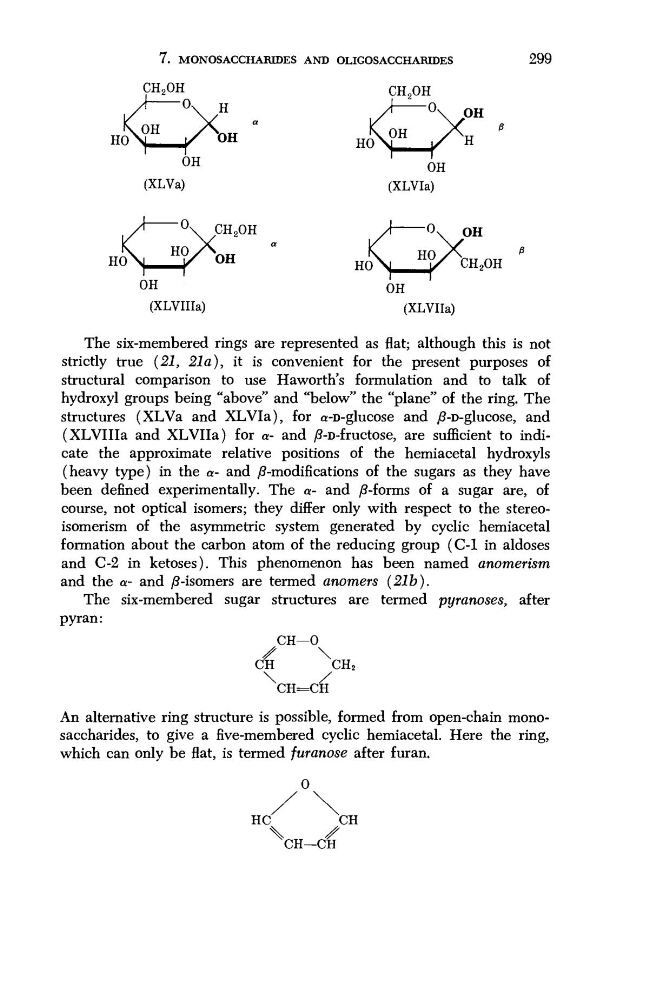
The six-membered rings are represented as flat; although this is not
strictly true (21, 21a), it is convenient for the present purposes of
structural comparison to use Haworth's formulation and to talk of
hydroxyl groups being "above" and "below" the "plane" of the ring. The
structures (XLVa and XLVIa), for α-D-glucose and ß-D-glucose, and
(XLVIIIa and XLVIIa) for a- and ß-D-fructose, are sufficient to indicate the approximate relative positions of the hemiacetal hydroxyls
(heavy type) in the a- and /^-modifications of the sugars as they have
been defined experimentally. The a- and /?-forms of a sugar are, of
course, not optical isomers; they differ only with respect to the stereoisomerism of the asymmetric system generated by cyclic hemiacetal
formation about the carbon atom of the reducing group (C-l in aldoses
and C-2 in ketoses). This phenomenon has been named anomerism
and the a- and ß-isomers are termed anomers (21b).
The six-membered sugar structures are termed pyranoses, after
pyran:
CH—O
CH
CH 2
CH=CH
An alternative ring structure is possible, formed from open-chain monosaccharides, to give a five-membered cyclic hemiacetal. Here the ring,
which can only be flat, is termed furanose after furan.
O
/
\
HC
CH
\
X
CH—CH
299
HO
CH 2 OH
.OH
OH
(XLVa)
\>K
OH
(XLVIa)
OH
OH
CH 2 OH
(XLVIIa)
The six-membered rings are represented as flat; although this is not
strictly true (21, 21a), it is convenient for the present purposes of
structural comparison to use Haworth's formulation and to talk of
hydroxyl groups being "above" and "below" the "plane" of the ring. The
structures (XLVa and XLVIa), for α-D-glucose and ß-D-glucose, and
(XLVIIIa and XLVIIa) for a- and ß-D-fructose, are sufficient to indicate the approximate relative positions of the hemiacetal hydroxyls
(heavy type) in the a- and /^-modifications of the sugars as they have
been defined experimentally. The a- and /?-forms of a sugar are, of
course, not optical isomers; they differ only with respect to the stereoisomerism of the asymmetric system generated by cyclic hemiacetal
formation about the carbon atom of the reducing group (C-l in aldoses
and C-2 in ketoses). This phenomenon has been named anomerism
and the a- and ß-isomers are termed anomers (21b).
The six-membered sugar structures are termed pyranoses, after
pyran:
CH—O
CH
CH 2
CH=CH
An alternative ring structure is possible, formed from open-chain monosaccharides, to give a five-membered cyclic hemiacetal. Here the ring,
which can only be flat, is termed furanose after furan.
O
/
\
HC
CH
\
X
CH—CH