

298
D. J. BELL
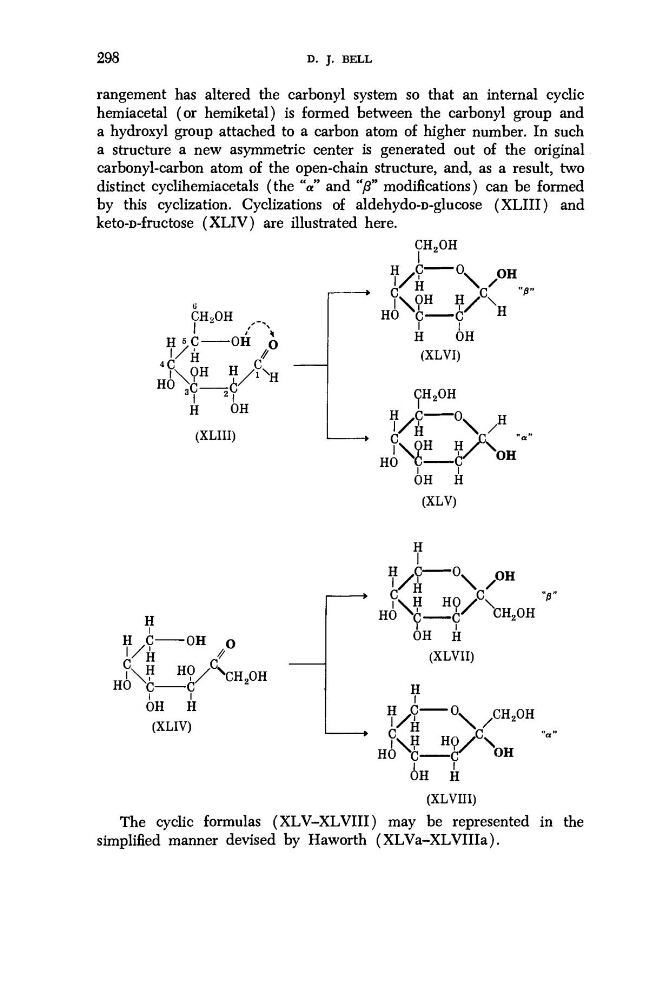
rangement has altered the carbonyl system so that an internal cyclic
hemiacetal (or hemiketal) is formed between the carbonyl group and
a hydroxyl group attached to a carbon atom of higher number. In such
a structure a new asymmetric center is generated out of the original
carbonyl-carbon atom of the open-chain structure, and, as a result, two
distinct cyclihemiacetals (the "a" and
t€ ßT modifications) can be formed
by this cyclization. Cyclizations of aldehydo-D-glucose (XLIII) and
keto-D-fructose (XLIV) are illustrated here.
CH 2 OH
CH 2 OH
H 6 C
OH o
I/H
//
H
OH
(XLIII)
i\?
H
¥/\
HO
N C
C
I
I
H
OH
(XLVI)
OH
H
^ OH
H X
HO i
i
OH I
(XLV)
V
ϊΑ>Β
H
1/
HO
H
I
H
H
-OH O
//
HO ?/
x CH 2 0H
OH H
(XLIV)
H
I
H ^C
0,
OH
v
I
H
,OH
"ß"
CH 2 OH
(XLVII)
H
C
H
HO
X C—
I
OH
fxArn
CH 2 OH
-C
I
H
(XLVIII)
The cyclic formulas (XLV-XLVIII) may be represented in the
simplified manner devised by Haworth (XLVa-XLVilla).
D. J. BELL
rangement has altered the carbonyl system so that an internal cyclic
hemiacetal (or hemiketal) is formed between the carbonyl group and
a hydroxyl group attached to a carbon atom of higher number. In such
a structure a new asymmetric center is generated out of the original
carbonyl-carbon atom of the open-chain structure, and, as a result, two
distinct cyclihemiacetals (the "a" and
t€ ßT modifications) can be formed
by this cyclization. Cyclizations of aldehydo-D-glucose (XLIII) and
keto-D-fructose (XLIV) are illustrated here.
CH 2 OH
CH 2 OH
H 6 C
OH o
I/H
//
H
OH
(XLIII)
i\?
H
¥/\
HO
N C
C
I
I
H
OH
(XLVI)
OH
H
^ OH
H X
HO i
i
OH I
(XLV)
V
ϊΑ>Β
H
1/
HO
H
I
H
H
-OH O
//
HO ?/
x CH 2 0H
OH H
(XLIV)
H
I
H ^C
0,
OH
v
I
H
,OH
"ß"
CH 2 OH
(XLVII)
H
C
H
HO
X C—
I
OH
fxArn
CH 2 OH
-C
I
H
(XLVIII)
The cyclic formulas (XLV-XLVIII) may be represented in the
simplified manner devised by Haworth (XLVa-XLVilla).