

7. MONOSACCHARIDES AND OLIGOSACCHARIDES
303
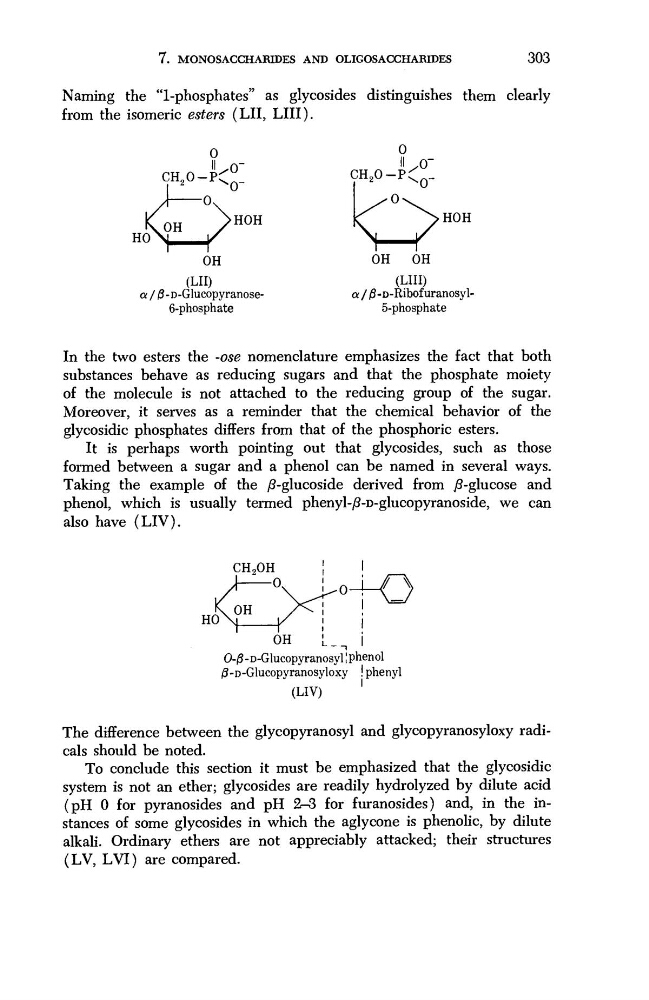
Naming the "1-phosphates" as glycosides distinguishes them clearly
from the isomeric esters (LII, LIII).
HOH
(LII)
a I ß-D-Glucopyranose6-phosphate
HOH
OH OH
(LIII)
a 10-D-Ribof uranosyl5-phosphate
In the two esters the -ose nomenclature emphasizes the fact that both
substances behave as reducing sugars and that the phosphate moiety
of the molecule is not attached to the reducing group of the sugar.
Moreover, it serves as a reminder that the chemical behavior of the
glycosidic phosphates differs from that of the phosphoric esters.
It is perhaps worth pointing out that glycosides, such as those
formed between a sugar and a phenol can be named in several ways.
Taking the example of the /?-glucoside derived from jo-glucose and
phenol, which is usually termed phenyl-ß-D-glucopyranoside, we can
also have (LIV).
CH 2 OH
O-ß - D-Glucopyranosyl! phenol
ß - D -Glucopy ranosyloxy ! phenyl
(LIV)
'
The difference between the glycopyranosyl and glycopyranosyloxy radicals should be noted.
To conclude this section it must be emphasized that the glycosidic
system is not an ether; glycosides are readily hydrolyzed by dilute acid
(pH 0 for pyranosides and pH 2^3 for furanosides) and, in the instances of some glycosides in which the aglycone is phenolic, by dilute
alkali. Ordinary ethers are not appreciably attacked; their structures
(LV, LVI) are compared.
303
Naming the "1-phosphates" as glycosides distinguishes them clearly
from the isomeric esters (LII, LIII).
HOH
(LII)
a I ß-D-Glucopyranose6-phosphate
HOH
OH OH
(LIII)
a 10-D-Ribof uranosyl5-phosphate
In the two esters the -ose nomenclature emphasizes the fact that both
substances behave as reducing sugars and that the phosphate moiety
of the molecule is not attached to the reducing group of the sugar.
Moreover, it serves as a reminder that the chemical behavior of the
glycosidic phosphates differs from that of the phosphoric esters.
It is perhaps worth pointing out that glycosides, such as those
formed between a sugar and a phenol can be named in several ways.
Taking the example of the /?-glucoside derived from jo-glucose and
phenol, which is usually termed phenyl-ß-D-glucopyranoside, we can
also have (LIV).
CH 2 OH
O-ß - D-Glucopyranosyl! phenol
ß - D -Glucopy ranosyloxy ! phenyl
(LIV)
'
The difference between the glycopyranosyl and glycopyranosyloxy radicals should be noted.
To conclude this section it must be emphasized that the glycosidic
system is not an ether; glycosides are readily hydrolyzed by dilute acid
(pH 0 for pyranosides and pH 2^3 for furanosides) and, in the instances of some glycosides in which the aglycone is phenolic, by dilute
alkali. Ordinary ethers are not appreciably attacked; their structures
(LV, LVI) are compared.