

18
F. B. SHORLAND
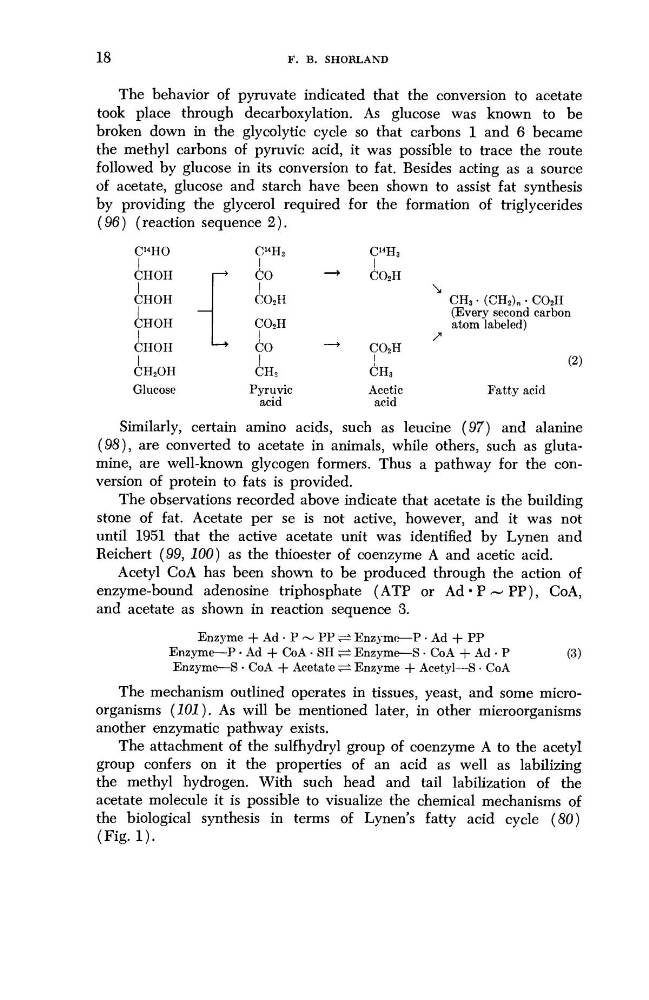
The behavior of pyruvate indicated that the conversion to acetate
took place through decarboxylation. As glucose was known to be
broken down in the glycolytic cycle so that carbons 1 and 6 became
the methyl carbons of pyruvic acid, it was possible to trace the route
followed by glucose in its conversion to fat. Besides acting as a source
of acetate, glucose and starch have been shown to assist fat synthesis
by providing the glycerol required for the formation of triglycerides
(96) (reaction sequence 2).
C
14
HO
CHOH
I
CHOH
I
CHOH
I
CHOH
I
CH 2 OH
Glucose
C"H,
I
CO
I
CO 2 H
CO 2 H
1
CO
I
CH 2
Pyruvic
acid
C
14
H 3
!
C0 2 H
C0 2 H
CH 3
Acetic
acid
\
f
CH 3 · (CHj)n · C0 2 H
(Every second carbon
atom labeled)
(2)
Fatty acid
Similarly, certain amino acids, such as leucine (97) and alanine
(98), are converted to acetate in animals, while others, such as glutamine, are well-known glycogen formers. Thus a pathway for the conversion of protein to fats is provided.
The observations recorded above indicate that acetate is the building
stone of fat. Acetate per se is not active, however, and it was not
until 1951 that the active acetate unit was identified by Lynen and
Reichert (99, 100) as the thioester of coenzyme A and acetic acid.
Acetyl CoA has been shown to be produced through the action of
enzyme-bound adenosine triphosphate (ATP or Ad · P ^ PP), CoA,
and acetate as shown in reaction sequence 3.
Enzyme + Ad · P ~ PP ;=± Enzyme—P · Ad + PP
Enzyme—P · Ad + CoA · SH ^± Enzyme—S · CoA + Ad · P
Enzyme—S · CoA + Acetate ;=± Enzyme + Acetyl—S · CoA
(3)
The mechanism outlined operates in tissues, yeast, and some microorganisms (101). As will be mentioned later, in other microorganisms
another enzymatic pathway exists.
The attachment of the sulfhydryl group of coenzyme A to the acetyl
group confers on it the properties of an acid as well as labilizing
the methyl hydrogen. With such head and tail labilization of the
acetate molecule it is possible to visualize the chemical mechanisms of
the biological synthesis in terms of Lynen's fatty acid cycle (80)
(Fig. 1).
F. B. SHORLAND
The behavior of pyruvate indicated that the conversion to acetate
took place through decarboxylation. As glucose was known to be
broken down in the glycolytic cycle so that carbons 1 and 6 became
the methyl carbons of pyruvic acid, it was possible to trace the route
followed by glucose in its conversion to fat. Besides acting as a source
of acetate, glucose and starch have been shown to assist fat synthesis
by providing the glycerol required for the formation of triglycerides
(96) (reaction sequence 2).
C
14
HO
CHOH
I
CHOH
I
CHOH
I
CHOH
I
CH 2 OH
Glucose
C"H,
I
CO
I
CO 2 H
CO 2 H
1
CO
I
CH 2
Pyruvic
acid
C
14
H 3
!
C0 2 H
C0 2 H
CH 3
Acetic
acid
\
f
CH 3 · (CHj)n · C0 2 H
(Every second carbon
atom labeled)
(2)
Fatty acid
Similarly, certain amino acids, such as leucine (97) and alanine
(98), are converted to acetate in animals, while others, such as glutamine, are well-known glycogen formers. Thus a pathway for the conversion of protein to fats is provided.
The observations recorded above indicate that acetate is the building
stone of fat. Acetate per se is not active, however, and it was not
until 1951 that the active acetate unit was identified by Lynen and
Reichert (99, 100) as the thioester of coenzyme A and acetic acid.
Acetyl CoA has been shown to be produced through the action of
enzyme-bound adenosine triphosphate (ATP or Ad · P ^ PP), CoA,
and acetate as shown in reaction sequence 3.
Enzyme + Ad · P ~ PP ;=± Enzyme—P · Ad + PP
Enzyme—P · Ad + CoA · SH ^± Enzyme—S · CoA + Ad · P
Enzyme—S · CoA + Acetate ;=± Enzyme + Acetyl—S · CoA
(3)
The mechanism outlined operates in tissues, yeast, and some microorganisms (101). As will be mentioned later, in other microorganisms
another enzymatic pathway exists.
The attachment of the sulfhydryl group of coenzyme A to the acetyl
group confers on it the properties of an acid as well as labilizing
the methyl hydrogen. With such head and tail labilization of the
acetate molecule it is possible to visualize the chemical mechanisms of
the biological synthesis in terms of Lynen's fatty acid cycle (80)
(Fig. 1).