

1. FATTY ACID OCCURRENCE AND DISTRIBUTION
19
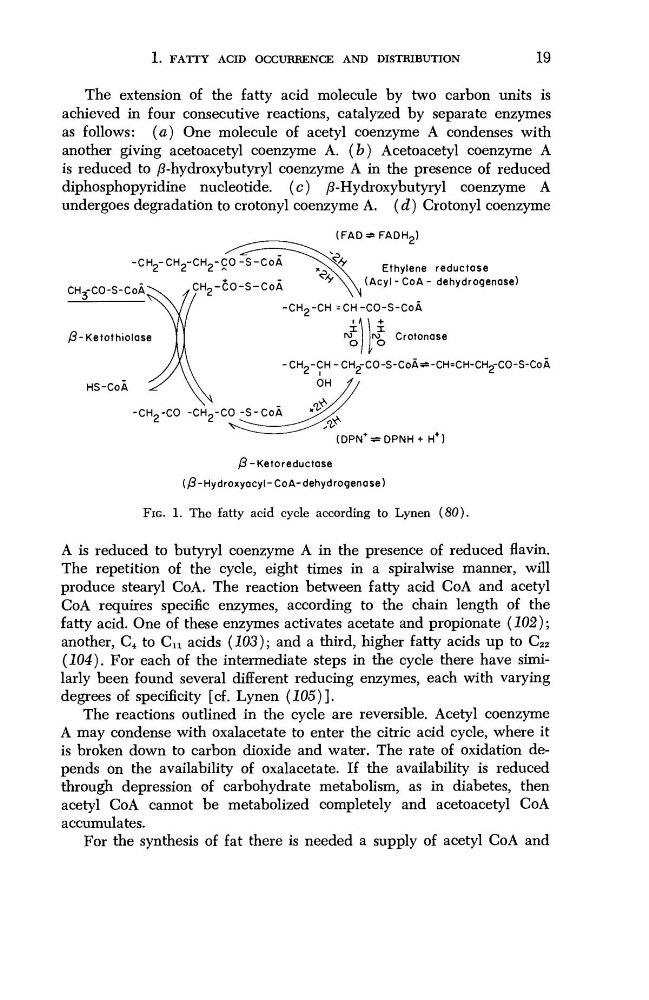
The extension of the fatty acid molecule by two carbon units is
achieved in four consecutive reactions, catalyzed by separate enzymes
as follows: (a) One molecule of acetyl coenzyme A condenses with
another giving acetoacetyl coenzyme A. (b) Acetoacetyl coenzyme A
is reduced to ß-hydroxybutyryl coenzyme A in the presence of reduced
diphosphopyridine nucleotide. (c) ß-Hydroxybutyryl coenzyme A
undergoes degradation to crotonyl coenzyme A. (d) Crotonyl coenzyme
-CH2-CH2-CH2-CO-S-CoA
CH3-CO-S-C0A
/3-Ketothiolase
HS-CoA
CH2-CO-S-CoA
(FAD=*FADH2)
Ethylene reductase
(Acyl-CoA- dehydrogenase)
-CH2-CH =CH-CO-S-CoÄ
±v, -
™
ro Crotonase
- CH2-CH - CH2-CO-S-CoA=*-CH=CH-CH2-CO-S-CoA
-CH2-CO -CH2-CO
(DPN*^DPNH + H
+ )
/3-Ketoreductase
(/3-Hydroxyacyl-CoA-dehydrogenase)
FIG. 1. The fatty acid cycle according to Lynen (80).
A is reduced to butyryl coenzyme A in the presence of reduced flavin.
The repetition of the cycle, eight times in a spiralwise manner, will
produce stearyl CoA. The reaction between fatty acid CoA and acetyl
CoA requires specific enzymes, according to the chain length of the
fatty acid. One of these enzymes activates acetate and propionate (102);
another, C 4 to Cn acids (103); and a third, higher fatty acids up to C 22
(104). For each of the intermediate steps in the cycle there have similarly been found several different reducing enzymes, each with varying
degrees of specificity [cf. Lynen (105)].
The reactions outlined in the cycle are reversible. Acetyl coenzyme
A may condense with oxalacetate to enter the citric acid cycle, where it
is broken down to carbon dioxide and water. The rate of oxidation depends on the availability of oxalacetate. If the availability is reduced
through depression of carbohydrate metabolism, as in diabetes, then
acetyl CoA cannot be metabolized completely and acetoacetyl CoA
accumulates.
For the synthesis of fat there is needed a supply of acetyl CoA and
19
The extension of the fatty acid molecule by two carbon units is
achieved in four consecutive reactions, catalyzed by separate enzymes
as follows: (a) One molecule of acetyl coenzyme A condenses with
another giving acetoacetyl coenzyme A. (b) Acetoacetyl coenzyme A
is reduced to ß-hydroxybutyryl coenzyme A in the presence of reduced
diphosphopyridine nucleotide. (c) ß-Hydroxybutyryl coenzyme A
undergoes degradation to crotonyl coenzyme A. (d) Crotonyl coenzyme
-CH2-CH2-CH2-CO-S-CoA
CH3-CO-S-C0A
/3-Ketothiolase
HS-CoA
CH2-CO-S-CoA
(FAD=*FADH2)
Ethylene reductase
(Acyl-CoA- dehydrogenase)
-CH2-CH =CH-CO-S-CoÄ
±v, -
™
ro Crotonase
- CH2-CH - CH2-CO-S-CoA=*-CH=CH-CH2-CO-S-CoA
-CH2-CO -CH2-CO
(DPN*^DPNH + H
+ )
/3-Ketoreductase
(/3-Hydroxyacyl-CoA-dehydrogenase)
FIG. 1. The fatty acid cycle according to Lynen (80).
A is reduced to butyryl coenzyme A in the presence of reduced flavin.
The repetition of the cycle, eight times in a spiralwise manner, will
produce stearyl CoA. The reaction between fatty acid CoA and acetyl
CoA requires specific enzymes, according to the chain length of the
fatty acid. One of these enzymes activates acetate and propionate (102);
another, C 4 to Cn acids (103); and a third, higher fatty acids up to C 22
(104). For each of the intermediate steps in the cycle there have similarly been found several different reducing enzymes, each with varying
degrees of specificity [cf. Lynen (105)].
The reactions outlined in the cycle are reversible. Acetyl coenzyme
A may condense with oxalacetate to enter the citric acid cycle, where it
is broken down to carbon dioxide and water. The rate of oxidation depends on the availability of oxalacetate. If the availability is reduced
through depression of carbohydrate metabolism, as in diabetes, then
acetyl CoA cannot be metabolized completely and acetoacetyl CoA
accumulates.
For the synthesis of fat there is needed a supply of acetyl CoA and