

1. FATTY ACID OCCURRENCE AND DISTRIBUTION
17
Using isotopically labeled acetate, Rittenberg and Bloch (86, 87)
showed that acetate is a precursor of the higher fatty acids, the condensation probably taking place through the successive addition of active
acetate to the carboxyl group of the fatty acid; or, as has been subsequently shown, the condensation of the acetate unit with the fatty acids
takes place through their CoA derivatives. This is the reverse of ß-oxidation, which was first demonstrated by Knoop (88) in 1905. By use of
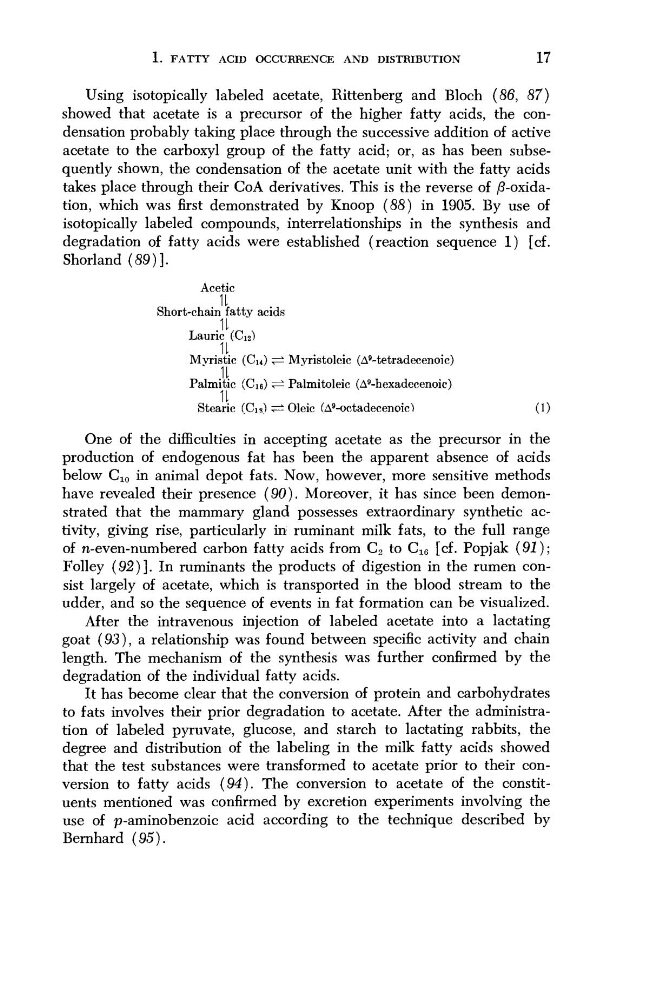
isotopically labeled compounds, interrelationships in the synthesis and
degradation of fatty acids were established (reaction sequence 1) [cf.
Shorland (89)].
Acetic
1L
Short-chain fatty acids
11
Laurie (Ci 2 )
11
Mvristic (C14) ^ Myristoleic (A
9 -tetradecenoic)
" 11
Palmitic (Cie) ^ Palmitoleic (A
9 -hexadecenoic)
11
Stearic (Cis) ^± Oleic (A
9 -octadecenoic)
(1
)
One of the difficulties in accepting acetate as the precursor in the
production of endogenous fat has been the apparent absence of acids
below C10 in animal depot fats. Now, however, more sensitive methods
have revealed their presence (90). Moreover, it has since been demonstrated that the mammary gland possesses extraordinary synthetic activity, giving rise, particularly in ruminant milk fats, to the full range
of n-even-numbered carbon fatty acids from C 2 to Ci 6 [cf. Popjak (91);
Folley (92)]. In ruminants the products of digestion in the rumen consist largely of acetate, which is transported in the blood stream to the
udder, and so the sequence of events in fat formation can be visualized.
After the intravenous injection of labeled acetate into a lactating
goat (93), a relationship was found between specific activity and chain
length. The mechanism of the synthesis was further confirmed by the
degradation of the individual fatty acids.
It has become clear that the conversion of protein and carbohydrates
to fats involves their prior degradation to acetate. After the administration of labeled pyruvate, glucose, and starch to lactating rabbits, the
degree and distribution of the labeling in the milk fatty acids showed
that the test substances were transformed to acetate prior to their conversion to fatty acids (94). The conversion to acetate of the constituents mentioned was confirmed by excretion experiments involving the
use of p-aminobenzoic acid according to the technique described by
Bernhard (95).
17
Using isotopically labeled acetate, Rittenberg and Bloch (86, 87)
showed that acetate is a precursor of the higher fatty acids, the condensation probably taking place through the successive addition of active
acetate to the carboxyl group of the fatty acid; or, as has been subsequently shown, the condensation of the acetate unit with the fatty acids
takes place through their CoA derivatives. This is the reverse of ß-oxidation, which was first demonstrated by Knoop (88) in 1905. By use of
isotopically labeled compounds, interrelationships in the synthesis and
degradation of fatty acids were established (reaction sequence 1) [cf.
Shorland (89)].
Acetic
1L
Short-chain fatty acids
11
Laurie (Ci 2 )
11
Mvristic (C14) ^ Myristoleic (A
9 -tetradecenoic)
" 11
Palmitic (Cie) ^ Palmitoleic (A
9 -hexadecenoic)
11
Stearic (Cis) ^± Oleic (A
9 -octadecenoic)
(1
)
One of the difficulties in accepting acetate as the precursor in the
production of endogenous fat has been the apparent absence of acids
below C10 in animal depot fats. Now, however, more sensitive methods
have revealed their presence (90). Moreover, it has since been demonstrated that the mammary gland possesses extraordinary synthetic activity, giving rise, particularly in ruminant milk fats, to the full range
of n-even-numbered carbon fatty acids from C 2 to Ci 6 [cf. Popjak (91);
Folley (92)]. In ruminants the products of digestion in the rumen consist largely of acetate, which is transported in the blood stream to the
udder, and so the sequence of events in fat formation can be visualized.
After the intravenous injection of labeled acetate into a lactating
goat (93), a relationship was found between specific activity and chain
length. The mechanism of the synthesis was further confirmed by the
degradation of the individual fatty acids.
It has become clear that the conversion of protein and carbohydrates
to fats involves their prior degradation to acetate. After the administration of labeled pyruvate, glucose, and starch to lactating rabbits, the
degree and distribution of the labeling in the milk fatty acids showed
that the test substances were transformed to acetate prior to their conversion to fatty acids (94). The conversion to acetate of the constituents mentioned was confirmed by excretion experiments involving the
use of p-aminobenzoic acid according to the technique described by
Bernhard (95).