

292
D. J. BELL
CH 2 OH
1
c=o
I
H—C—OH
1
H—C—OH
1
CH 2 OH
(XIV)
D-Erythropentulose
[D-Ribulose, -Arabinulose]
HCHO
1
-C—H
1
1
-C—H
1
-C—OH
1
CH 2 OH
(XVII)
D-Lyxose
HCH 3
1
1
c=o
1
1
-C—H
1
1
-C—H
j
CH 3
(XV)
CH 2 OH
1
c=o
1
HO—C—H
1
H—C—OH
1
CH 2 OH
CHO
1
H—C—OH
1
HO—C—H
1
H—C—OH
1
CH 2 OH
(XVI)
D-Xylose
(XVIII)
D-Threopentulose
[D-Xylulose, -Lyxulose]
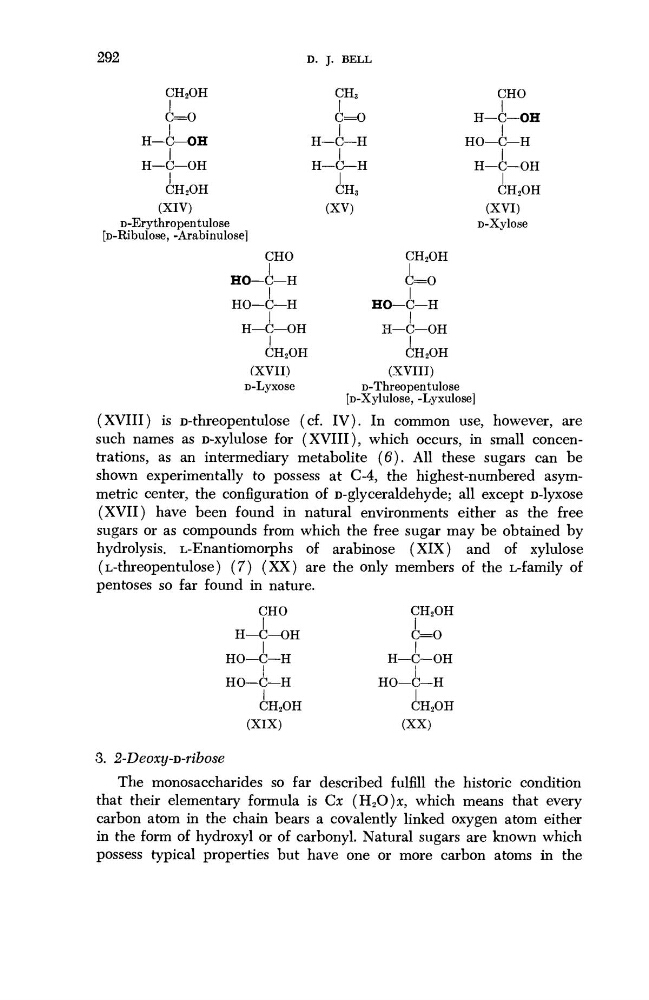
(XVIII) is D-threopentulose (cf. IV). In common use, however, are
such names as D-xylulose for (XVIII), which occurs, in small concentrations, as an intermediary metabolite (6). All these sugars can be
shown experimentally to possess at C-4, the highest-numbered asymmetric center, the configuration of D-glyceraldehyde; all except D-lyxose
(XVII) have been found in natural environments either as the free
sugars or as compounds from which the free sugar may be obtained by
hydrolysis. L-Enantiomorphs of arabinose (XIX) and of xylulose
(L-threopentulose) (7) (XX) are the only members of the L-family of
pentoses so far found in nature.
CHO
I
H—C—OH
HO—C—H
HO—C—H
CH 2 OH
(XIX)
CH 2 OH
I
c=o
I
H—C—OH
HO—C—H
CH 2 OH
(XX)
3. 2-Deoxy-O-ribose
The monosaccharides so far described fulfill the historic condition
that their elementary formula is Cx (H 2 0)x, which means that every
carbon atom in the chain bears a covalently linked oxygen atom either
in the form of hydroxyl or of carbonyl. Natural sugars are known which
possess typical properties but have one or more carbon atoms in the
D. J. BELL
CH 2 OH
1
c=o
I
H—C—OH
1
H—C—OH
1
CH 2 OH
(XIV)
D-Erythropentulose
[D-Ribulose, -Arabinulose]
HCHO
1
-C—H
1
1
-C—H
1
-C—OH
1
CH 2 OH
(XVII)
D-Lyxose
HCH 3
1
1
c=o
1
1
-C—H
1
1
-C—H
j
CH 3
(XV)
CH 2 OH
1
c=o
1
HO—C—H
1
H—C—OH
1
CH 2 OH
CHO
1
H—C—OH
1
HO—C—H
1
H—C—OH
1
CH 2 OH
(XVI)
D-Xylose
(XVIII)
D-Threopentulose
[D-Xylulose, -Lyxulose]
(XVIII) is D-threopentulose (cf. IV). In common use, however, are
such names as D-xylulose for (XVIII), which occurs, in small concentrations, as an intermediary metabolite (6). All these sugars can be
shown experimentally to possess at C-4, the highest-numbered asymmetric center, the configuration of D-glyceraldehyde; all except D-lyxose
(XVII) have been found in natural environments either as the free
sugars or as compounds from which the free sugar may be obtained by
hydrolysis. L-Enantiomorphs of arabinose (XIX) and of xylulose
(L-threopentulose) (7) (XX) are the only members of the L-family of
pentoses so far found in nature.
CHO
I
H—C—OH
HO—C—H
HO—C—H
CH 2 OH
(XIX)
CH 2 OH
I
c=o
I
H—C—OH
HO—C—H
CH 2 OH
(XX)
3. 2-Deoxy-O-ribose
The monosaccharides so far described fulfill the historic condition
that their elementary formula is Cx (H 2 0)x, which means that every
carbon atom in the chain bears a covalently linked oxygen atom either
in the form of hydroxyl or of carbonyl. Natural sugars are known which
possess typical properties but have one or more carbon atoms in the