

7. MONOSACCHARIDES AND OLIGOSACCHARIDES
291
CH 3
CH 2 OH
CH 2 OH
I
I
I
c=o
c=o
c=o
I
I
I
H—C—H
H—C—OH
HO—C—H
I
I
I
CH 3
CH 2 OH
CH 2 OH
(VIII)
(IX)
(X)
able to adopt any structure other than the one shown above and, strictly
speaking, do not comply with the definition of a monosaccharide (see
above). However, for a number of good reasons both chemical and
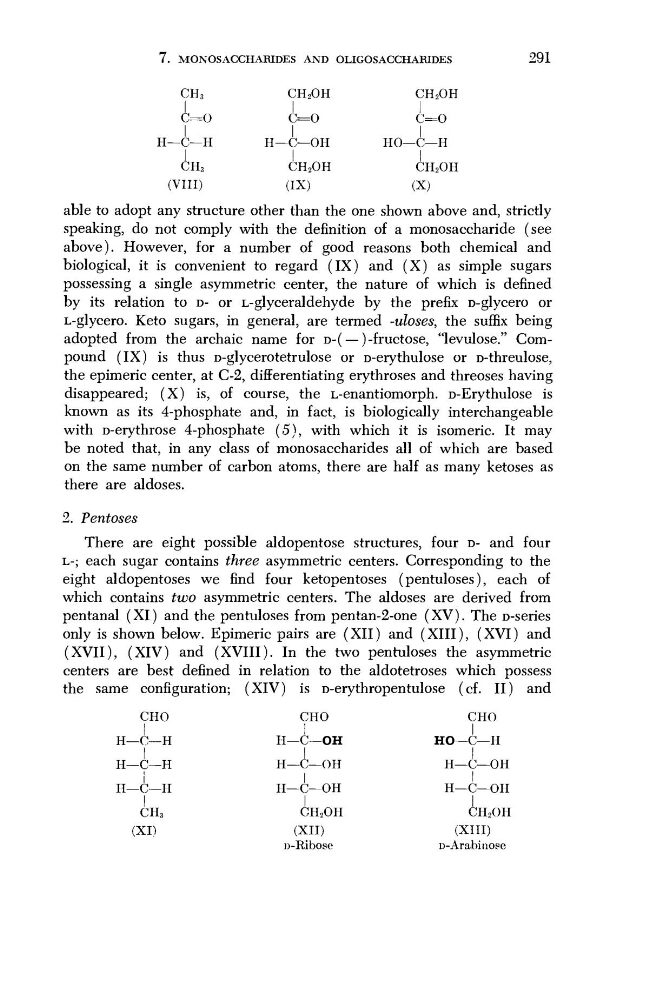
biological, it is convenient to regard (IX) and (X) as simple sugars
possessing a single asymmetric center, the nature of which is defined
by its relation to D- or L-glyceraldehyde by the prefix D-glycero or
L-glycero. Keto sugars, in general, are termed -uloses, the suffix being
adopted from the archaic name for D-(—)-fructose, "levulose." Compound (IX) is thus D-glycerotetrulose or D-erythulose or D-threulose,
the epimeric center, at C-2, differentiating erythroses and threoses having
disappeared; (X) is, of course, the L-enantiomorph. D-Erythulose is
known as its 4-phosphate and, in fact, is biologically interchangeable
with D-erythrose 4-phosphate (5), with which it is isomeric. It may
be noted that, in any class of monosaccharides all of which are based
on the same number of carbon atoms, there are half as many ketoses as
there are aldoses.
2. Pentoses
There are eight possible aldopentose structures, four D- and four
L-; each sugar contains three asymmetric centers. Corresponding to the
eight aldopentoses we find four ketopentoses (pentuloses), each of
which contains two asymmetric centers. The aldoses are derived from
pentanal (XI) and the pentuloses from pentan-2-one (XV). The D-series
only is shown below. Epimeric pairs are (XII) and (XIII), (XVI) and
(XVII), (XIV) and (XVIII). In the two pentuloses the asymmetric
centers are best defined in relation to the aldotetroses which possess
the same configuration; (XIV) is D-erythropentulose (cf. II) and
CHO
CHO
CHO
I
I
I
H—C—H
H—C—OH
HO—C—H
I
I
I
H—C—H
H—C—OH
H—C—OH
I
I
I
H—C—H
H—C—OH
H—C—OH
I
I
I
291
CH 3
CH 2 OH
CH 2 OH
I
I
I
c=o
c=o
c=o
I
I
I
H—C—H
H—C—OH
HO—C—H
I
I
I
CH 3
CH 2 OH
CH 2 OH
(VIII)
(IX)
(X)
able to adopt any structure other than the one shown above and, strictly
speaking, do not comply with the definition of a monosaccharide (see
above). However, for a number of good reasons both chemical and
biological, it is convenient to regard (IX) and (X) as simple sugars
possessing a single asymmetric center, the nature of which is defined
by its relation to D- or L-glyceraldehyde by the prefix D-glycero or
L-glycero. Keto sugars, in general, are termed -uloses, the suffix being
adopted from the archaic name for D-(—)-fructose, "levulose." Compound (IX) is thus D-glycerotetrulose or D-erythulose or D-threulose,
the epimeric center, at C-2, differentiating erythroses and threoses having
disappeared; (X) is, of course, the L-enantiomorph. D-Erythulose is
known as its 4-phosphate and, in fact, is biologically interchangeable
with D-erythrose 4-phosphate (5), with which it is isomeric. It may
be noted that, in any class of monosaccharides all of which are based
on the same number of carbon atoms, there are half as many ketoses as
there are aldoses.
2. Pentoses
There are eight possible aldopentose structures, four D- and four
L-; each sugar contains three asymmetric centers. Corresponding to the
eight aldopentoses we find four ketopentoses (pentuloses), each of
which contains two asymmetric centers. The aldoses are derived from
pentanal (XI) and the pentuloses from pentan-2-one (XV). The D-series
only is shown below. Epimeric pairs are (XII) and (XIII), (XVI) and
(XVII), (XIV) and (XVIII). In the two pentuloses the asymmetric
centers are best defined in relation to the aldotetroses which possess
the same configuration; (XIV) is D-erythropentulose (cf. II) and
CHO
CHO
CHO
I
I
I
H—C—H
H—C—OH
HO—C—H
I
I
I
H—C—H
H—C—OH
H—C—OH
I
I
I
H—C—H
H—C—OH
H—C—OH
I
I
I