

290
D. J. BELL
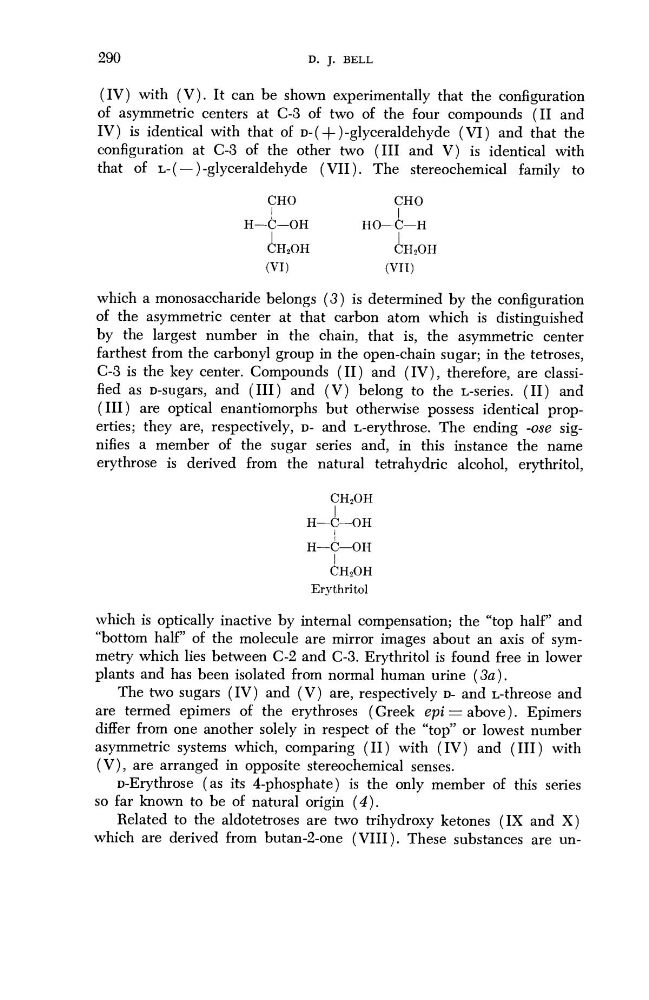
(IV) with (V). It can be shown experimentally that the configuration
of asymmetric centers at C-3 of two of the four compounds (II and
IV) is identical with that of D-(-(-)-glyceraldehyde (VI) and that the
configuration at C-3 of the other two (III and V) is identical with
that of L-( — )-glyceraldehyde (VII). The stereochemical family to
CHO
CHO
!
!
H—C—OH
HO—C—H
I
I
CH 2 OH
CH20H
(VI)
(VIT)
which a monosaccharide belongs (3) is determined by the configuration
of the asymmetric center at that carbon atom which is distinguished
by the largest number in the chain, that is, the asymmetric center
farthest from the carbonyl group in the open-chain sugar; in the tetroses,
C-3 is the key center. Compounds (II) and (IV), therefore, are classified as D-sugars, and (III) and (V) belong to the L-series. (II) and
(III) are optical enantiomorphs but otherwise possess identical properties; they are, respectively, D- and L-erythrose. The ending -ose signifies a member of the sugar series and, in this instance the name
erythrose is derived from the natural tetrahydric alcohol, erythritol,
CH 2 OH
I
H—C—OH
1
H—C—OH
j
CH 2 OH
E^thritol
which is optically inactive by internal compensation; the "top half and
"bottom half of the molecule are mirror images about an axis of symmetry which lies between C-2 and C-3. Erythritol is found free in lower
plants and has been isolated from normal human urine (3a).
The two sugars (IV) and (V) are, respectively D- and L-threose and
are termed epimers of the erythroses (Greek epi = above). Epimers
differ from one another solely in respect of the "top" or lowest number
asymmetric systems which, comparing (II) with (IV) and (III) with
(V), are arranged in opposite stereochemical senses.
D-Erythrose (as its 4-phosphate) is the only member of this series
so far known to be of natural origin (4).
Related to the aldotetroses are two trihydroxy ketones (IX and X)
which are derived from butan-2-one (VIII). These substances are un-
D. J. BELL
(IV) with (V). It can be shown experimentally that the configuration
of asymmetric centers at C-3 of two of the four compounds (II and
IV) is identical with that of D-(-(-)-glyceraldehyde (VI) and that the
configuration at C-3 of the other two (III and V) is identical with
that of L-( — )-glyceraldehyde (VII). The stereochemical family to
CHO
CHO
!
!
H—C—OH
HO—C—H
I
I
CH 2 OH
CH20H
(VI)
(VIT)
which a monosaccharide belongs (3) is determined by the configuration
of the asymmetric center at that carbon atom which is distinguished
by the largest number in the chain, that is, the asymmetric center
farthest from the carbonyl group in the open-chain sugar; in the tetroses,
C-3 is the key center. Compounds (II) and (IV), therefore, are classified as D-sugars, and (III) and (V) belong to the L-series. (II) and
(III) are optical enantiomorphs but otherwise possess identical properties; they are, respectively, D- and L-erythrose. The ending -ose signifies a member of the sugar series and, in this instance the name
erythrose is derived from the natural tetrahydric alcohol, erythritol,
CH 2 OH
I
H—C—OH
1
H—C—OH
j
CH 2 OH
E^thritol
which is optically inactive by internal compensation; the "top half and
"bottom half of the molecule are mirror images about an axis of symmetry which lies between C-2 and C-3. Erythritol is found free in lower
plants and has been isolated from normal human urine (3a).
The two sugars (IV) and (V) are, respectively D- and L-threose and
are termed epimers of the erythroses (Greek epi = above). Epimers
differ from one another solely in respect of the "top" or lowest number
asymmetric systems which, comparing (II) with (IV) and (III) with
(V), are arranged in opposite stereochemical senses.
D-Erythrose (as its 4-phosphate) is the only member of this series
so far known to be of natural origin (4).
Related to the aldotetroses are two trihydroxy ketones (IX and X)
which are derived from butan-2-one (VIII). These substances are un-