

7. MONOSACCHARIDES AND OLIGOSACCHARIDES
289
net as wide as possible, he just had to draw the line somewhere. Without the aid provided by the Chemical Society's publication, Current
Chemical Papers the whole task would have proved well-nigh impossible. The literature has been surveyed to December, 1960.
I. The Monosaccharides
The monosaccharides are compounds, each of which, as a rule, can
exist in several different interconvertible, structural arrangements. The
simplest of all these structures is the so-called open-chain form where
the sugar has the structure of an aldehyde, or a ketone, derived from
a polyhydroxybutane, -pentane, -hexane, -heptane, or higher molecule
in which all or the majority of the noncarbonyl carbon atoms are hydroxylated. In all but rare instances the parent hydrocarbon belongs to
the unbranched or normal series. As will become evident later, the
biologically important structures of the monosaccharides, and of their
derivatives, are rarely if ever the "aldo" or "keto" forms. Nevertheless
a survey of these simple open-chain structures, with the help of their
"projection formulas" introduced by Emil Fischer (I) serves best to
illustrate the isomerism and stereochemical relationships existing between the different members of the family; certain special features
anent the nomenclature of carbohydrates (2) will be considered at the
same time.
A. THE D- AND L-FAMILIES OF MONOSACCHARIDES
1. Tetroses
The simplest true monosaccharides that can exist in structural forms
other than that of the simple open-chain polyhydroxy aldehydes are
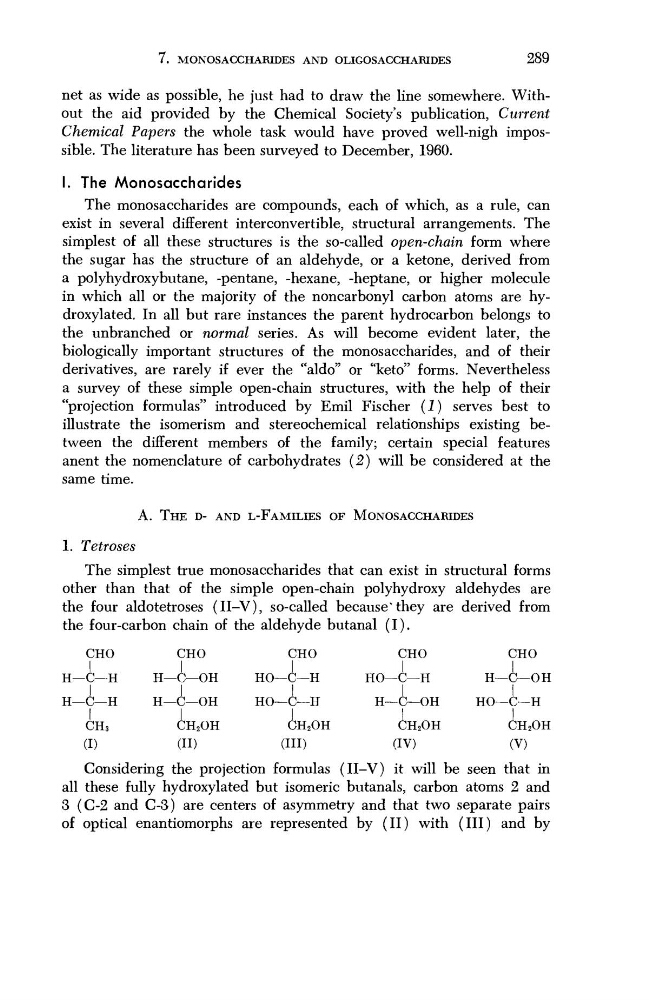
the four aldotetroses (II-V), so-called because'they are derived from
the four-carbon chain of the aldehyde butanal (I).
CHO
CHO
CHO
CHO
CHO
I
I
I
I
I
H—C—H
H—C—OH
HO—C—H
HO—C—H
H—C—OH
I
I
I
I
I
H—C—H
H—C—OH
HO—C—H
H—C—OH
HO—C—H
I
I
!
I
I
CH 3
CH 2 OH
CH 2 OH
CH 2 OH
CH 2 OH
(I)
(Π)
(HD
(IV)
(V)
Considering the projection formulas (II-V) it will be seen that in
all these fully hydroxylated but isomeric butanals, carbon atoms 2 and
3 (C-2 and C-3) are centers of asymmetry and that two separate pairs
of optical enantiomorphs are represented by (II) with (III) and by
289
net as wide as possible, he just had to draw the line somewhere. Without the aid provided by the Chemical Society's publication, Current
Chemical Papers the whole task would have proved well-nigh impossible. The literature has been surveyed to December, 1960.
I. The Monosaccharides
The monosaccharides are compounds, each of which, as a rule, can
exist in several different interconvertible, structural arrangements. The
simplest of all these structures is the so-called open-chain form where
the sugar has the structure of an aldehyde, or a ketone, derived from
a polyhydroxybutane, -pentane, -hexane, -heptane, or higher molecule
in which all or the majority of the noncarbonyl carbon atoms are hydroxylated. In all but rare instances the parent hydrocarbon belongs to
the unbranched or normal series. As will become evident later, the
biologically important structures of the monosaccharides, and of their
derivatives, are rarely if ever the "aldo" or "keto" forms. Nevertheless
a survey of these simple open-chain structures, with the help of their
"projection formulas" introduced by Emil Fischer (I) serves best to
illustrate the isomerism and stereochemical relationships existing between the different members of the family; certain special features
anent the nomenclature of carbohydrates (2) will be considered at the
same time.
A. THE D- AND L-FAMILIES OF MONOSACCHARIDES
1. Tetroses
The simplest true monosaccharides that can exist in structural forms
other than that of the simple open-chain polyhydroxy aldehydes are
the four aldotetroses (II-V), so-called because'they are derived from
the four-carbon chain of the aldehyde butanal (I).
CHO
CHO
CHO
CHO
CHO
I
I
I
I
I
H—C—H
H—C—OH
HO—C—H
HO—C—H
H—C—OH
I
I
I
I
I
H—C—H
H—C—OH
HO—C—H
H—C—OH
HO—C—H
I
I
!
I
I
CH 3
CH 2 OH
CH 2 OH
CH 2 OH
CH 2 OH
(I)
(Π)
(HD
(IV)
(V)
Considering the projection formulas (II-V) it will be seen that in
all these fully hydroxylated but isomeric butanals, carbon atoms 2 and
3 (C-2 and C-3) are centers of asymmetry and that two separate pairs
of optical enantiomorphs are represented by (II) with (III) and by