

7. MONOSACCHARIDES AND OLIGOSACCHARIDES
293
chain bearing no hydroxyl but, in its place, a hydrogen atom. Such
compounds are termed deoxy sugars and are given a numerical prefix
to indicate which atom or atoms carry hydrogen in place of hydroxyl.
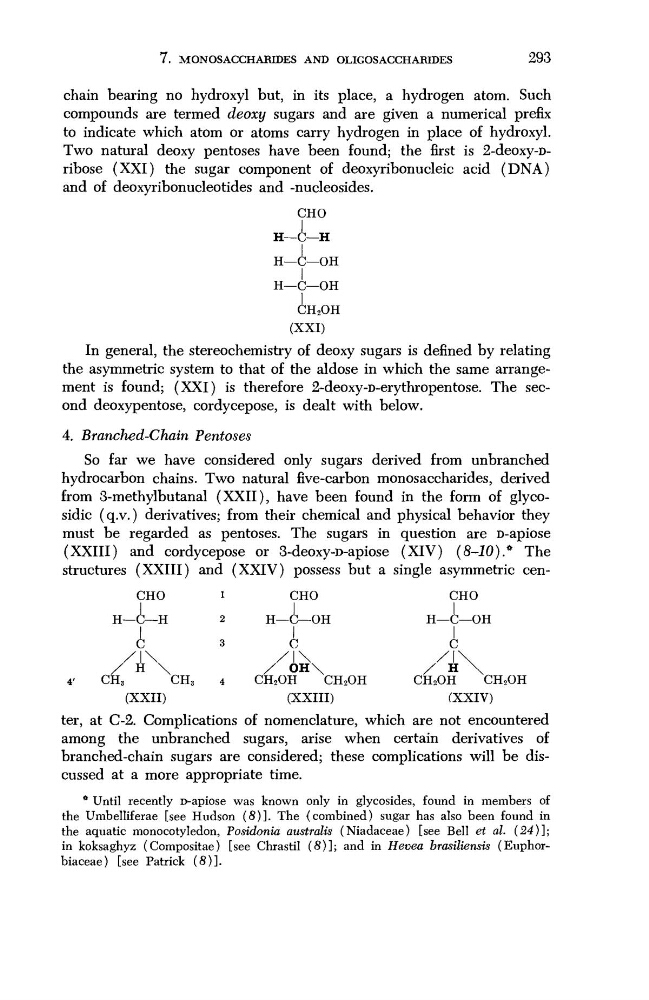
Two natural deoxy pentoses have been found; the first is 2-deoxy-Dribose (XXI) the sugar component of deoxyribonucleic acid (DNA)
and of deoxyribonucleotides and -nucleosides.
CHO
I
H—C—H
I
H—C—OH
I
H—C—OH I
CH 2 OH
(XXI)
In general, the stereochemistry of deoxy sugars is defined by relating
the asymmetric system to that of the aldose in which the same arrangement is found; (XXI) is therefore 2-deoxy-D-erythropentose. The second deoxypentose, cordycepose, is dealt with below.
4. Branched-Chain Pentoses
So far we have considered only sugars derived from unbranched
hydrocarbon chains. Two natural five-carbon monosaccharides, derived
from 3-methylbutanal (XXII), have been found in the form of glycosidic (q.v.) derivatives; from their chemical and physical behavior they
must be regarded as pentoses. The sugars in question are D-apiose
(XXIII) and cordycepose or 3-deoxy-D-apiose (XIV) (8-10).* The
structures (XXIII) and (XXIV) possess but a single asymmetric cenCHO
i
CHO
CHO
I
I
I
H—C—H
2
H—C—OH
H—C—OH
I
I
I
c
3
c
c
/ i \
κ ι \
/ ι \
/
H \
/
O H \
/
H
\
4'
CH 3
CH 3
4
CH 2 OH
CH 2 OH
CH 2 OH
CH 2 OH
(XXII)
(XXIII)
(XXIV)
ter, at C-2. Complications of nomenclature, which are not encountered
among the unbranched sugars, arise when certain derivatives of
branched-chain sugars are considered; these complications will be discussed at a more appropriate time.
* Until recently D-apiose was known only in glycosides, found in members of
the Umbelliferae [see Hudson (8)]. The (combined) sugar has also been found in
the aquatic monocotyledon, Fosidonia australis (Niadaceae) [see Bell et al. (24)];
in koksaghyz (Compositae) [see Chrastil (8)]; and in Hevea brasiliensis (Euphorbiaceae) [see Patrick (8)].
293
chain bearing no hydroxyl but, in its place, a hydrogen atom. Such
compounds are termed deoxy sugars and are given a numerical prefix
to indicate which atom or atoms carry hydrogen in place of hydroxyl.
Two natural deoxy pentoses have been found; the first is 2-deoxy-Dribose (XXI) the sugar component of deoxyribonucleic acid (DNA)
and of deoxyribonucleotides and -nucleosides.
CHO
I
H—C—H
I
H—C—OH
I
H—C—OH I
CH 2 OH
(XXI)
In general, the stereochemistry of deoxy sugars is defined by relating
the asymmetric system to that of the aldose in which the same arrangement is found; (XXI) is therefore 2-deoxy-D-erythropentose. The second deoxypentose, cordycepose, is dealt with below.
4. Branched-Chain Pentoses
So far we have considered only sugars derived from unbranched
hydrocarbon chains. Two natural five-carbon monosaccharides, derived
from 3-methylbutanal (XXII), have been found in the form of glycosidic (q.v.) derivatives; from their chemical and physical behavior they
must be regarded as pentoses. The sugars in question are D-apiose
(XXIII) and cordycepose or 3-deoxy-D-apiose (XIV) (8-10).* The
structures (XXIII) and (XXIV) possess but a single asymmetric cenCHO
i
CHO
CHO
I
I
I
H—C—H
2
H—C—OH
H—C—OH
I
I
I
c
3
c
c
/ i \
κ ι \
/ ι \
/
H \
/
O H \
/
H
\
4'
CH 3
CH 3
4
CH 2 OH
CH 2 OH
CH 2 OH
CH 2 OH
(XXII)
(XXIII)
(XXIV)
ter, at C-2. Complications of nomenclature, which are not encountered
among the unbranched sugars, arise when certain derivatives of
branched-chain sugars are considered; these complications will be discussed at a more appropriate time.
* Until recently D-apiose was known only in glycosides, found in members of
the Umbelliferae [see Hudson (8)]. The (combined) sugar has also been found in
the aquatic monocotyledon, Fosidonia australis (Niadaceae) [see Bell et al. (24)];
in koksaghyz (Compositae) [see Chrastil (8)]; and in Hevea brasiliensis (Euphorbiaceae) [see Patrick (8)].