

5. DISTRIBUTION OF PHOSPHOLIPIDS
247
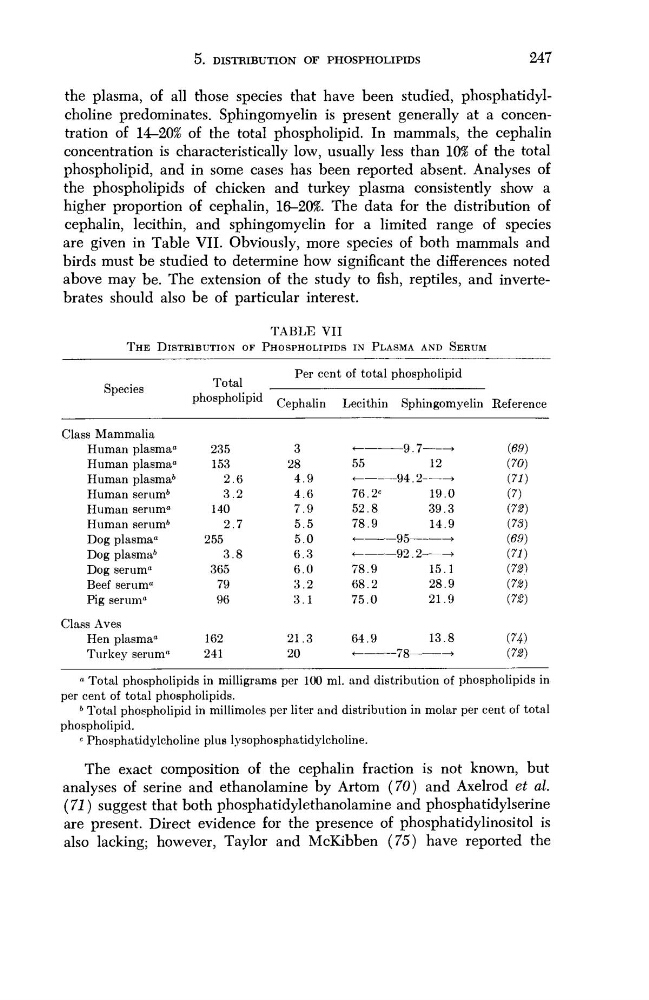
the plasma, of all those species that have been studied, phosphatidylcholine predominates. Sphingomyelin is present generally at a concentration of 14-20% of the total phospholipid. In mammals, the cephalin
concentration is characteristically low, usually less than 10% of the total
phospholipid, and in some cases has been reported absent. Analyses of
the phospholipids of chicken and turkey plasma consistently show a
higher proportion of cephalin, l&-20%. The data for the distribution of
cephalin, lecithin, and sphingomyelin for a limited range of species
are given in Table VII. Obviously, more species of both mammals and
birds must be studied to determine how significant the differences noted
above may be. The extension of the study to fish, reptiles, and invertebrates should also be of particular interest.
TABLE VII
THE DISTRIBUTION OF PHOSPHOLIPIDS IN PLASMA AND SERUM
Species
Total
Per cent of total phospholipid
phospholipid Cephalin
Lecithin Sphingomyelin Reference
Class Mammalia
Human plasma«
235
3
<
9.7
>
(69)
Human plasma
0
153
28
55
12
(70)
Human plasma
6
2.6
4.9
<
94.2
>
(71)
Human serum
6
3.2
4.6
76.2
C
19.0
(7)
Human serum«
140
7.9
52.8
39.3
(72)
Human serum
6
2.7
5.5
78.9
14.9
(73)
Dog plasma«
255
5.0
<
95
►
(69)
Dog plasma
6
3.8
6.3
<
92.2
>
(71)
Dog serum«
365
6.0
78.9
15.1
(72)
Beef serum«
79
3.2
68.2
28.9
(72)
Pig serum«
96
3.1
75.0
21.9
(72)
Class Aves
Hen plasma«
162
21.3
64.9
13.8
(74)
Turkey serum«
241
20
<
78
>
(72)
« Total phospholipids in milligrams per 100 ml. and distribution of phospholipids in
per cent of total phospholipids.
6 Total phospholipid in millimoles per liter and distribution in molar per cent of total
phospholipid.
c Phosphatidylcholine plus lysophosphatidylcholine.
The exact composition of the cephalin fraction is not known, but
analyses of serine and ethanolamine by Artom (70) and Axelrod et al.
(71) suggest that both phosphatidylethanolamine and phosphatidylserine
are present. Direct evidence for the presence of phosphatidylinositol is
also lacking; however, Taylor and McKibben (75) have reported the
247
the plasma, of all those species that have been studied, phosphatidylcholine predominates. Sphingomyelin is present generally at a concentration of 14-20% of the total phospholipid. In mammals, the cephalin
concentration is characteristically low, usually less than 10% of the total
phospholipid, and in some cases has been reported absent. Analyses of
the phospholipids of chicken and turkey plasma consistently show a
higher proportion of cephalin, l&-20%. The data for the distribution of
cephalin, lecithin, and sphingomyelin for a limited range of species
are given in Table VII. Obviously, more species of both mammals and
birds must be studied to determine how significant the differences noted
above may be. The extension of the study to fish, reptiles, and invertebrates should also be of particular interest.
TABLE VII
THE DISTRIBUTION OF PHOSPHOLIPIDS IN PLASMA AND SERUM
Species
Total
Per cent of total phospholipid
phospholipid Cephalin
Lecithin Sphingomyelin Reference
Class Mammalia
Human plasma«
235
3
<
9.7
>
(69)
Human plasma
0
153
28
55
12
(70)
Human plasma
6
2.6
4.9
<
94.2
>
(71)
Human serum
6
3.2
4.6
76.2
C
19.0
(7)
Human serum«
140
7.9
52.8
39.3
(72)
Human serum
6
2.7
5.5
78.9
14.9
(73)
Dog plasma«
255
5.0
<
95
►
(69)
Dog plasma
6
3.8
6.3
<
92.2
>
(71)
Dog serum«
365
6.0
78.9
15.1
(72)
Beef serum«
79
3.2
68.2
28.9
(72)
Pig serum«
96
3.1
75.0
21.9
(72)
Class Aves
Hen plasma«
162
21.3
64.9
13.8
(74)
Turkey serum«
241
20
<
78
>
(72)
« Total phospholipids in milligrams per 100 ml. and distribution of phospholipids in
per cent of total phospholipids.
6 Total phospholipid in millimoles per liter and distribution in molar per cent of total
phospholipid.
c Phosphatidylcholine plus lysophosphatidylcholine.
The exact composition of the cephalin fraction is not known, but
analyses of serine and ethanolamine by Artom (70) and Axelrod et al.
(71) suggest that both phosphatidylethanolamine and phosphatidylserine
are present. Direct evidence for the presence of phosphatidylinositol is
also lacking; however, Taylor and McKibben (75) have reported the