

246
JOHN C. DITTMER
Limited data are available on the fatty acid composition of muscle
phospholipids. Gray and Macfarlane (54) report only minor amounts
of saturated fatty acid in the cardiolipin of beef heart. Seventy per cent
of the fatty acid was found to be linoleic acid. The remainder was made
up of more or less equal amounts of palmitoleic, oleic, and linolenic.
Pangborn reported that linoleic predominated in the cardiolipin she
isolated. The remainder was made up of more or less equal amounts of
palmitoleic, oleic, and linolenic. In agreement with the report of Faure
and Morelec-Coulon (65), Gray and Macfarlane found that approximately 50% of the fatty acid of beef heart phosphatidylinositol was
saturated. They found 46% stearic and 3% palmitic acid. Analysis of the
unsaturated fatty acids showed approximately 42% oleic, 25% linoleic
plus linolenic, 22% arachidonic, 9% C 20 and C 22 unidentified polyene
acids, and 2% palmitoleic. Gray (66) has analyzed the fatty acids of
phosphatidylcholine, phosphatidylethanolamine, and the choline and
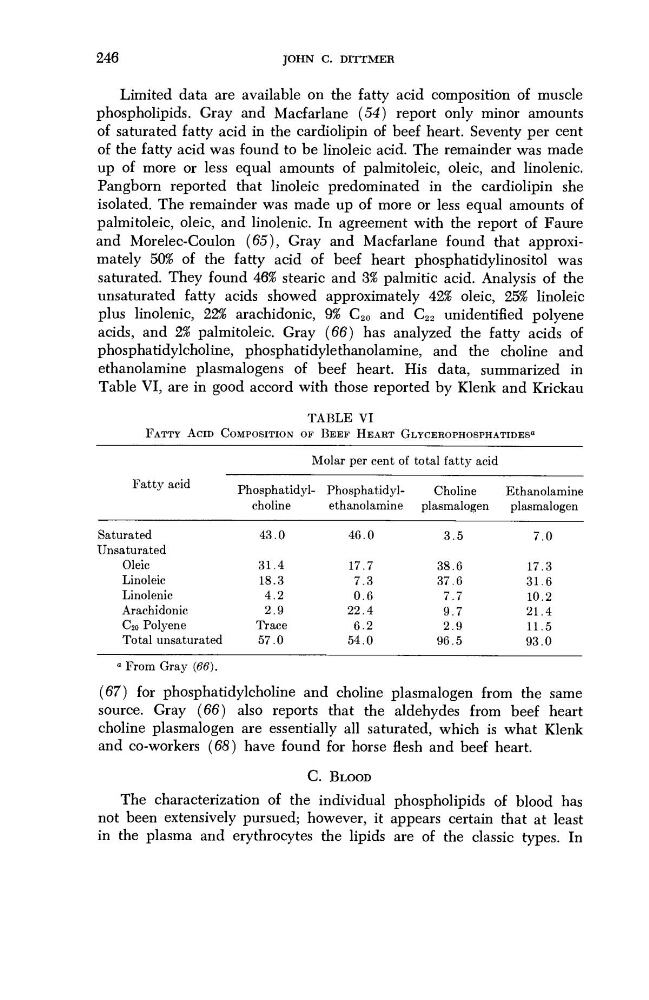
ethanolamine plasmalogens of beef heart. His data, summarized in
Table VI, are in good accord with those reported by Klenk and Krickau
TABLE VI
FATTY ACID COMPOSITION OF BEEF HEART GLYCEROPHOSPHATIDES
0
Molar per cent of total fatty acid
Fatty acid
Saturated
Unsaturated
Oleic
Linoleic
Linolenic
Arachidonic
C 2 o Polyene
Total unsaturated
Phosphatidylcholine
43.0
31.4
18.3
4.2
2.9
Trace
57.0
- Phosphatidylethanolamine
46.0
17.7
7.3
0.6
22.4
6.2
54.0
Choline
plasmalogen
3.5
38.6
37.6
7.7
9.7
2.9
96.5
Ethanolamine
plasmalogen
7.0
17.3
31.6
10.2
21.4
11.5
93.0
«From Gray (66).
(67) for phosphatidylcholine and choline plasmalogen from the same
source. Gray (66) also reports that the aldehydes from beef heart
choline plasmalogen are essentially all saturated, which is what Klenk
and co-workers (68) have found for horse flesh and beef heart.
C. BLOOD
The characterization of the individual phospholipids of blood has
not been extensively pursued; however, it appears certain that at least
in the plasma and erythrocytes the lipids are of the classic types. In
JOHN C. DITTMER
Limited data are available on the fatty acid composition of muscle
phospholipids. Gray and Macfarlane (54) report only minor amounts
of saturated fatty acid in the cardiolipin of beef heart. Seventy per cent
of the fatty acid was found to be linoleic acid. The remainder was made
up of more or less equal amounts of palmitoleic, oleic, and linolenic.
Pangborn reported that linoleic predominated in the cardiolipin she
isolated. The remainder was made up of more or less equal amounts of
palmitoleic, oleic, and linolenic. In agreement with the report of Faure
and Morelec-Coulon (65), Gray and Macfarlane found that approximately 50% of the fatty acid of beef heart phosphatidylinositol was
saturated. They found 46% stearic and 3% palmitic acid. Analysis of the
unsaturated fatty acids showed approximately 42% oleic, 25% linoleic
plus linolenic, 22% arachidonic, 9% C 20 and C 22 unidentified polyene
acids, and 2% palmitoleic. Gray (66) has analyzed the fatty acids of
phosphatidylcholine, phosphatidylethanolamine, and the choline and
ethanolamine plasmalogens of beef heart. His data, summarized in
Table VI, are in good accord with those reported by Klenk and Krickau
TABLE VI
FATTY ACID COMPOSITION OF BEEF HEART GLYCEROPHOSPHATIDES
0
Molar per cent of total fatty acid
Fatty acid
Saturated
Unsaturated
Oleic
Linoleic
Linolenic
Arachidonic
C 2 o Polyene
Total unsaturated
Phosphatidylcholine
43.0
31.4
18.3
4.2
2.9
Trace
57.0
- Phosphatidylethanolamine
46.0
17.7
7.3
0.6
22.4
6.2
54.0
Choline
plasmalogen
3.5
38.6
37.6
7.7
9.7
2.9
96.5
Ethanolamine
plasmalogen
7.0
17.3
31.6
10.2
21.4
11.5
93.0
«From Gray (66).
(67) for phosphatidylcholine and choline plasmalogen from the same
source. Gray (66) also reports that the aldehydes from beef heart
choline plasmalogen are essentially all saturated, which is what Klenk
and co-workers (68) have found for horse flesh and beef heart.
C. BLOOD
The characterization of the individual phospholipids of blood has
not been extensively pursued; however, it appears certain that at least
in the plasma and erythrocytes the lipids are of the classic types. In