

248
JOHN C. DITTMER
presence of inositol in the plasma phospholipids of dog, rabbit, and
man. Both choline and ethanolamine plasmalogen have also been reported in plasma (76). No serine plasmalogen was detected. Dawson
(77) has recently developed an analytical technique for the determination of all of the classic-type phospholipids in a tissue. This technique
is based on the analytical determination of the deacylated compounds
after separation by paper chromatography and accordingly provides
good evidence for the occurrence in the tissue of the phospholipids
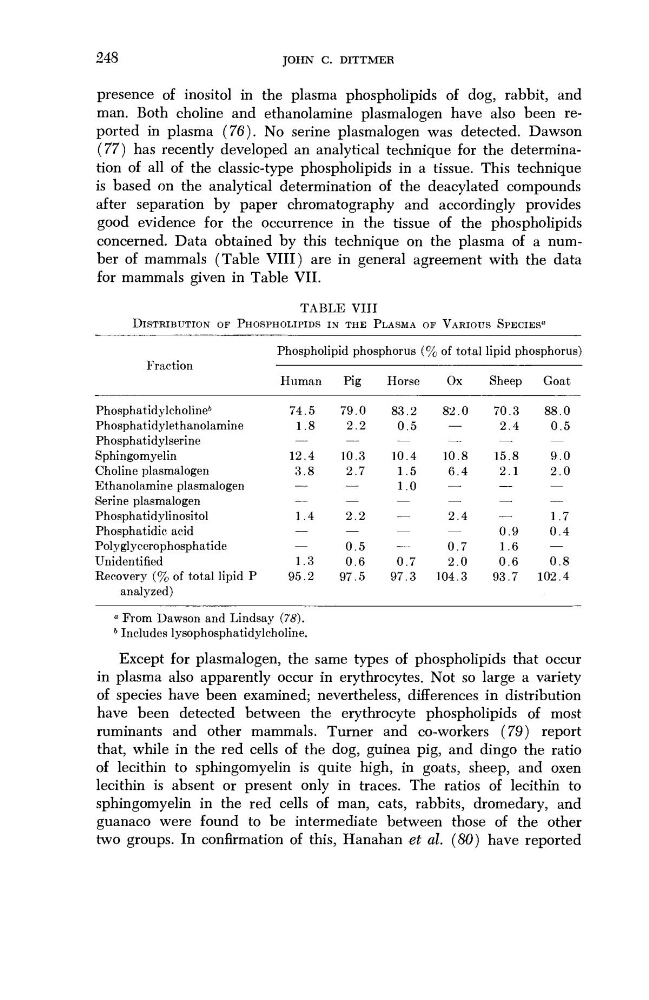
concerned. Data obtained by this technique on the plasma of a number of mammals (Table VIII) are in general agreement with the data
for mammals given in Table VII.
TABLE VIII
DISTRIBUTION OF PHOSPHOLIPIDS IN THE PLASMA OF VARIOUS SPECIES"
Phospholipid phosphorus (% of total lipid phosphorus)
Fraction
Phosphatidylcholine
6
Phosphatidylethanolamine
Phosphatidylserine
Sphingomyelin
Choline plasmalogen
Ethanolamine plasmalogen
Serine plasmalogen
Phosphatidylinositol
Phosphatidic acid
Polyglycerophosphatide
Unidentified
Recovery (% of total lipid P
Human
74.5
1.8
—
12.4
3.8
—
—
1.4
—
—
1.3
95.2
Pig
79.0
2.2
—
10.3
2.7
—
—
2.2
—
0.5
0.6
97.5
Horse
83.2
0.5
—
10.4
1.5
1.0
—
—
—
—
0.7
97.3
Ox
82.0
—
—
10.8
6.4
—
—
2.4
—
0.7
2.0
104.3
Sheep
70.3
2.4
—
15.8
2.1
—
—
—
0.9
1.6
0.6
93.7
Goat
88.0
0.5
—
9.0
2.0
—
—
1.7
0.4
—
0.8
102.4
analyzed)
a From Dawson and Lindsay (78).
b Includes lysophosphatidylcholine.
Except for plasmalogen, the same types of phospholipids that occur
in plasma also apparently occur in erythrocytes. Not so large a variety
of species have been examined; nevertheless, differences in distribution
have been detected between the erythrocyte phospholipids of most
ruminants and other mammals. Turner and co-workers (79) report
that, while in the red cells of the dog, guinea pig, and dingo the ratio
of lecithin to sphingomyelin is quite high, in goats, sheep, and oxen
lecithin is absent or present only in traces. The ratios of lecithin to
sphingomyelin in the red cells of man, cats, rabbits, dromedary, and
guanaco were found to be intermediate between those of the other
two groups. In confirmation of this, Hanahan et al. (80) have reported
JOHN C. DITTMER
presence of inositol in the plasma phospholipids of dog, rabbit, and
man. Both choline and ethanolamine plasmalogen have also been reported in plasma (76). No serine plasmalogen was detected. Dawson
(77) has recently developed an analytical technique for the determination of all of the classic-type phospholipids in a tissue. This technique
is based on the analytical determination of the deacylated compounds
after separation by paper chromatography and accordingly provides
good evidence for the occurrence in the tissue of the phospholipids
concerned. Data obtained by this technique on the plasma of a number of mammals (Table VIII) are in general agreement with the data
for mammals given in Table VII.
TABLE VIII
DISTRIBUTION OF PHOSPHOLIPIDS IN THE PLASMA OF VARIOUS SPECIES"
Phospholipid phosphorus (% of total lipid phosphorus)
Fraction
Phosphatidylcholine
6
Phosphatidylethanolamine
Phosphatidylserine
Sphingomyelin
Choline plasmalogen
Ethanolamine plasmalogen
Serine plasmalogen
Phosphatidylinositol
Phosphatidic acid
Polyglycerophosphatide
Unidentified
Recovery (% of total lipid P
Human
74.5
1.8
—
12.4
3.8
—
—
1.4
—
—
1.3
95.2
Pig
79.0
2.2
—
10.3
2.7
—
—
2.2
—
0.5
0.6
97.5
Horse
83.2
0.5
—
10.4
1.5
1.0
—
—
—
—
0.7
97.3
Ox
82.0
—
—
10.8
6.4
—
—
2.4
—
0.7
2.0
104.3
Sheep
70.3
2.4
—
15.8
2.1
—
—
—
0.9
1.6
0.6
93.7
Goat
88.0
0.5
—
9.0
2.0
—
—
1.7
0.4
—
0.8
102.4
analyzed)
a From Dawson and Lindsay (78).
b Includes lysophosphatidylcholine.
Except for plasmalogen, the same types of phospholipids that occur
in plasma also apparently occur in erythrocytes. Not so large a variety
of species have been examined; nevertheless, differences in distribution
have been detected between the erythrocyte phospholipids of most
ruminants and other mammals. Turner and co-workers (79) report
that, while in the red cells of the dog, guinea pig, and dingo the ratio
of lecithin to sphingomyelin is quite high, in goats, sheep, and oxen
lecithin is absent or present only in traces. The ratios of lecithin to
sphingomyelin in the red cells of man, cats, rabbits, dromedary, and
guanaco were found to be intermediate between those of the other
two groups. In confirmation of this, Hanahan et al. (80) have reported