

5. DISTRIBUTION OF PHOSPHOLIPIDS
235
refers to the analogous compound or fraction less one molecule of
fatty acid.
One additional comment on the structure of the glycerophosphatides
is of special importance to some of the comparative aspects. Any one
of the types of phospholipids described above may produce on hydrolysis a fairly wide variety of fatty acids or, in the case of the plasmalogens, fatty acids and fatty aldehydes. There is evidence which suggests that there may be some limitation on the type of fatty acids found
in given positions of the molecule (14, 15); yet, even taking this into
consideration, a large number of different individual phospholipids exists
for each of the various types described. A few individual phosphatidylcholines of known fatty acid content have been isolated. In other cases
the fatty acids or fatty aldehyde of a given type of phospholipid have
been analyzed and although the data only give a suggestion of the
possible variety of individual phospholipids that may be present, they
have in general been included. For the rest, it should be remembered
that although phospholipids of different species may appear to be the
same, because of their fatty acids they may in fact be completely
different.
III. Structure of the Sphingophosphatides
The structures of the sphingophosphatides are based on the phosphate ester of the long-chain base sphingosine, O-erythro-2-amino-l,&dihydroxy-4-frarw-octadecene, or compounds of very similar structure.
The work leading to the establishment of the structure of sphingosine
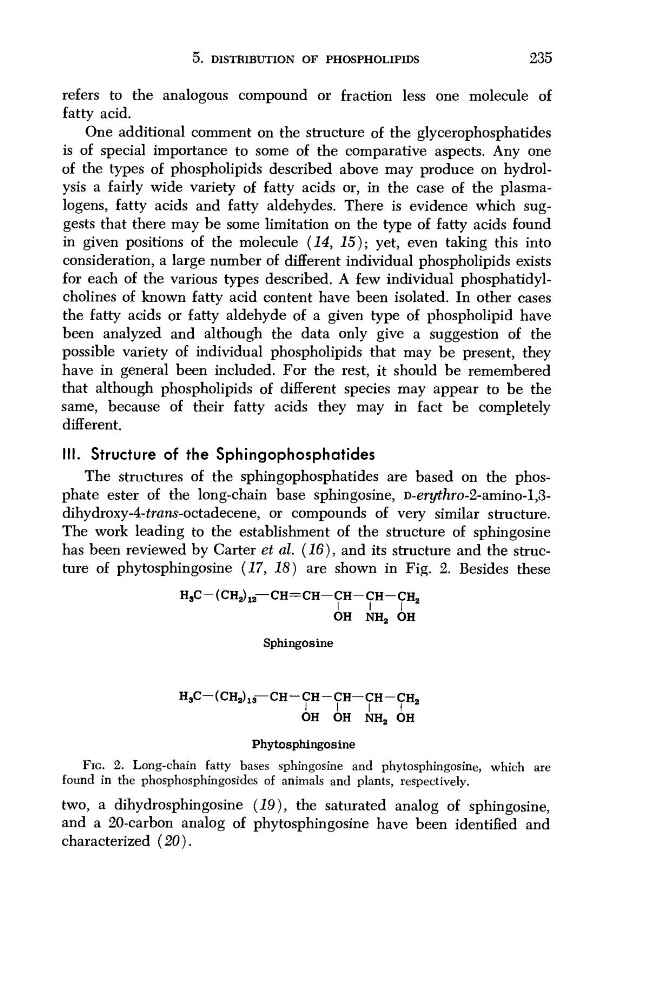
has been reviewed by Carter et al. (16), and its structure and the structure of phytosphingosine (17, 18) are shown in Fig. 2. Besides these
H 8 C-(CH 2 ) 12 — CH=CH—CH-CH-CH,
III
OH NH 2 OH
Sphingosine
H 3 C-(CH 2 ) 13 —CH-CH-CH—CH-CH 2
OH OH NH 2 OH
Phytosphingosine
FIG. 2. Long-chain fatty bases sphingosine and phytosphingosine, which are
found in the phosphosphingosides of animals and plants, respectively.
two, a dihydrosphingosine (19), the saturated analog of sphingosine,
and a 20-carbon analog of phytosphingosine have been identified and
characterized (20).
235
refers to the analogous compound or fraction less one molecule of
fatty acid.
One additional comment on the structure of the glycerophosphatides
is of special importance to some of the comparative aspects. Any one
of the types of phospholipids described above may produce on hydrolysis a fairly wide variety of fatty acids or, in the case of the plasmalogens, fatty acids and fatty aldehydes. There is evidence which suggests that there may be some limitation on the type of fatty acids found
in given positions of the molecule (14, 15); yet, even taking this into
consideration, a large number of different individual phospholipids exists
for each of the various types described. A few individual phosphatidylcholines of known fatty acid content have been isolated. In other cases
the fatty acids or fatty aldehyde of a given type of phospholipid have
been analyzed and although the data only give a suggestion of the
possible variety of individual phospholipids that may be present, they
have in general been included. For the rest, it should be remembered
that although phospholipids of different species may appear to be the
same, because of their fatty acids they may in fact be completely
different.
III. Structure of the Sphingophosphatides
The structures of the sphingophosphatides are based on the phosphate ester of the long-chain base sphingosine, O-erythro-2-amino-l,&dihydroxy-4-frarw-octadecene, or compounds of very similar structure.
The work leading to the establishment of the structure of sphingosine
has been reviewed by Carter et al. (16), and its structure and the structure of phytosphingosine (17, 18) are shown in Fig. 2. Besides these
H 8 C-(CH 2 ) 12 — CH=CH—CH-CH-CH,
III
OH NH 2 OH
Sphingosine
H 3 C-(CH 2 ) 13 —CH-CH-CH—CH-CH 2
OH OH NH 2 OH
Phytosphingosine
FIG. 2. Long-chain fatty bases sphingosine and phytosphingosine, which are
found in the phosphosphingosides of animals and plants, respectively.
two, a dihydrosphingosine (19), the saturated analog of sphingosine,
and a 20-carbon analog of phytosphingosine have been identified and
characterized (20).