

236
JOHN C. DITTMER
The only fully characterized sphingophosphatide from animals is
sphingomyelin. The elucidation of its structure, as shown in Fig. 3, has
been actively pursued for several years and a good review of this work
is given by Lovern (I). Although dihydrosphingosine has been shown
to be a constituent of animal phospholipids (19, 21), direct evidence
O
CH 3
-
'I
,
w l
0-P-0-(CH 2 )
+
2 N-CH 3
O
CH 3
H 3 C-(CH 2 ) 12 —CH=CH—CH—CH-CH 2
OH N-H
I
c=o
I
R
FIG. 3. Sphingomyelin, the most widely distributed sphingophosphatide in animal tissues.
that it occurs as the analog of sphingomyelin, dihydrosphingomyelin, is
still lacking. Evidence that a compound analogous to sphingomyelin but
with the choline substituted by ethanolamine has been obtained
(22, 23).
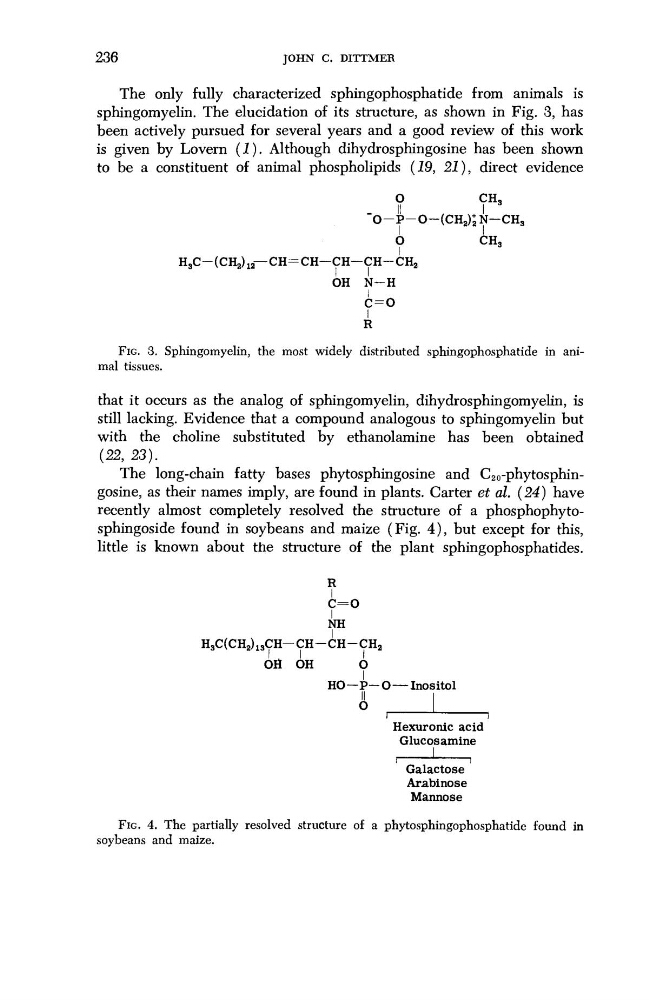
The long-chain fatty bases phytosphingosine and C 20 -phytosphingosine, as their names imply, are found in plants. Carter et al. (24) have
recently almost completely resolved the structure of a phosphophytosphingoside found in soybeans and maize (Fig. 4), but except for this,
little is known about the structure of the plant sphingophosphatides.
R
I
c=o
I
NH
I
H 3 C(CH 2 ) 13 CH—CH—CH-CH 2
OÖ OH
O
I
HO—P-O—Inositol
II
I
o
1
i
'
1
Hexuronic acid
Glucosamine
■
'
,
Galactose
Arabinose
Mannose
FIG. 4. The partially resolved structure of a phytosphingophosphatide found in
soybeans and maize.
JOHN C. DITTMER
The only fully characterized sphingophosphatide from animals is
sphingomyelin. The elucidation of its structure, as shown in Fig. 3, has
been actively pursued for several years and a good review of this work
is given by Lovern (I). Although dihydrosphingosine has been shown
to be a constituent of animal phospholipids (19, 21), direct evidence
O
CH 3
-
'I
,
w l
0-P-0-(CH 2 )
+
2 N-CH 3
O
CH 3
H 3 C-(CH 2 ) 12 —CH=CH—CH—CH-CH 2
OH N-H
I
c=o
I
R
FIG. 3. Sphingomyelin, the most widely distributed sphingophosphatide in animal tissues.
that it occurs as the analog of sphingomyelin, dihydrosphingomyelin, is
still lacking. Evidence that a compound analogous to sphingomyelin but
with the choline substituted by ethanolamine has been obtained
(22, 23).
The long-chain fatty bases phytosphingosine and C 20 -phytosphingosine, as their names imply, are found in plants. Carter et al. (24) have
recently almost completely resolved the structure of a phosphophytosphingoside found in soybeans and maize (Fig. 4), but except for this,
little is known about the structure of the plant sphingophosphatides.
R
I
c=o
I
NH
I
H 3 C(CH 2 ) 13 CH—CH—CH-CH 2
OÖ OH
O
I
HO—P-O—Inositol
II
I
o
1
i
'
1
Hexuronic acid
Glucosamine
■
'
,
Galactose
Arabinose
Mannose
FIG. 4. The partially resolved structure of a phytosphingophosphatide found in
soybeans and maize.