

234
JOHN C. DITTMER
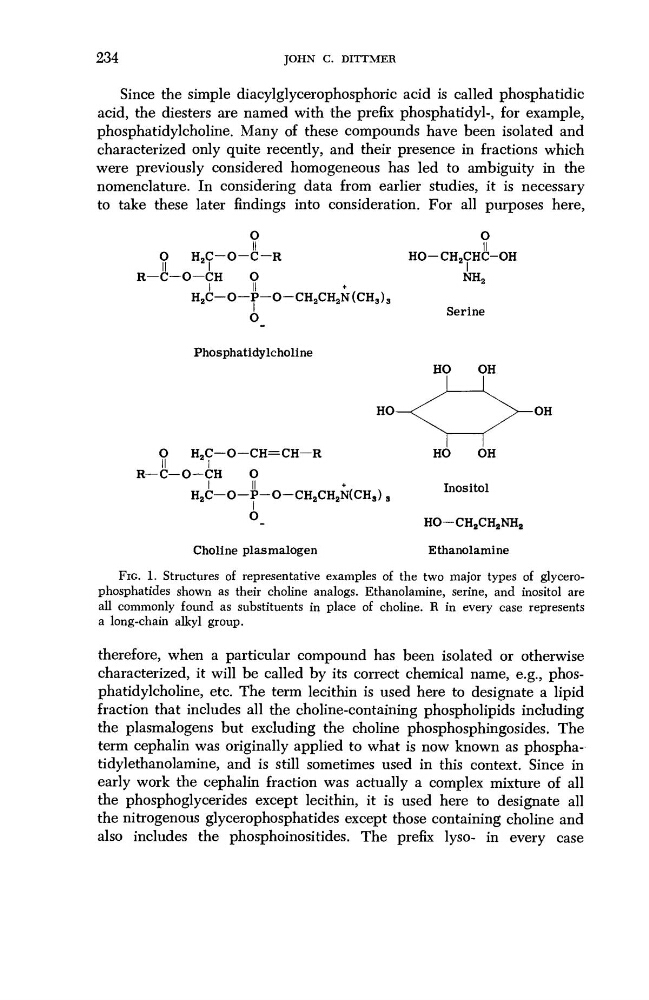
Since the simple diacylglycerophosphoric acid is called phosphatidic
acid, the diesters are named with the prefix phosphatidyl-, for example,
phosphatidylcholine. Many of these compounds have been isolated and
characterized only quite recently, and their presence in fractions which
were previously considered homogeneous has led to ambiguity in the
nomenclature. In considering data from earlier studies, it is necessary
to take these later findings into consideration. For all purposes here,
R—C—O—CH
I
H 2 C—O—P—0-CH 2 CH 2 N(CH 3 ) 3
O
HO-CH 2 CHC-OH
NH 2
Serine
Phosphatidylcholine
R—C—O-CH
I
H 2 C—O—P-0-CH 2 CH 2 N(CH 3 )
O
Choline plasmalogen
Ethanolamine
FIG. 1. Structures of representative examples of the two major types of glycerophosphatides shown as their choline analogs. Ethanolamine, serine, and inositol are
all commonly found as substituents in place of choline. R in every case represents
a long-chain alkyl group.
therefore, when a particular compound has been isolated or otherwise
characterized, it will be called by its correct chemical name, e.g., phosphatidylcholine, etc. The term lecithin is used here to designate a lipid
fraction that includes all the choline-containing phospholipids including
the plasmalogens but excluding the choline phosphosphingosides. The
term cephalin was originally applied to what is now known as phosphatidylethanolamine, and is still sometimes used in this context. Since in
early work the cephalin fraction was actually a complex mixture of all
the phosphoglycerides except lecithin, it is used here to designate all
the nitrogenous glycerophosphatides except those containing choline and
also includes the phosphoinositides. The prefix lyso- in every case
JOHN C. DITTMER
Since the simple diacylglycerophosphoric acid is called phosphatidic
acid, the diesters are named with the prefix phosphatidyl-, for example,
phosphatidylcholine. Many of these compounds have been isolated and
characterized only quite recently, and their presence in fractions which
were previously considered homogeneous has led to ambiguity in the
nomenclature. In considering data from earlier studies, it is necessary
to take these later findings into consideration. For all purposes here,
R—C—O—CH
I
H 2 C—O—P—0-CH 2 CH 2 N(CH 3 ) 3
O
HO-CH 2 CHC-OH
NH 2
Serine
Phosphatidylcholine
R—C—O-CH
I
H 2 C—O—P-0-CH 2 CH 2 N(CH 3 )
O
Choline plasmalogen
Ethanolamine
FIG. 1. Structures of representative examples of the two major types of glycerophosphatides shown as their choline analogs. Ethanolamine, serine, and inositol are
all commonly found as substituents in place of choline. R in every case represents
a long-chain alkyl group.
therefore, when a particular compound has been isolated or otherwise
characterized, it will be called by its correct chemical name, e.g., phosphatidylcholine, etc. The term lecithin is used here to designate a lipid
fraction that includes all the choline-containing phospholipids including
the plasmalogens but excluding the choline phosphosphingosides. The
term cephalin was originally applied to what is now known as phosphatidylethanolamine, and is still sometimes used in this context. Since in
early work the cephalin fraction was actually a complex mixture of all
the phosphoglycerides except lecithin, it is used here to designate all
the nitrogenous glycerophosphatides except those containing choline and
also includes the phosphoinositides. The prefix lyso- in every case