

72
HENRY EYRING, RICHARD P. BOYCE AND JOHN D. SPIKES
gether with the proportionality constant b, the transmission coefficient κ,
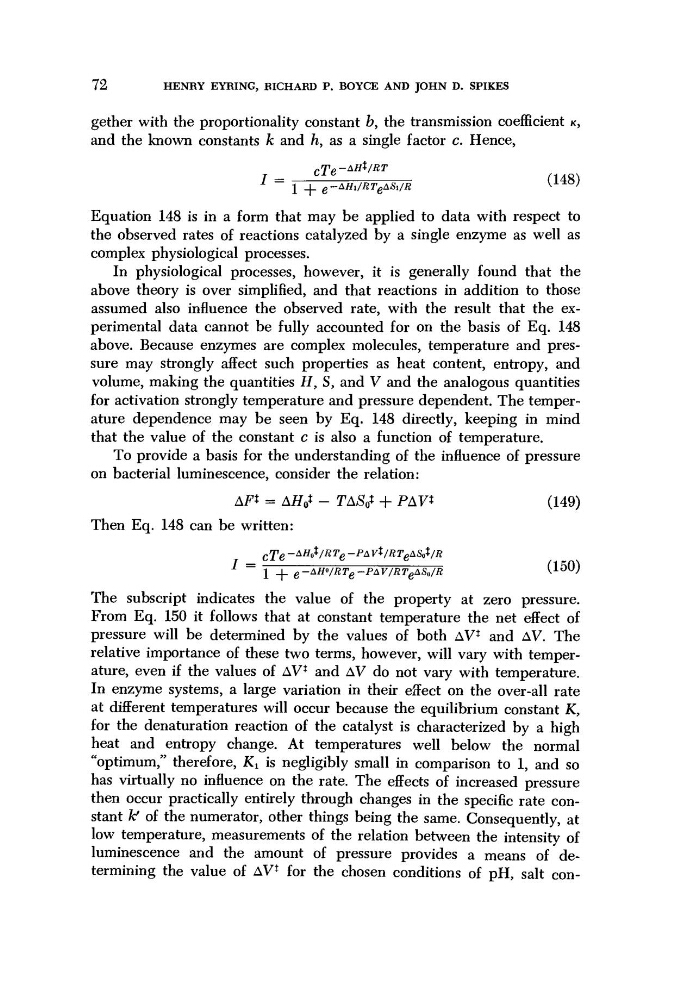
and the known constants k and h, as a single factor c. Hence,
I =
££ϋ
(148)
1
l _|_ e -AHi/RT e ASi/R
\*
m J
Equation 148 is in a form that may be applied to data with respect to
the observed rates of reactions catalyzed by a single enzyme as well as
complex physiological processes.
In physiological processes, however, it is generally found that the
above theory is over simplified, and that reactions in addition to those
assumed also influence the observed rate, with the result that the experimental data cannot be fully accounted for on the basis of Eq. 148
above. Because enzymes are complex molecules, temperature and pressure may strongly affect such properties as heat content, entropy, and
volume, making the quantities H, S, and V and the analogous quantities
for activation strongly temperature and pressure dependent. The temperature dependence may be seen by Eq. 148 directly, keeping in mind
that the value of the constant c is also a function of temperature.
To provide a basis for the understanding of the influence of pressure
on bacterial luminescence, consider the relation:
AF* = AH Q t - TAS (149)
Then Eq. 148 can be written:
c T e -AH 0 t/RT e
-PAVt/RT e AS 0 t/R
*
=
l _|_ e -AH°/RT e -PAV/RT e AS 0 /R
(150)
The subscript indicates the value of the property at zero pressure.
From Eq. 150 it follows that at constant temperature the net effect of
pressure will be determined by the values of both AV* and AV. The
relative importance of these two terms, however, will vary with temperature, even if the values of AV* and AV do not vary with temperature.
In enzyme systems, a large variation in their effect on the over-all rate
at different temperatures will occur because the equilibrium constant K,
for the denaturation reaction of the catalyst is characterized by a high
heat and entropy change. At temperatures well below the normal
"optimum," therefore, K x is negligibly small in comparison to 1, and so
has virtually no influence on the rate. The effects of increased pressure
then occur practically entirely through changes in the specific rate constant kf of the numerator, other things being the same. Consequently, at
low temperature, measurements of the relation between the intensity of
luminescence and the amount of pressure provides a means of determining the value of AV* for the chosen conditions of pH, salt con-
HENRY EYRING, RICHARD P. BOYCE AND JOHN D. SPIKES
gether with the proportionality constant b, the transmission coefficient κ,
and the known constants k and h, as a single factor c. Hence,
I =
££ϋ
(148)
1
l _|_ e -AHi/RT e ASi/R
\*
m J
Equation 148 is in a form that may be applied to data with respect to
the observed rates of reactions catalyzed by a single enzyme as well as
complex physiological processes.
In physiological processes, however, it is generally found that the
above theory is over simplified, and that reactions in addition to those
assumed also influence the observed rate, with the result that the experimental data cannot be fully accounted for on the basis of Eq. 148
above. Because enzymes are complex molecules, temperature and pressure may strongly affect such properties as heat content, entropy, and
volume, making the quantities H, S, and V and the analogous quantities
for activation strongly temperature and pressure dependent. The temperature dependence may be seen by Eq. 148 directly, keeping in mind
that the value of the constant c is also a function of temperature.
To provide a basis for the understanding of the influence of pressure
on bacterial luminescence, consider the relation:
AF* = AH Q t - TAS (149)
Then Eq. 148 can be written:
c T e -AH 0 t/RT e
-PAVt/RT e AS 0 t/R
*
=
l _|_ e -AH°/RT e -PAV/RT e AS 0 /R
(150)
The subscript indicates the value of the property at zero pressure.
From Eq. 150 it follows that at constant temperature the net effect of
pressure will be determined by the values of both AV* and AV. The
relative importance of these two terms, however, will vary with temperature, even if the values of AV* and AV do not vary with temperature.
In enzyme systems, a large variation in their effect on the over-all rate
at different temperatures will occur because the equilibrium constant K,
for the denaturation reaction of the catalyst is characterized by a high
heat and entropy change. At temperatures well below the normal
"optimum," therefore, K x is negligibly small in comparison to 1, and so
has virtually no influence on the rate. The effects of increased pressure
then occur practically entirely through changes in the specific rate constant kf of the numerator, other things being the same. Consequently, at
low temperature, measurements of the relation between the intensity of
luminescence and the amount of pressure provides a means of determining the value of AV* for the chosen conditions of pH, salt con-