

2. THERMODYNAMICS OF LIVING SYSTEMS
71
Or
[ΑΛ = r
i p^
(143)
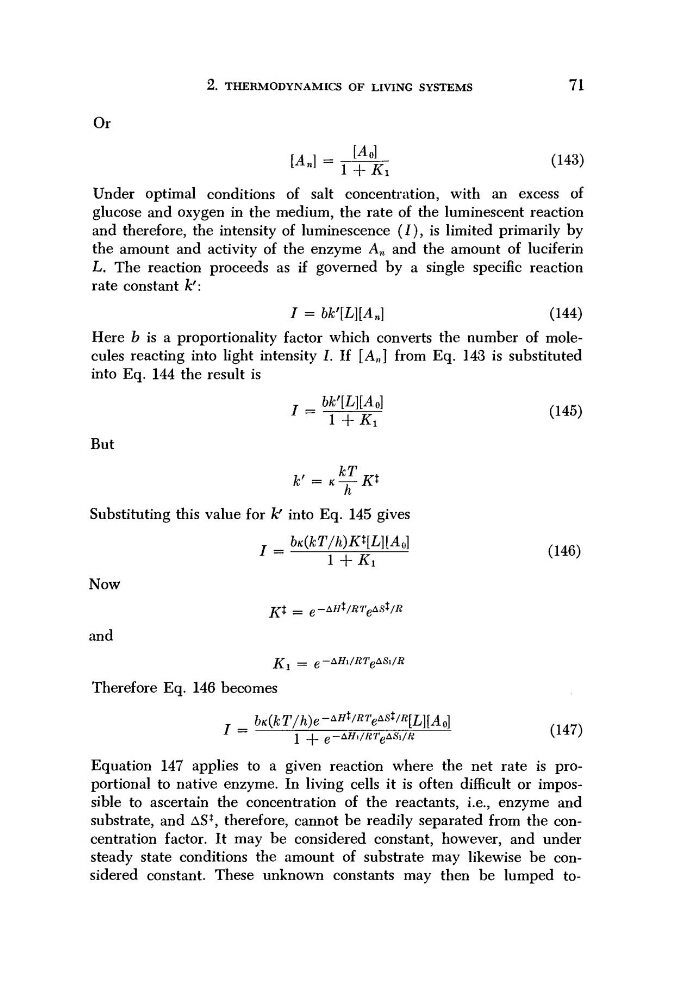
Under optimal conditions of salt concentration, with an excess of
glucose and oxygen in the medium, the rate of the luminescent reaction
and therefore, the intensity of luminescence (I), is limited primarily by
the amount and activity of the enzyme A n and the amount of luciferin
L. The reaction proceeds as if governed by a single specific reaction
rate constant k':
I = bk'[L][A n ]
(144)
Here b is a proportionality factor which converts the number of molecules reacting into light intensity 1. If [A n ] from Eq. 143 is substituted
into Eq. 144 the result is
I « **™
(145)
1 + Ai
But
jfc' =
κ^Κί
h
Substituting this value for k* into Eq. 145 gives
_ bK(kT/h)Kt[L][A,]
1+Kl
V
w )
Now
J£t =
e -AHt/RT e ASt/R
and
jf =
e -AHi/RT e ASi/R
Therefore Eq. 146 becomes
_ bK(kT/h)e-*
Ht '
RT e*
8t '
R [L][A 0 ]
_
1 ~~
l _|_ e -AHi/RT e ASi/R
U
4 ')
Equation 147 applies to a given reaction where the net rate is proportional to native enzyme. In living cells it is often difficult or impossible to ascertain the concentration of the reactants, i.e., enzyme and
substrate, and AS*, therefore, cannot be readily separated from the concentration factor. It may be considered constant, however, and under
steady state conditions the amount of substrate may likewise be considered constant. These unknown constants may then be lumped to-
71
Or
[ΑΛ = r
i p^
(143)
Under optimal conditions of salt concentration, with an excess of
glucose and oxygen in the medium, the rate of the luminescent reaction
and therefore, the intensity of luminescence (I), is limited primarily by
the amount and activity of the enzyme A n and the amount of luciferin
L. The reaction proceeds as if governed by a single specific reaction
rate constant k':
I = bk'[L][A n ]
(144)
Here b is a proportionality factor which converts the number of molecules reacting into light intensity 1. If [A n ] from Eq. 143 is substituted
into Eq. 144 the result is
I « **™
(145)
1 + Ai
But
jfc' =
κ^Κί
h
Substituting this value for k* into Eq. 145 gives
_ bK(kT/h)Kt[L][A,]
1+Kl
V
w )
Now
J£t =
e -AHt/RT e ASt/R
and
jf =
e -AHi/RT e ASi/R
Therefore Eq. 146 becomes
_ bK(kT/h)e-*
Ht '
RT e*
8t '
R [L][A 0 ]
_
1 ~~
l _|_ e -AHi/RT e ASi/R
U
4 ')
Equation 147 applies to a given reaction where the net rate is proportional to native enzyme. In living cells it is often difficult or impossible to ascertain the concentration of the reactants, i.e., enzyme and
substrate, and AS*, therefore, cannot be readily separated from the concentration factor. It may be considered constant, however, and under
steady state conditions the amount of substrate may likewise be considered constant. These unknown constants may then be lumped to-