

58
HENRY EYRING, RICHARD P. BOYCE AND JOHN D. SPIKES
if the following conditions are satisfied: (a) the thermodynamic forces
are chosen in such a way that Eq. 107 holds; and (b) these forces also
satisfy Eq. 109.
E. APPLICATIONS OF THE THEORY
Onsager's reciprocal relations permit a closer look at some of the
coupling between irreversible processes. As an example let us extend
an analysis developed by Prigogine (11) to our simple model of a cell.
Suppose the a- and ß-phases to have uniform concentrations throughout
and to differ only with respect to pressure and electrical potentials. It is
a well-known phenomenon that in many cells, a potential difference
exists across the membrane. In nerve cells, for example, in the resting
state a transmembrane potential exists of the order of 100 mv.
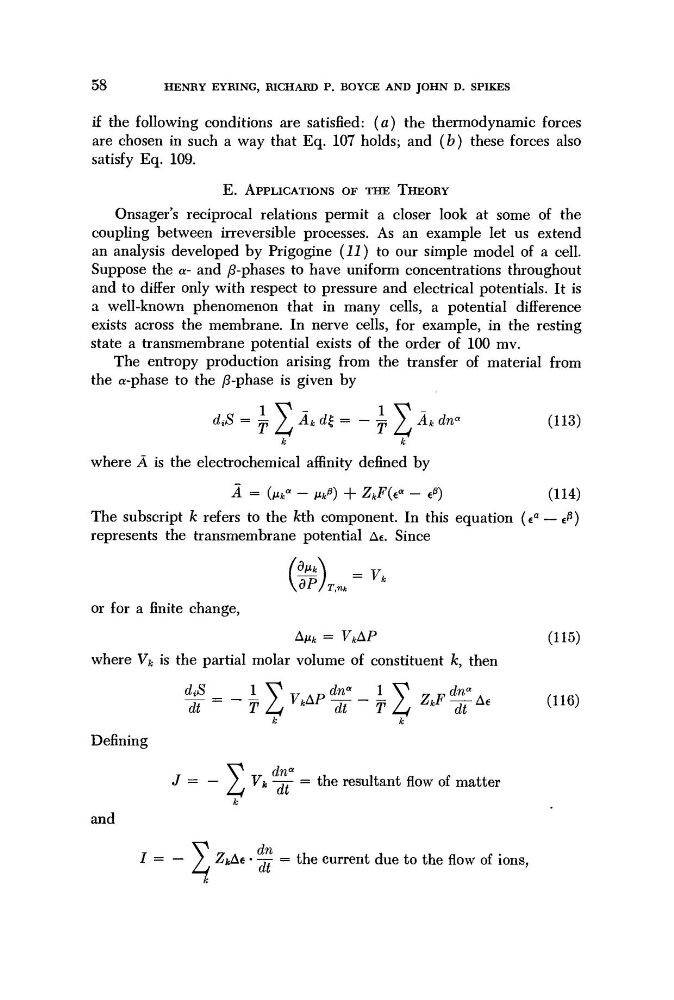
The entropy production arising from the transfer of material from
the «-phase to the ß-phase is given by
diS =
T Li
Ak d
*
=
~" T L/
Ak
k
k
dn«
(113)
where A is the electrochemical affinity defined by
A = (μ*
β - μ^) + Z k F(e« - f)
(114)
The subscript k refers to the kth component. In this equation (e
a — €0)
represents the transmembrane potential Ae. Since
ίδμΛ
_
\dP/T,n k
or for a finite change,
Δμ, = V k AP
(115)
where V& is the partial molar volume of constituent k, then
diS
1 V T M D ^
! V σ „dn
a
A
,__ N
Ίΰ
=
-τΙ
ν
*
ΑΡ
-π-τλ,
ζ
*
ρ
ΊϊΓ
Αί
(116)
k
k
Defining
V k ~rr = the resultant flow of matter
and
-?■
I = — } Z k Ae · -ΤΓ = the current due to the flow of ions,
dt
HENRY EYRING, RICHARD P. BOYCE AND JOHN D. SPIKES
if the following conditions are satisfied: (a) the thermodynamic forces
are chosen in such a way that Eq. 107 holds; and (b) these forces also
satisfy Eq. 109.
E. APPLICATIONS OF THE THEORY
Onsager's reciprocal relations permit a closer look at some of the
coupling between irreversible processes. As an example let us extend
an analysis developed by Prigogine (11) to our simple model of a cell.
Suppose the a- and ß-phases to have uniform concentrations throughout
and to differ only with respect to pressure and electrical potentials. It is
a well-known phenomenon that in many cells, a potential difference
exists across the membrane. In nerve cells, for example, in the resting
state a transmembrane potential exists of the order of 100 mv.
The entropy production arising from the transfer of material from
the «-phase to the ß-phase is given by
diS =
T Li
Ak d
*
=
~" T L/
Ak
k
k
dn«
(113)
where A is the electrochemical affinity defined by
A = (μ*
β - μ^) + Z k F(e« - f)
(114)
The subscript k refers to the kth component. In this equation (e
a — €0)
represents the transmembrane potential Ae. Since
ίδμΛ
_
\dP/T,n k
or for a finite change,
Δμ, = V k AP
(115)
where V& is the partial molar volume of constituent k, then
diS
1 V T M D ^
! V σ „dn
a
A
,__ N
Ίΰ
=
-τΙ
ν
*
ΑΡ
-π-τλ,
ζ
*
ρ
ΊϊΓ
Αί
(116)
k
k
Defining
V k ~rr = the resultant flow of matter
and
-?■
I = — } Z k Ae · -ΤΓ = the current due to the flow of ions,
dt