

2. THERMODYNAMICS OF LIVING SYSTEMS
57
be dissipated to the ß-phase. At the same time, suppose there is also
present a diffusable substance in the α-phase which passes to the ßphase. Let A represent the rate of energy flow and J 2 represent the
rate of matter flow. The rate of each is regarded as being proportional
to a "thermodynamic force." In the case of energy, we have already
seen that this force is — v T. In the case of diffusion it was seen to be
— Vfti· When two or more such processes occur simultaneously, the
rates of the separate processes are considered to be proportional not
only to the corresponding force, but proportional also to other forces.
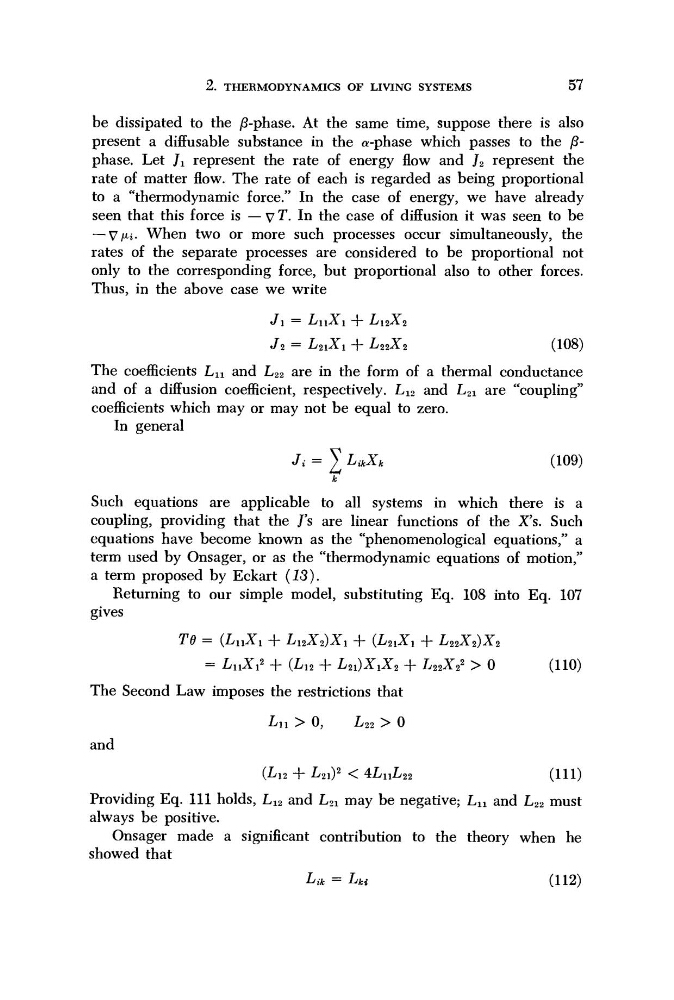
Thus, in the above case we write
J\ = LnXi -\- L12X2
J 2
= L21X1 T" Li22
The coefficients L n and L 22 are in the form of a thermal conductance
and of a diffusion coefficient, respectively. L 12 and L 2i are "coupling"
coefficients which may or may not be equal to zero.
In general
Ji = £
L
*x*
(
109
)
k
Such equations are applicable to all systems in which there is a
coupling, providing that the J's are linear functions of the X's. Such
equations have become known as the "phenomenological equations," a
term used by Onsager, or as the "thermodynamic equations of motion,"
a term proposed by Eckart (IS).
Returning to our simple model, substituting Eq. 108 into Eq. 107
gives
Τθ = (LnXi + LuX2)Xi + (L21X1 + 1/22X2)^2
= LnXi
2 + (L12 + £ 2 i)XiX 2 + L22X2
2 > 0
(110)
The Second Law imposes the restrictions that
L u > 0,
L 22 > 0
and
(L12 + L21)
2 < 4L n L 22
(111)
Providing Eq. Ill holds, L 12 and L 21 may be negative; L X1 and L 22 must
always be positive.
Onsager made a significant contribution to the theory when he
showed that
Lik — Ljci
(112)
57
be dissipated to the ß-phase. At the same time, suppose there is also
present a diffusable substance in the α-phase which passes to the ßphase. Let A represent the rate of energy flow and J 2 represent the
rate of matter flow. The rate of each is regarded as being proportional
to a "thermodynamic force." In the case of energy, we have already
seen that this force is — v T. In the case of diffusion it was seen to be
— Vfti· When two or more such processes occur simultaneously, the
rates of the separate processes are considered to be proportional not
only to the corresponding force, but proportional also to other forces.
Thus, in the above case we write
J\ = LnXi -\- L12X2
J 2
= L21X1 T" Li22
The coefficients L n and L 22 are in the form of a thermal conductance
and of a diffusion coefficient, respectively. L 12 and L 2i are "coupling"
coefficients which may or may not be equal to zero.
In general
Ji = £
L
*x*
(
109
)
k
Such equations are applicable to all systems in which there is a
coupling, providing that the J's are linear functions of the X's. Such
equations have become known as the "phenomenological equations," a
term used by Onsager, or as the "thermodynamic equations of motion,"
a term proposed by Eckart (IS).
Returning to our simple model, substituting Eq. 108 into Eq. 107
gives
Τθ = (LnXi + LuX2)Xi + (L21X1 + 1/22X2)^2
= LnXi
2 + (L12 + £ 2 i)XiX 2 + L22X2
2 > 0
(110)
The Second Law imposes the restrictions that
L u > 0,
L 22 > 0
and
(L12 + L21)
2 < 4L n L 22
(111)
Providing Eq. Ill holds, L 12 and L 21 may be negative; L X1 and L 22 must
always be positive.
Onsager made a significant contribution to the theory when he
showed that
Lik — Ljci
(112)