

2. THERMODYNAMICS OF LIVING SYSTEMS
59
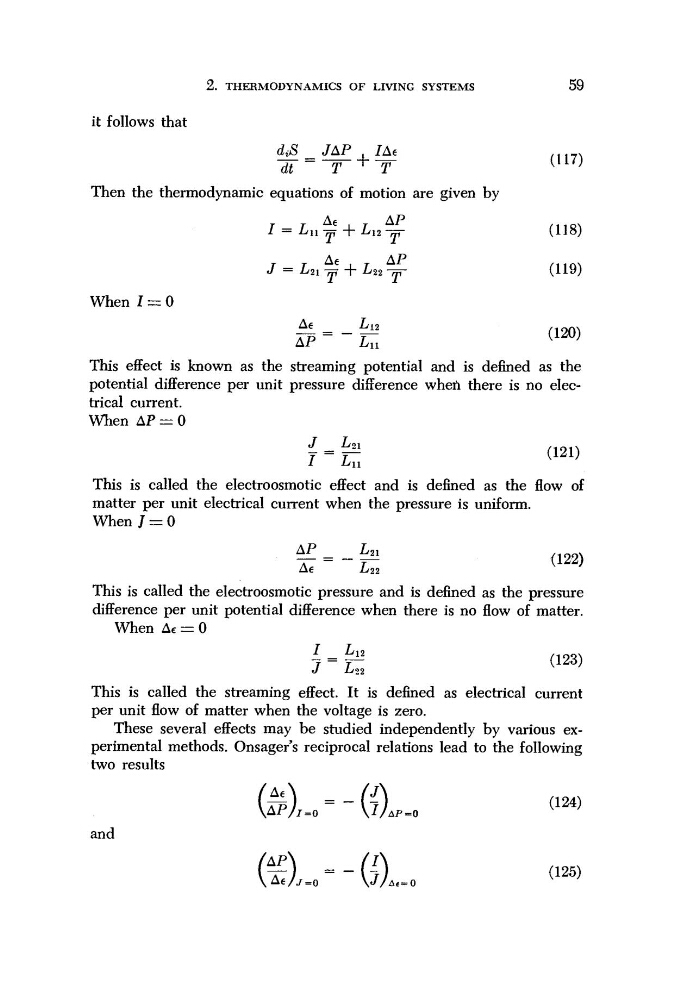
it follows that
(hS _JAP
lAe
(U7)
dt " T
+
T
U
;
Then the thermodynamic equations of motion are given by
/ = L 11 || + L 12 ^
(118)
J = L 21 ^
€ + L 22 ^
(119)
When 1 = 0
(120)
Ae
L12
AP
L n
This effect is known as the streaming potential and is defined as the
potential difference per unit pressure difference when there is no electrical current.
When ΔΡ = 0
T -1
(m)
This is called the electroosmotic effect and is defined as the flow of
matter per unit electrical current when the pressure is uniform.
When 7 = 0
Δ€
JL/22
This is called the electroosmotic pressure and is defined as the pressure
difference per unit potential difference when there is no flow of matter.
When Ac = 0
7 - £
<
123
>
This is called the streaming effect. It is defined as electrical current
per unit flow of matter when the voltage is zero.
These several effects may be studied independently by various experimental methods. Onsager's reciprocal relations lead to the following
two results
(£L--(i).«
(124
>
and
(£)„"ÖL.
59
it follows that
(hS _JAP
lAe
(U7)
dt " T
+
T
U
;
Then the thermodynamic equations of motion are given by
/ = L 11 || + L 12 ^
(118)
J = L 21 ^
€ + L 22 ^
(119)
When 1 = 0
(120)
Ae
L12
AP
L n
This effect is known as the streaming potential and is defined as the
potential difference per unit pressure difference when there is no electrical current.
When ΔΡ = 0
T -1
(m)
This is called the electroosmotic effect and is defined as the flow of
matter per unit electrical current when the pressure is uniform.
When 7 = 0
Δ€
JL/22
This is called the electroosmotic pressure and is defined as the pressure
difference per unit potential difference when there is no flow of matter.
When Ac = 0
7 - £
<
123
>
This is called the streaming effect. It is defined as electrical current
per unit flow of matter when the voltage is zero.
These several effects may be studied independently by various experimental methods. Onsager's reciprocal relations lead to the following
two results
(£L--(i).«
(124
>
and
(£)„"ÖL.