

2. THERMODYNAMICS OF LIVING SYSTEMS
47
with
Δ^ = -7.8 kcal.
However, if the last radical is hydrolyzed the free energy change is
some 4 times smaller:
A—p + H 2 0 -> A + H 3 P0 4
where now
AF = -2 kcal.
This magnitude of free energy change is that associated with a common
ester linkage. The obvious conclusion is that when there are three
phosphate radicals, the two terminal radicals become modified in such
a way that hydrolysis of them is characterized by a large negative AF.
Thus we write
A—p ~ p ~ p
and call the ^ bond a "high-energy bond."
ATP is not the only example of so-called high-energy phosphates.
For convenience these compounds may be classified into four principle
groups:
(a) Carboxyl phosphates (1,3-diphosphoglyceric acid, acetyl phosphate, etc.)
(b) Enol phosphates (phosphopyruvic acid, phenylphosphates,
etc.)
(c) Pyrophosphates (ATP, ADP, etc.)
(d) Amino phosphates (creatine phosphate, arginine phosphate,
etc.)
These types of high-energy phosphates are all characterized by a large
change in free energy upon hydrolysis, e.g., from —5 to —10 kcal, per
mole as compared to the considerably smaller —1 to —3 kcal, per mole
for the ordinary ester linkage. Oesper (9) discusses in detail why these
four main types are characterized by high energy. Essentially types (a)
and (c) owe their high energy to what he refers to as "opposing resonance." Group (b) owes its energy to the fact that the enol form is unstable relative to the carbonyl form of the molecule after hydrolysis
has taken place. Type (d) owes its energy chiefly to the neutralization
of the base formed by the hydrolysis.
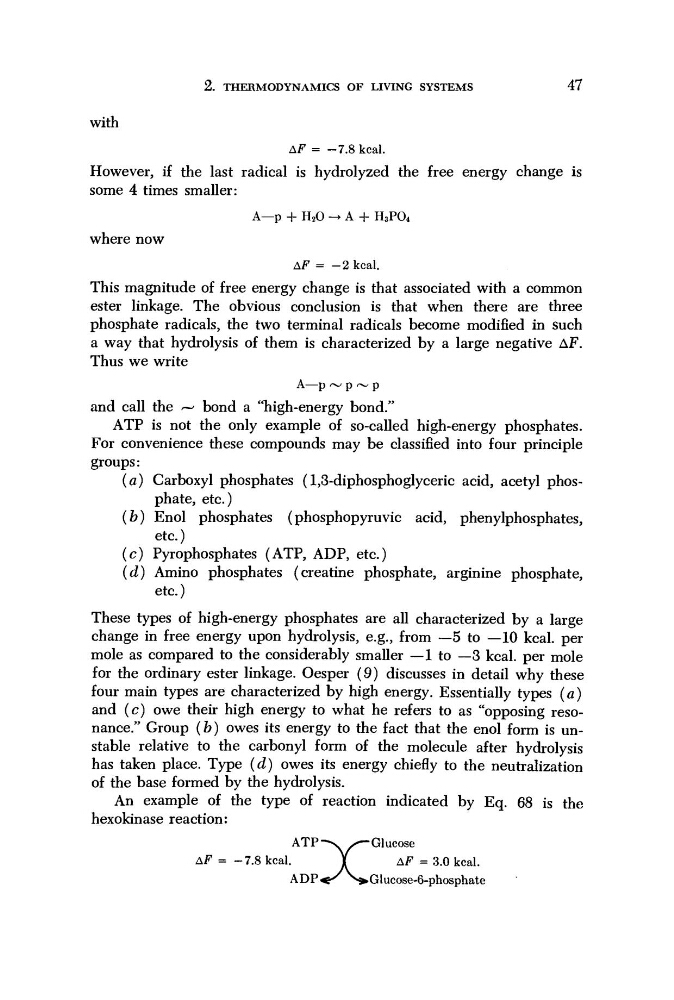
An example of the type of reaction indicated by Eq. 68 is the
hexokinase reaction:
ATP^v ^-Glucose
AF = -7.8 kcal.
Y
AF = 3.0 kcal.
ADP<^ ^>Glucose-6-phosphate
47
with
Δ^ = -7.8 kcal.
However, if the last radical is hydrolyzed the free energy change is
some 4 times smaller:
A—p + H 2 0 -> A + H 3 P0 4
where now
AF = -2 kcal.
This magnitude of free energy change is that associated with a common
ester linkage. The obvious conclusion is that when there are three
phosphate radicals, the two terminal radicals become modified in such
a way that hydrolysis of them is characterized by a large negative AF.
Thus we write
A—p ~ p ~ p
and call the ^ bond a "high-energy bond."
ATP is not the only example of so-called high-energy phosphates.
For convenience these compounds may be classified into four principle
groups:
(a) Carboxyl phosphates (1,3-diphosphoglyceric acid, acetyl phosphate, etc.)
(b) Enol phosphates (phosphopyruvic acid, phenylphosphates,
etc.)
(c) Pyrophosphates (ATP, ADP, etc.)
(d) Amino phosphates (creatine phosphate, arginine phosphate,
etc.)
These types of high-energy phosphates are all characterized by a large
change in free energy upon hydrolysis, e.g., from —5 to —10 kcal, per
mole as compared to the considerably smaller —1 to —3 kcal, per mole
for the ordinary ester linkage. Oesper (9) discusses in detail why these
four main types are characterized by high energy. Essentially types (a)
and (c) owe their high energy to what he refers to as "opposing resonance." Group (b) owes its energy to the fact that the enol form is unstable relative to the carbonyl form of the molecule after hydrolysis
has taken place. Type (d) owes its energy chiefly to the neutralization
of the base formed by the hydrolysis.
An example of the type of reaction indicated by Eq. 68 is the
hexokinase reaction:
ATP^v ^-Glucose
AF = -7.8 kcal.
Y
AF = 3.0 kcal.
ADP<^ ^>Glucose-6-phosphate