

48
HENRY EYRIKG, RICHARD P. BÖYCE ÄND JÖHK D. SPIKES
Since AF for the phosphorylation is positive, direct introduction of the
phosphate group is energetically impossible; however, in the presence
of ATP and the enzyme hexokinase the reaction takes place. In the
over-all reaction some 4.8 kcal, of free energy is liberated, rendering
the reaction quite inefficient energetically speaking. The importance of
the reaction is that before glucose can either be stored or metabolized
it must first be phosphorylated. The hexokinase reaction is the principle
pathway by which this is accomplished.
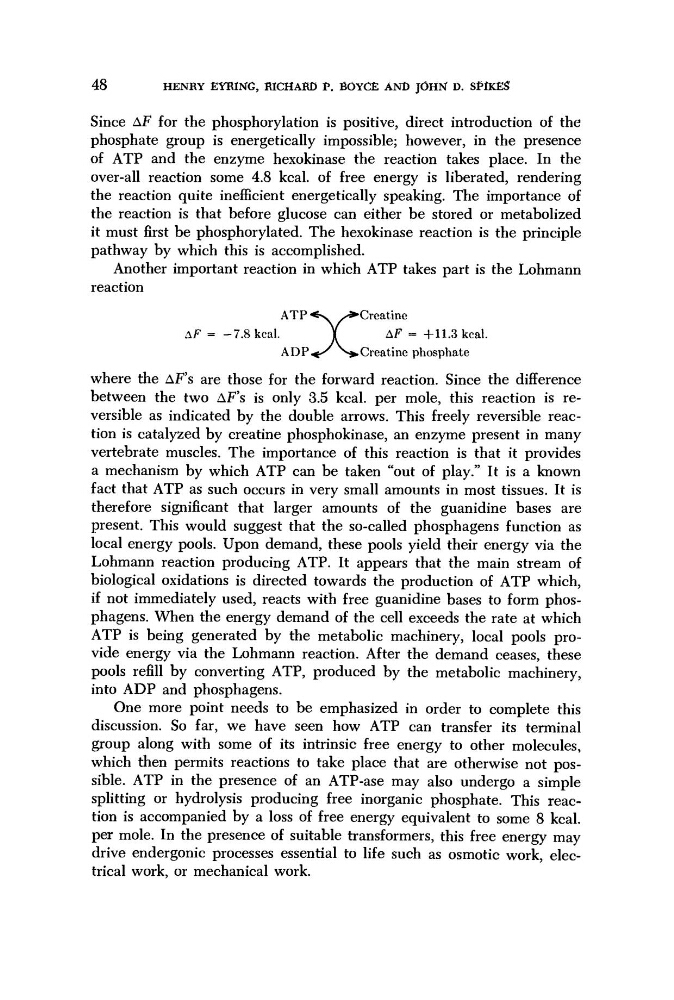
Another important reaction in which ATP takes part is the Lohmann
reaction
ATP^^Creatine
AF = -7.8 kcal.
Y
AF = +11.3 kcal.
ADP^^^>Creatine phosphate
where the AF's are those for the forward reaction. Since the difference
between the two AF's is only 3.5 kcal, per mole, this reaction is reversible as indicated by the double arrows. This freely reversible reaction is catalyzed by creatine phosphokinase, an enzyme present in many
vertebrate muscles. The importance of this reaction is that it provides
a mechanism by which ATP can be taken "out of play." It is a known
fact that ATP as such occurs in very small amounts in most tissues. It is
therefore significant that larger amounts of the guanidine bases are
present. This would suggest that the so-called phosphagens function as
local energy pools. Upon demand, these pools yield their energy via the
Lohmann reaction producing ATP. It appears that the main stream of
biological oxidations is directed towards the production of ATP which,
if not immediately used, reacts with free guanidine bases to form phosphagens. When the energy demand of the cell exceeds the rate at which
ATP is being generated by the metabolic machinery, local pools provide energy via the Lohmann reaction. After the demand ceases, these
pools refill by converting ATP, produced by the metabolic machinery,
into ADP and phosphagens.
One more point needs to be emphasized in order to complete this
discussion. So far, we have seen how ATP can transfer its terminal
group along with some of its intrinsic free energy to other molecules,
which then permits reactions to take place that are otherwise not possible. ATP in the presence of an ATP-ase may also undergo a simple
splitting or hydrolysis producing free inorganic phosphate. This reaction is accompanied by a loss of free energy equivalent to some 8 kcal,
per mole. In the presence of suitable transformers, this free energy may
drive endergonic processes essential to life such as osmotic work, electrical work, or mechanical work.
HENRY EYRIKG, RICHARD P. BÖYCE ÄND JÖHK D. SPIKES
Since AF for the phosphorylation is positive, direct introduction of the
phosphate group is energetically impossible; however, in the presence
of ATP and the enzyme hexokinase the reaction takes place. In the
over-all reaction some 4.8 kcal, of free energy is liberated, rendering
the reaction quite inefficient energetically speaking. The importance of
the reaction is that before glucose can either be stored or metabolized
it must first be phosphorylated. The hexokinase reaction is the principle
pathway by which this is accomplished.
Another important reaction in which ATP takes part is the Lohmann
reaction
ATP^^Creatine
AF = -7.8 kcal.
Y
AF = +11.3 kcal.
ADP^^^>Creatine phosphate
where the AF's are those for the forward reaction. Since the difference
between the two AF's is only 3.5 kcal, per mole, this reaction is reversible as indicated by the double arrows. This freely reversible reaction is catalyzed by creatine phosphokinase, an enzyme present in many
vertebrate muscles. The importance of this reaction is that it provides
a mechanism by which ATP can be taken "out of play." It is a known
fact that ATP as such occurs in very small amounts in most tissues. It is
therefore significant that larger amounts of the guanidine bases are
present. This would suggest that the so-called phosphagens function as
local energy pools. Upon demand, these pools yield their energy via the
Lohmann reaction producing ATP. It appears that the main stream of
biological oxidations is directed towards the production of ATP which,
if not immediately used, reacts with free guanidine bases to form phosphagens. When the energy demand of the cell exceeds the rate at which
ATP is being generated by the metabolic machinery, local pools provide energy via the Lohmann reaction. After the demand ceases, these
pools refill by converting ATP, produced by the metabolic machinery,
into ADP and phosphagens.
One more point needs to be emphasized in order to complete this
discussion. So far, we have seen how ATP can transfer its terminal
group along with some of its intrinsic free energy to other molecules,
which then permits reactions to take place that are otherwise not possible. ATP in the presence of an ATP-ase may also undergo a simple
splitting or hydrolysis producing free inorganic phosphate. This reaction is accompanied by a loss of free energy equivalent to some 8 kcal,
per mole. In the presence of suitable transformers, this free energy may
drive endergonic processes essential to life such as osmotic work, electrical work, or mechanical work.