

46
HENRY EYRING, RICHARD P. BOYCE AND JOHN D. SPIKES
us that in order for heat to be converted into work it must operate between a hot source and a cold sink. In biological systems, the temperature is essentially constant; therefore reversal of the above reaction cannot be effected merely by the addition of heat. The principal mechanism
of reforming the reactants evolved by living organisms is to alter
favorably the free energy of one of the products. This is often done by incorporating into it a phosphate radical which will be represented in
this discussion by P. A typical reaction of this type may be represented
by the following scheme:
L + M + N + · · · + X-P -+L-P + M + N · · · +X
(67)
In the presence of a suitable enzyme the following reaction takes place:
X + L-P + M+iV+----+A+£ + C+··· + X-P
(68)
One important aspect of this reaction should be emphasized. In general, it will proceed by a pathway different from the one characterized
by Eq. 67. This is true because of the striking specificity of most enzymes. An enzyme which operates on L in general will not operate on
L-P.
Another important aspect of this reaction emerges if we examine the
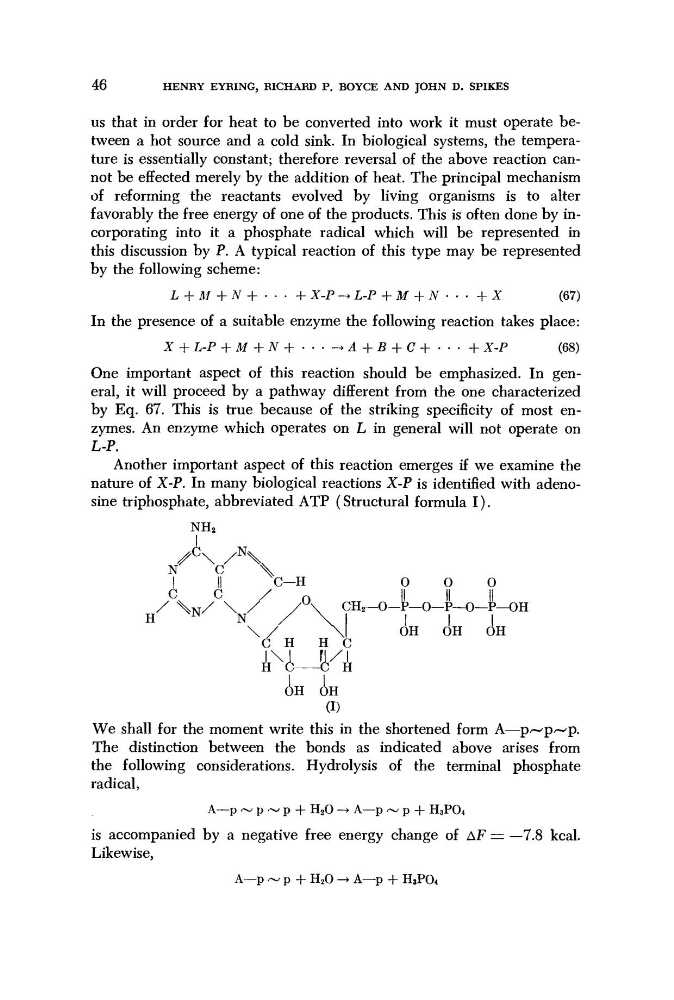
nature of X-P. In many biological reactions X-P is identified with adenosine triphosphate, abbreviated ATP (Structural formula I).
OOO
CH 2 —O—P—O—P—0—P—OH
OH
OH OH
L·
m
(i)
We shall for the moment write this in the shortened form A—p^p^p.
The distinction between the bonds as indicated above arises from
the following considerations. Hydrolysis of the terminal phosphate
radical,
A—p ~ p ~ p + H 2 0 -> A—p ~ p + H3PO4
is accompanied by a negative free energy change of AF = —7.8 kcal.
Likewise,
A—p — p + H 2 0 -► A—p + H3PO4
HENRY EYRING, RICHARD P. BOYCE AND JOHN D. SPIKES
us that in order for heat to be converted into work it must operate between a hot source and a cold sink. In biological systems, the temperature is essentially constant; therefore reversal of the above reaction cannot be effected merely by the addition of heat. The principal mechanism
of reforming the reactants evolved by living organisms is to alter
favorably the free energy of one of the products. This is often done by incorporating into it a phosphate radical which will be represented in
this discussion by P. A typical reaction of this type may be represented
by the following scheme:
L + M + N + · · · + X-P -+L-P + M + N · · · +X
(67)
In the presence of a suitable enzyme the following reaction takes place:
X + L-P + M+iV+----+A+£ + C+··· + X-P
(68)
One important aspect of this reaction should be emphasized. In general, it will proceed by a pathway different from the one characterized
by Eq. 67. This is true because of the striking specificity of most enzymes. An enzyme which operates on L in general will not operate on
L-P.
Another important aspect of this reaction emerges if we examine the
nature of X-P. In many biological reactions X-P is identified with adenosine triphosphate, abbreviated ATP (Structural formula I).
OOO
CH 2 —O—P—O—P—0—P—OH
OH
OH OH
L·
m
(i)
We shall for the moment write this in the shortened form A—p^p^p.
The distinction between the bonds as indicated above arises from
the following considerations. Hydrolysis of the terminal phosphate
radical,
A—p ~ p ~ p + H 2 0 -> A—p ~ p + H3PO4
is accompanied by a negative free energy change of AF = —7.8 kcal.
Likewise,
A—p — p + H 2 0 -► A—p + H3PO4