

2. THERMODYNAMICS OF LIVING SYSTEMS
41
Then
E = E ^RT ln m
(65)
nF
[Red]
Many reactions in biological systems, especially those involved in
energy transfer, are of the oxidation-reduction type. Thus Eq. 65 has
practical applications since if E 0 is known for a system it is possible to
calculate the actual redox potential, E, for any degree of oxidation of
the system. Since E and F are related as shown in Eq. 62, E 0 is also
a measure of the redox tendency of a system. Thus, if we assume oxidizing systems as the more positive as is usually done in biochemistry
(a convention which is just the opposite to that used by American
physical chemists), a system with an E 0 of + 0.3 volts will oxidize a
system with an E 0 of +0.1 volts, and will in turn be oxidized by a
system with an E 0 of + 0.5 volts. In the aerobic oxidation of ß-hydroxybutyrate to acetoacetate in living material, the two electrons removed
are transferred by several separate steps to oxygen with the formation of
water. These steps, with their associated potentials, are shown in a
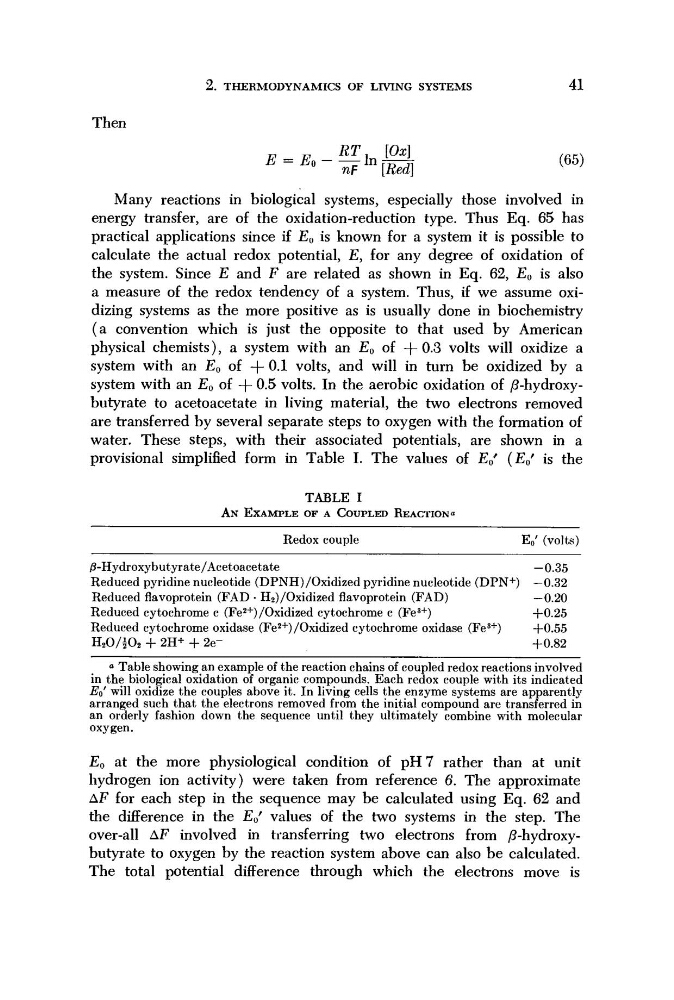
provisional simplified form in Table I. The values of EJ (E 0 ' is the
TABLE I
AN EXAMPLE OF A COUPLED REACTION«
Redox couple
E 0 ' (volts)
/3-Hydroxybuty rate/Acetoacetate
— 0.35
Reduced pyridine nucleotide (DPNH)/Oxidized pyridine nucleotide (DPN
+ ) —0.32
Reduced flavoprotein (FAD · H 2 ) /Oxidized flavoprotein (FAD)
-0.20
Reduced cytochrome c (Fe
2+ )/Oxidized cytochrome c (Fe
3+ )
+0.25
Reduced cytochrome oxidase (Fe
2+ )/Oxidized cytochrome oxidase (Fe
3+ )
+0.55
H 2 0/i0 2 + 2Η+ + 2e"
+0.82
α Table showing an example of the reaction chains of coupled redox reactions involved
in the biological oxidation of organic compounds. Each redox couple with its indicated
EQ' will oxidize the couples above it. In living cells the enzyme systems are apparently
arranged such that the electrons removed from the initial compound are transferred in
an orderly fashion down the sequence until they ultimately combine with molecular
oxygen.
Έ 0 at the more physiological condition of pH 7 rather than at unit
hydrogen ion activity) were taken from reference 6. The approximate
AF for each step in the sequence may be calculated using Eq. 62 and
the difference in the E 0 ' values of the two systems in the step. The
over-all AF involved in transferring two electrons from ß-hydroxybutyrate to oxygen by the reaction system above can also be calculated.
The total potential difference through which the electrons move is
41
Then
E = E ^RT ln m
(65)
nF
[Red]
Many reactions in biological systems, especially those involved in
energy transfer, are of the oxidation-reduction type. Thus Eq. 65 has
practical applications since if E 0 is known for a system it is possible to
calculate the actual redox potential, E, for any degree of oxidation of
the system. Since E and F are related as shown in Eq. 62, E 0 is also
a measure of the redox tendency of a system. Thus, if we assume oxidizing systems as the more positive as is usually done in biochemistry
(a convention which is just the opposite to that used by American
physical chemists), a system with an E 0 of + 0.3 volts will oxidize a
system with an E 0 of +0.1 volts, and will in turn be oxidized by a
system with an E 0 of + 0.5 volts. In the aerobic oxidation of ß-hydroxybutyrate to acetoacetate in living material, the two electrons removed
are transferred by several separate steps to oxygen with the formation of
water. These steps, with their associated potentials, are shown in a
provisional simplified form in Table I. The values of EJ (E 0 ' is the
TABLE I
AN EXAMPLE OF A COUPLED REACTION«
Redox couple
E 0 ' (volts)
/3-Hydroxybuty rate/Acetoacetate
— 0.35
Reduced pyridine nucleotide (DPNH)/Oxidized pyridine nucleotide (DPN
+ ) —0.32
Reduced flavoprotein (FAD · H 2 ) /Oxidized flavoprotein (FAD)
-0.20
Reduced cytochrome c (Fe
2+ )/Oxidized cytochrome c (Fe
3+ )
+0.25
Reduced cytochrome oxidase (Fe
2+ )/Oxidized cytochrome oxidase (Fe
3+ )
+0.55
H 2 0/i0 2 + 2Η+ + 2e"
+0.82
α Table showing an example of the reaction chains of coupled redox reactions involved
in the biological oxidation of organic compounds. Each redox couple with its indicated
EQ' will oxidize the couples above it. In living cells the enzyme systems are apparently
arranged such that the electrons removed from the initial compound are transferred in
an orderly fashion down the sequence until they ultimately combine with molecular
oxygen.
Έ 0 at the more physiological condition of pH 7 rather than at unit
hydrogen ion activity) were taken from reference 6. The approximate
AF for each step in the sequence may be calculated using Eq. 62 and
the difference in the E 0 ' values of the two systems in the step. The
over-all AF involved in transferring two electrons from ß-hydroxybutyrate to oxygen by the reaction system above can also be calculated.
The total potential difference through which the electrons move is