

42
HENRY EYRING, RICHARD P. BOYCE AND JOHN D. SPIKES
0.82 + 0.35 = 1.17 volts. Substituting this value into Eq. 62 we get
AF = -nFE = -2 X 96,500 X 1.17 = -226,000 joules
= -226,000/4.18 = -54,000 cal. = -54 kcal.
It must be recognized that the above calculation is only an approximation since the reactants are obviously not in their standard states. Also
the reaction system is much more likely to be in a steady state condition
rather than in equilibrium but this is not a significant complication.
J. THIRD LAW
It is possible to determine the thermodynamic equilibrium constant
for a reaction without requiring the measurement of a single equilibrium state of the reaction itself by resorting to the Third Law of
Thermodynamics.
The Second Law fixes the entropy of any state provided it is
known for some particular state, say the crystalline state at absolute
zero. The Third Law provides a simple method for determining entropy
changes of reactions since it gives us the information that AS for any
reaction carried out for crystalline systems at absolute zero is zero.
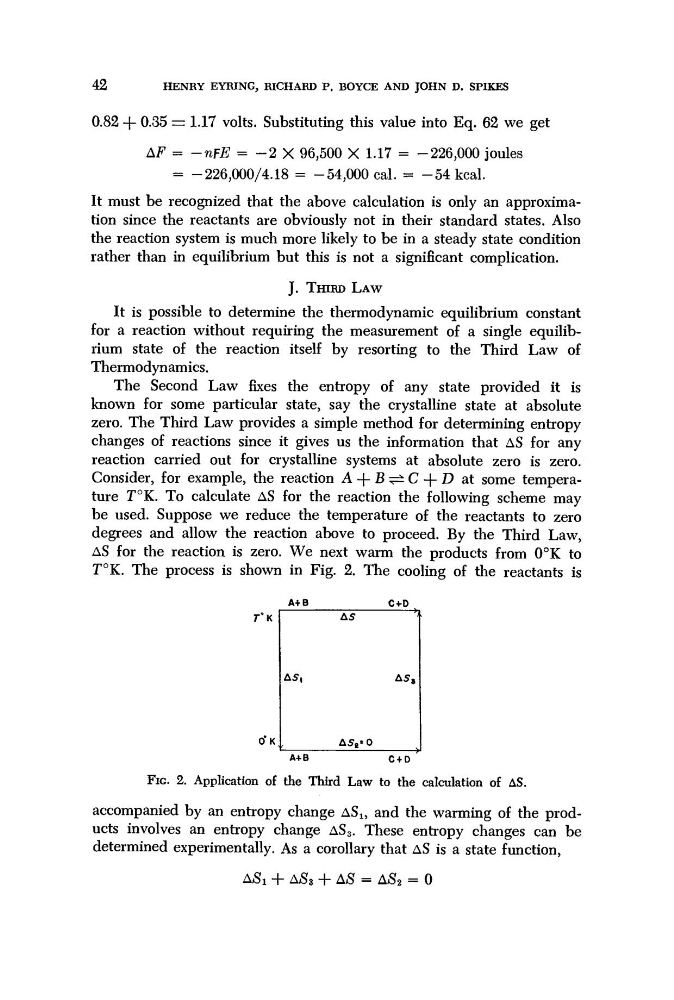
Consider, for example, the reaction A + B^±C + D at some temperature T°K. To calculate AS for the reaction the following scheme may
be used. Suppose we reduce the temperature of the reactants to zero
degrees and allow the reaction above to proceed. By the Third Law,
AS for the reaction is zero. We next warm the products from 0°K to
T°K. The process is shown in Fig. 2. The cooling of the reactants is
A+B
C+D
_
H
Δ5,
Δ5 8
Δ5 Β «0
ZJL
^Ι
A+B
C + D
FIG. 2. Application of the Third Law to the calculation of AS.
accompanied by an entropy change ASi, and the warming of the products involves an entropy change AS 3 . These entropy changes can be
determined experimentally. As a corollary that AS is a state function,
ΓΚ
o K
ASi + AS 3 + AS = AS 2 = 0
HENRY EYRING, RICHARD P. BOYCE AND JOHN D. SPIKES
0.82 + 0.35 = 1.17 volts. Substituting this value into Eq. 62 we get
AF = -nFE = -2 X 96,500 X 1.17 = -226,000 joules
= -226,000/4.18 = -54,000 cal. = -54 kcal.
It must be recognized that the above calculation is only an approximation since the reactants are obviously not in their standard states. Also
the reaction system is much more likely to be in a steady state condition
rather than in equilibrium but this is not a significant complication.
J. THIRD LAW
It is possible to determine the thermodynamic equilibrium constant
for a reaction without requiring the measurement of a single equilibrium state of the reaction itself by resorting to the Third Law of
Thermodynamics.
The Second Law fixes the entropy of any state provided it is
known for some particular state, say the crystalline state at absolute
zero. The Third Law provides a simple method for determining entropy
changes of reactions since it gives us the information that AS for any
reaction carried out for crystalline systems at absolute zero is zero.
Consider, for example, the reaction A + B^±C + D at some temperature T°K. To calculate AS for the reaction the following scheme may
be used. Suppose we reduce the temperature of the reactants to zero
degrees and allow the reaction above to proceed. By the Third Law,
AS for the reaction is zero. We next warm the products from 0°K to
T°K. The process is shown in Fig. 2. The cooling of the reactants is
A+B
C+D
_
H
Δ5,
Δ5 8
Δ5 Β «0
ZJL
^Ι
A+B
C + D
FIG. 2. Application of the Third Law to the calculation of AS.
accompanied by an entropy change ASi, and the warming of the products involves an entropy change AS 3 . These entropy changes can be
determined experimentally. As a corollary that AS is a state function,
ΓΚ
o K
ASi + AS 3 + AS = AS 2 = 0