

40
HENRY EYRING, RICHARD P. BOYCE AND JOHN D. SPIKES
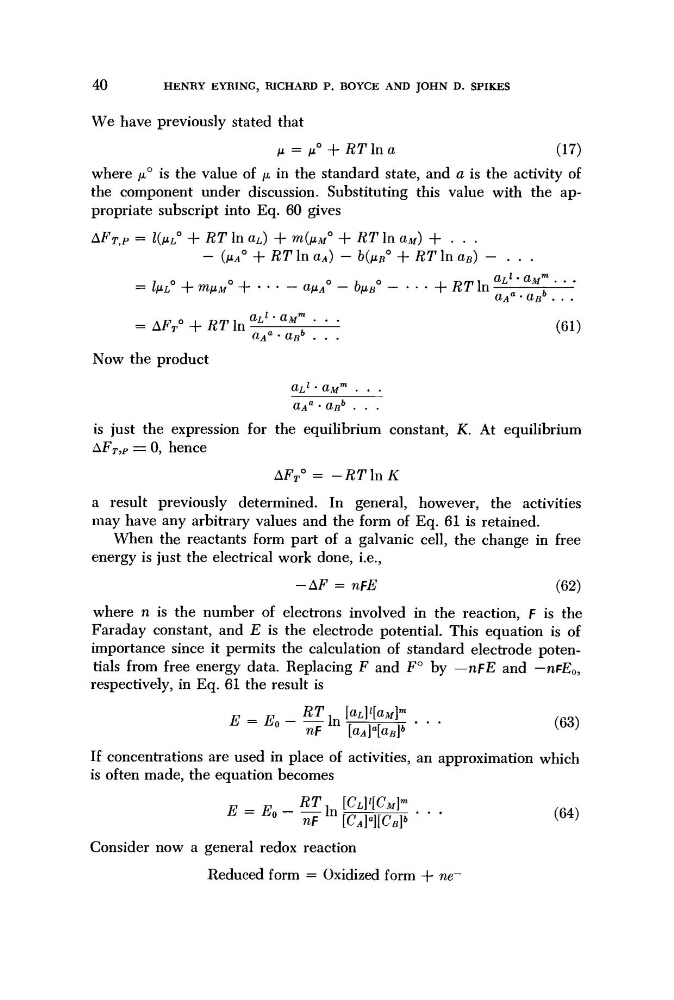
We have previously stated that
μ = μ° + RT In a
(17)
where μ° is the value of μ in the standard state, and a is the activity of
the component under discussion. Substituting this value with the appropriate subscript into Eq. 60 gives
AF T>P = KML° + RT In a L ) + πι(μ Μ ° + RT In a M ) + . . .
- (μ Α ° + RT In a A ) - &(μ*° + RT In a B ) - . . .
a L
l · a M
m . . .
= h L ° + πι μΜ ° + · · · - αμ Α ° - b ßB ° - · · · + AT In a A
a ·a B
b
. . .
= AF T ° + RT In
ai} '
αΜ ™ ' ' '
(61)
a A
a · a B
b . . .
Now the product
a L
l · a M
w
a^
a · a ß
6
is just the expression for the equilibrium constant, K. At equilibrium
AF T , P = 0, hence
AF T ° =
-RTlnK
a result previously determined. In general, however, the activities
may have any arbitrary values and the form of Eq. 61 is retained.
When the reactants form part of a galvanic cell, the change in free
energy is just the electrical work done, i.e.,
-Δ^ = nFE
(62)
where n is the number of electrons involved in the reaction, F is the
Faraday constant, and E is the electrode potential. This equation is of
importance since it permits the calculation of standard electrode potentials from free energy data. Replacing F and F° by —nFE and —nfE 0 ,
respectively, in Eq. 61 the result is
nF
M
a M
&
v J
If concentrations are used in place of activities, an approximation which
is often made, the equation becomes
Ä _^ 0 _ _!„____...
(64)
Consider now a general redox reaction
Reduced form = Oxidized form + ne~
HENRY EYRING, RICHARD P. BOYCE AND JOHN D. SPIKES
We have previously stated that
μ = μ° + RT In a
(17)
where μ° is the value of μ in the standard state, and a is the activity of
the component under discussion. Substituting this value with the appropriate subscript into Eq. 60 gives
AF T>P = KML° + RT In a L ) + πι(μ Μ ° + RT In a M ) + . . .
- (μ Α ° + RT In a A ) - &(μ*° + RT In a B ) - . . .
a L
l · a M
m . . .
= h L ° + πι μΜ ° + · · · - αμ Α ° - b ßB ° - · · · + AT In a A
a ·a B
b
. . .
= AF T ° + RT In
ai} '
αΜ ™ ' ' '
(61)
a A
a · a B
b . . .
Now the product
a L
l · a M
w
a^
a · a ß
6
is just the expression for the equilibrium constant, K. At equilibrium
AF T , P = 0, hence
AF T ° =
-RTlnK
a result previously determined. In general, however, the activities
may have any arbitrary values and the form of Eq. 61 is retained.
When the reactants form part of a galvanic cell, the change in free
energy is just the electrical work done, i.e.,
-Δ^ = nFE
(62)
where n is the number of electrons involved in the reaction, F is the
Faraday constant, and E is the electrode potential. This equation is of
importance since it permits the calculation of standard electrode potentials from free energy data. Replacing F and F° by —nFE and —nfE 0 ,
respectively, in Eq. 61 the result is
nF
M
a M
&
v J
If concentrations are used in place of activities, an approximation which
is often made, the equation becomes
Ä _^ 0 _ _!„____...
(64)
Consider now a general redox reaction
Reduced form = Oxidized form + ne~