

20
HENRY EYRING, RICHARD P. BOYCE AND JOHN D. SPIKES
systems where the final state is determined by the initial conditions.
Equifinality has been used by many, including Driesch (la), as the
principal argument of vitalism. Driesch maintained that forces different
from those of known physics and chemistry were responsible for governing certain natural processes by foresight of the goal to be attained.
Such forces then give rise to the same final result, namely a typical
organism from a whole germ, a half germ, two fused germs, or after
translocation of cells in the embryos of certain organisms. In the light
of the above analysis, equifinality arises as a consequence of the model
chosen and in no way suggests extraphysical forces.
C. A SIMPLE MODEL
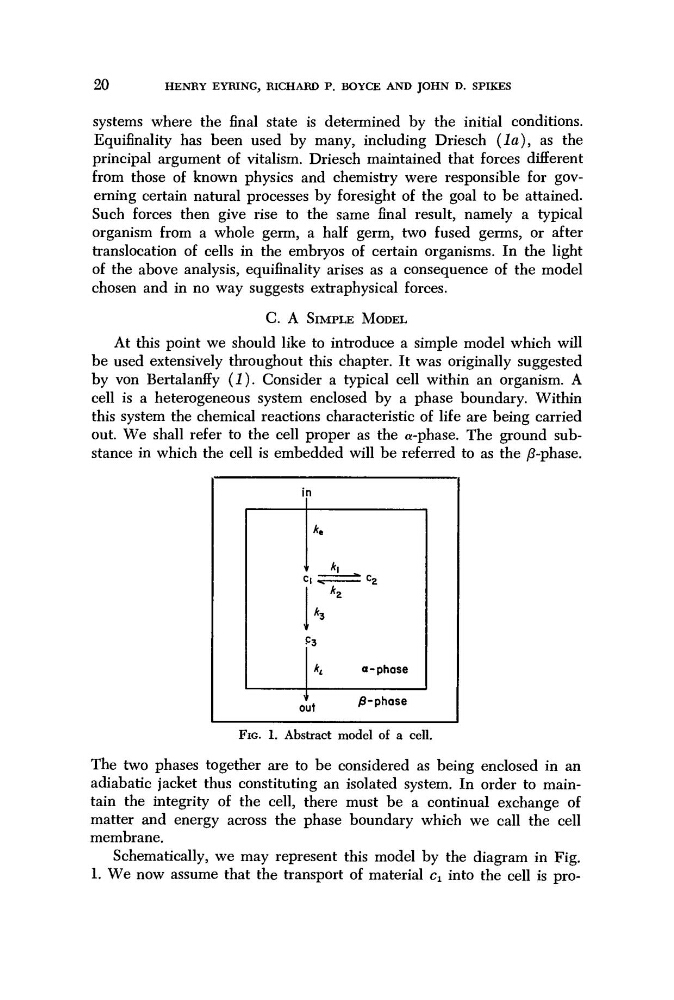
At this point we should like to introduce a simple model which will
be used extensively throughout this chapter. It was originally suggested
by von Bertalanffy (J). Consider a typical cell within an organism. A
cell is a heterogeneous system enclosed by a phase boundary. Within
this system the chemical reactions characteristic of life are being carried
out. We shall refer to the cell proper as the α-phase. The ground substance in which the cell is embedded will be referred to as the /?-phase.
in
*e
*3
£3
kL
a-phase
FIG. 1. Abstract model of a cell.
The two phases together are to be considered as being enclosed in an
adiabatic jacket thus constituting an isolated system. In order to maintain the integrity of the cell, there must be a continual exchange of
matter and energy across the phase boundary which we call the cell
membrane.
Schematically, we may represent this model by the diagram in Fig.
1. We now assume that the transport of material c x into the cell is pro-
HENRY EYRING, RICHARD P. BOYCE AND JOHN D. SPIKES
systems where the final state is determined by the initial conditions.
Equifinality has been used by many, including Driesch (la), as the
principal argument of vitalism. Driesch maintained that forces different
from those of known physics and chemistry were responsible for governing certain natural processes by foresight of the goal to be attained.
Such forces then give rise to the same final result, namely a typical
organism from a whole germ, a half germ, two fused germs, or after
translocation of cells in the embryos of certain organisms. In the light
of the above analysis, equifinality arises as a consequence of the model
chosen and in no way suggests extraphysical forces.
C. A SIMPLE MODEL
At this point we should like to introduce a simple model which will
be used extensively throughout this chapter. It was originally suggested
by von Bertalanffy (J). Consider a typical cell within an organism. A
cell is a heterogeneous system enclosed by a phase boundary. Within
this system the chemical reactions characteristic of life are being carried
out. We shall refer to the cell proper as the α-phase. The ground substance in which the cell is embedded will be referred to as the /?-phase.
in
*e
*3
£3
kL
a-phase
FIG. 1. Abstract model of a cell.
The two phases together are to be considered as being enclosed in an
adiabatic jacket thus constituting an isolated system. In order to maintain the integrity of the cell, there must be a continual exchange of
matter and energy across the phase boundary which we call the cell
membrane.
Schematically, we may represent this model by the diagram in Fig.
1. We now assume that the transport of material c x into the cell is pro-