

2. THERMODYNAMICS OF LIVING SYSTEMS
19
('
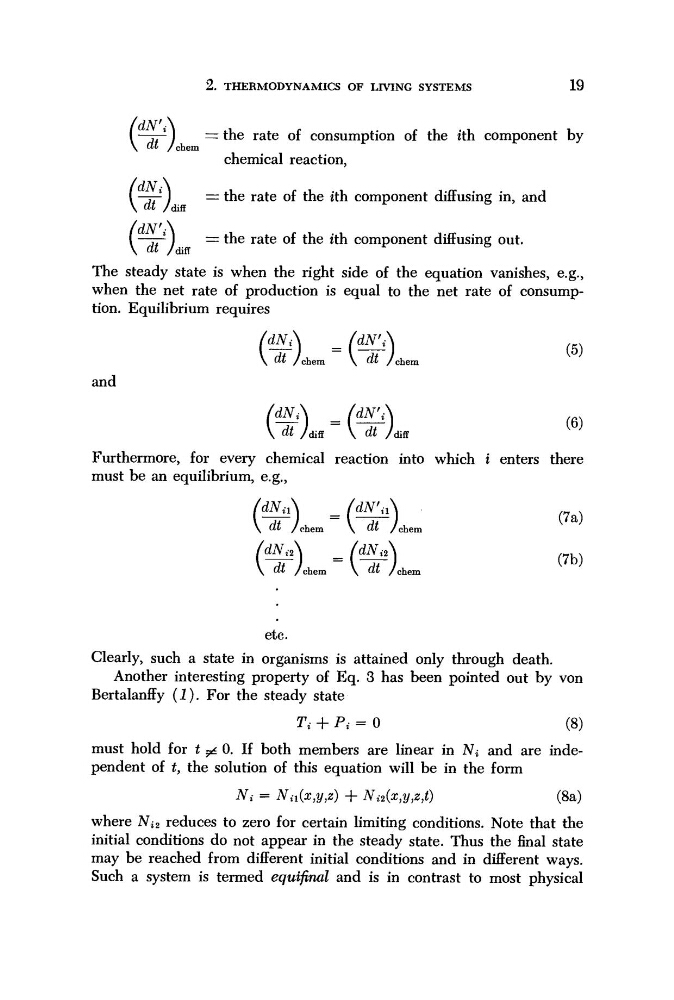
( ——- J = the rate of consumption of the ith component by
at /chem
chemical reaction,
—7-^ 1
= the rate of the ith component diffusing in, and
, at /diff
/diV'\
I —J1 I
= the rate of the ith component diffusing out.
\ at /diff
The steady state is when the right side of the equation vanishes, e.g.,
when the net rate of production is equal to the net rate of consumption. Equilibrium requires
/άΝλ
= fdN\\
(5)
\ dt /chem
\ at /chem
and
(d_NA
=
(dWÄ
\ dt /diff
\ dt /die
v ;
Furthermore, for every chemical reaction into which i enters there
must be an equilibrium, e.g.,
(ψ\ ,(ψ)
(7b)
\ ai /chem
\ ai /chem
etc.
Clearly, such a state in organisms is attained only through death.
Another interesting property of Eq. 3 has been pointed out by von
Bertalanffy (J). For the steady state
Ti + Pi = 0
(8)
must hold for t ^ 0. If both members are linear in Ni and are independent of t, the solution of this equation will be in the form
Ni = Nn(x,y,z) + Ni 2 (x,y,z,t)
(8a)
where N i2 reduces to zero for certain limiting conditions. Note that the
initial conditions do not appear in the steady state. Thus the final state
may be reached from different initial conditions and in different ways.
Such a system is termed equifinal and is in contrast to most physical
19
('
( ——- J = the rate of consumption of the ith component by
at /chem
chemical reaction,
—7-^ 1
= the rate of the ith component diffusing in, and
, at /diff
/diV'\
I —J1 I
= the rate of the ith component diffusing out.
\ at /diff
The steady state is when the right side of the equation vanishes, e.g.,
when the net rate of production is equal to the net rate of consumption. Equilibrium requires
/άΝλ
= fdN\\
(5)
\ dt /chem
\ at /chem
and
(d_NA
=
(dWÄ
\ dt /diff
\ dt /die
v ;
Furthermore, for every chemical reaction into which i enters there
must be an equilibrium, e.g.,
(ψ\ ,(ψ)
(7b)
\ ai /chem
\ ai /chem
etc.
Clearly, such a state in organisms is attained only through death.
Another interesting property of Eq. 3 has been pointed out by von
Bertalanffy (J). For the steady state
Ti + Pi = 0
(8)
must hold for t ^ 0. If both members are linear in Ni and are independent of t, the solution of this equation will be in the form
Ni = Nn(x,y,z) + Ni 2 (x,y,z,t)
(8a)
where N i2 reduces to zero for certain limiting conditions. Note that the
initial conditions do not appear in the steady state. Thus the final state
may be reached from different initial conditions and in different ways.
Such a system is termed equifinal and is in contrast to most physical