

2. THERMODYNAMICS OF LIVING SYSTEMS
21
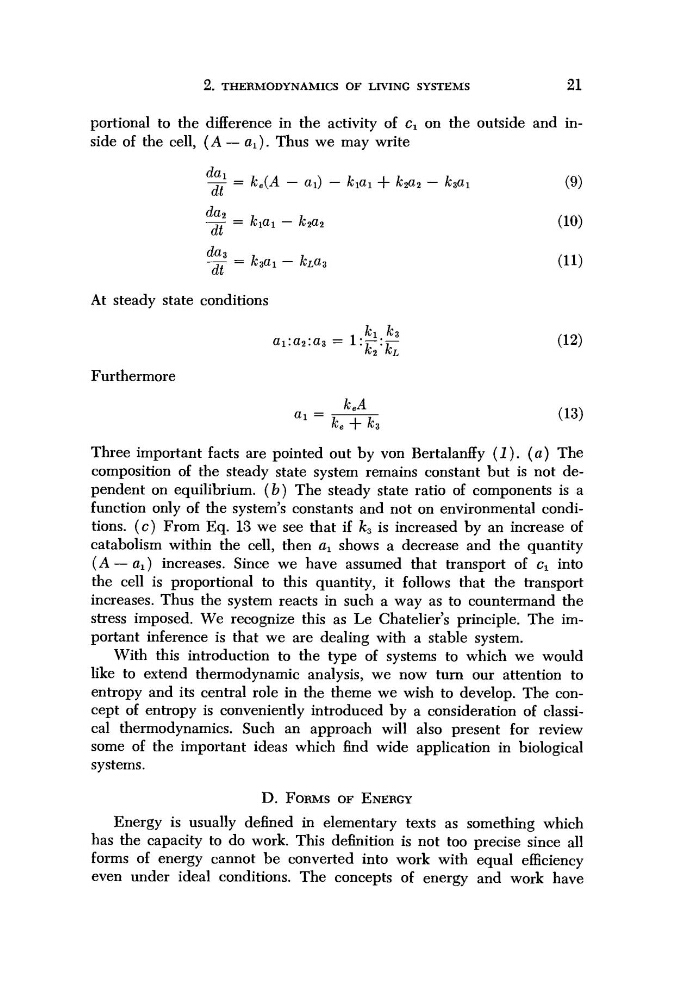
portional to the difference in the activity of c t on the outside and inside of the cell, (A — α χ ). Thus we may write
= k e (A — ai) — kidi + fc 2 a 2 —
fc 3 ai
(9)
dt
At steady state conditions
Furthermore
da i
~dt
—£ = kidi — k 2 a 2
(10)
dt
-^ = fc 3 ai — k L a z
(11)
ai:a 2 :o 3 = l:^:^
(
12 )
* - Ϊ7ΤΈ,
(13)
Three important facts are pointed out by von Bertalanffy (I), (a) The
composition of the steady state system remains constant but is not dependent on equilibrium, (b) The steady state ratio of components is a
function only of the system's constants and not on environmental conditions, (c) From Eq. 13 we see that if k 3 is increased by an increase of
catabolism within the cell, then a x shows a decrease and the quantity
(A —ai) increases. Since we have assumed that transport of d into
the cell is proportional to this quantity, it follows that the transport
increases. Thus the system reacts in such a way as to countermand the
stress imposed. We recognize this as Le Chatelier's principle. The important inference is that we are dealing with a stable system.
With this introduction to the type of systems to which we would
like to extend thermodynamic analysis, we now turn our attention to
entropy and its central role in the theme we wish to develop. The concept of entropy is conveniently introduced by a consideration of classical thermodynamics. Such an approach will also present for review
some of the important ideas which find wide application in biological
systems.
D. FORMS OF ENERGY
Energy is usually defined in elementary texts as something which
has the capacity to do work. This definition is not too precise since all
forms of energy cannot be converted into work with equal efficiency
even under ideal conditions. The concepts of energy and work have
21
portional to the difference in the activity of c t on the outside and inside of the cell, (A — α χ ). Thus we may write
= k e (A — ai) — kidi + fc 2 a 2 —
fc 3 ai
(9)
dt
At steady state conditions
Furthermore
da i
~dt
—£ = kidi — k 2 a 2
(10)
dt
-^ = fc 3 ai — k L a z
(11)
ai:a 2 :o 3 = l:^:^
(
12 )
* - Ϊ7ΤΈ,
(13)
Three important facts are pointed out by von Bertalanffy (I), (a) The
composition of the steady state system remains constant but is not dependent on equilibrium, (b) The steady state ratio of components is a
function only of the system's constants and not on environmental conditions, (c) From Eq. 13 we see that if k 3 is increased by an increase of
catabolism within the cell, then a x shows a decrease and the quantity
(A —ai) increases. Since we have assumed that transport of d into
the cell is proportional to this quantity, it follows that the transport
increases. Thus the system reacts in such a way as to countermand the
stress imposed. We recognize this as Le Chatelier's principle. The important inference is that we are dealing with a stable system.
With this introduction to the type of systems to which we would
like to extend thermodynamic analysis, we now turn our attention to
entropy and its central role in the theme we wish to develop. The concept of entropy is conveniently introduced by a consideration of classical thermodynamics. Such an approach will also present for review
some of the important ideas which find wide application in biological
systems.
D. FORMS OF ENERGY
Energy is usually defined in elementary texts as something which
has the capacity to do work. This definition is not too precise since all
forms of energy cannot be converted into work with equal efficiency
even under ideal conditions. The concepts of energy and work have