

7. THE DISTRIBUTION AND EVOLUTION OF VISUAL SYSTEMS
335
rhodopsin of A max 500 ni/x. All these pigments yielded retinenei on
bleaching.
Wald and co-workers (59) have made two further contributions to
this development. They have shown that fishes which frequent depths
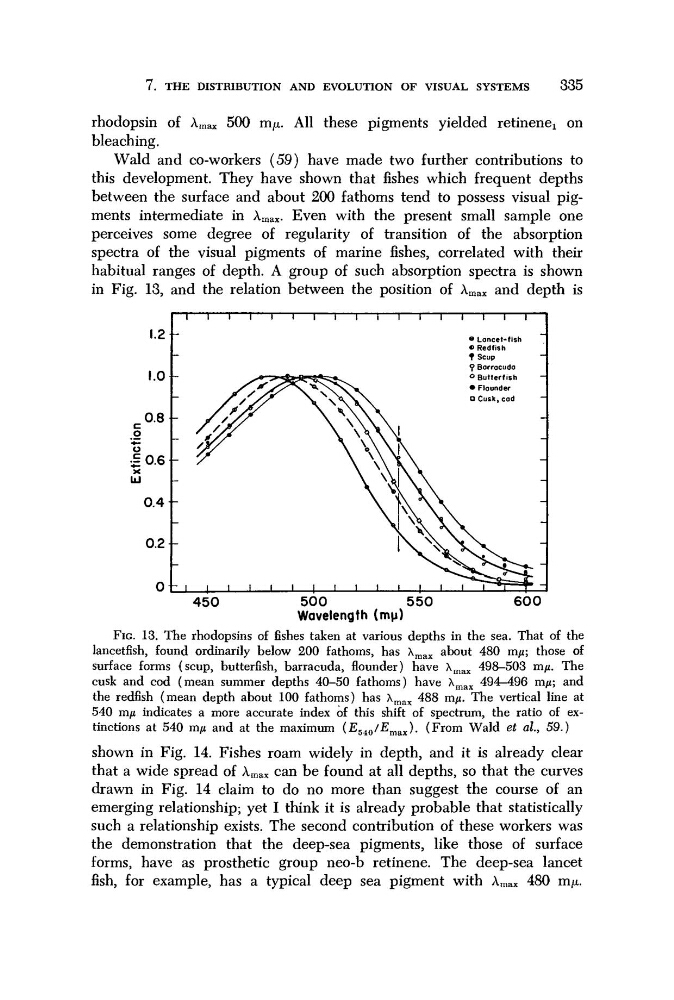
between the surface and about 200 fathoms tend to possess visual pigments intermediate in A max . Even with the present small sample one
perceives some degree of regularity of transition of the absorption
spectra of the visual pigments of marine fishes, correlated with their
habitual ranges of depth. A group of such absorption spectra is shown
in Fig. 13, and the relation between the position of A max and depth is
_
,
,
,
,
,
,
,
,
,
,
p—,
,
,
,
j
I P iJ
, '
t - I
β Lancet-fish
Π
I
© Redfish
I
r~
f Scup
H
FIG. 13. The rhodopsins of fishes taken at various depths in the sea. That of the
lancetfish, found ordinarily below 200 fathoms, has X max about 480 πΐμ; those of
surface forms (scup, butterfish, barracuda, flounder) have X max 498-503 τημ. The
cusk and cod (mean summer depths 40-50 fathoms) have X max 494-496 τημ; and
the redfish (mean depth about 100 fathoms) has X max 488 ιημ. The vertical line at
540 τημ indicates a more accurate index of this shift of spectrum, the ratio of extinctions at 540 πιμ and at the maximum (E 5 ± 0 /E max ).
(From Wald et ah, 59.)
shown in Fig. 14. Fishes roam widely in depth, and it is already clear
that a wide spread of A max can be found at all depths, so that the curves
drawn in Fig. 14 claim to do no more than suggest the course of an
emerging relationship; yet I think it is already probable that statistically
such a relationship exists. The second contribution of these workers was
the demonstration that the deep-sea pigments, like those of surface
forms, have as prosthetic group neo-b retinene. The deep-sea lancet
fish, for example, has a typical deep sea pigment with A max 480 m/x.
335
rhodopsin of A max 500 ni/x. All these pigments yielded retinenei on
bleaching.
Wald and co-workers (59) have made two further contributions to
this development. They have shown that fishes which frequent depths
between the surface and about 200 fathoms tend to possess visual pigments intermediate in A max . Even with the present small sample one
perceives some degree of regularity of transition of the absorption
spectra of the visual pigments of marine fishes, correlated with their
habitual ranges of depth. A group of such absorption spectra is shown
in Fig. 13, and the relation between the position of A max and depth is
_
,
,
,
,
,
,
,
,
,
,
p—,
,
,
,
j
I P iJ
, '
t - I
β Lancet-fish
Π
I
© Redfish
I
r~
f Scup
H
FIG. 13. The rhodopsins of fishes taken at various depths in the sea. That of the
lancetfish, found ordinarily below 200 fathoms, has X max about 480 πΐμ; those of
surface forms (scup, butterfish, barracuda, flounder) have X max 498-503 τημ. The
cusk and cod (mean summer depths 40-50 fathoms) have X max 494-496 τημ; and
the redfish (mean depth about 100 fathoms) has X max 488 ιημ. The vertical line at
540 τημ indicates a more accurate index of this shift of spectrum, the ratio of extinctions at 540 πιμ and at the maximum (E 5 ± 0 /E max ).
(From Wald et ah, 59.)
shown in Fig. 14. Fishes roam widely in depth, and it is already clear
that a wide spread of A max can be found at all depths, so that the curves
drawn in Fig. 14 claim to do no more than suggest the course of an
emerging relationship; yet I think it is already probable that statistically
such a relationship exists. The second contribution of these workers was
the demonstration that the deep-sea pigments, like those of surface
forms, have as prosthetic group neo-b retinene. The deep-sea lancet
fish, for example, has a typical deep sea pigment with A max 480 m/x.