

7. THE DISTRIBUTION AND EVOLUTION OF VISUAL SYSTEMS
317
At such hindered eis linkages, therefore, the molecule should be not
only bent but twisted; and since planarity is the condition for free resonance, and resonance promotes stability, such hindered eis linkages were
expected to be both rare and unstable.
It is now known however that the neo-b isomer from which all known
visual pigments are formed possesses such a hindered eis linkage in the
11 position (16). The much greater hindrance at double bond 7 has
so far prevented the synthesis of the 7-eis molecule; but the 11-cis, neo-b
isomer, given the necessary energy, forms readily, and once formed is
surprisingly stable. Indeed, under proper conditions it is a highly favored
isomer. One can isomerize the retinenes by simple exposure to light, provided it contains the blue, violet, and near ultraviolet components that
the retinenes absorb. Any isomer of retinene, on irradiation with such
light, goes over into a steady state mixture of all possible isomers. In a
homopolar solvent such as hexane, this mixture is about 95% all-trans; but
in such a polar solvent as ethyl alcohol, the eis isomers are much more
prevalent, and about 25% of the steady state mixture is in the hindered,
11-cis configuration (9, 17).
All the visual pigments now known appear to have as prosthetic
group the same neo-b, 11-cis, configuration of retinene. This is true
equally of the rod and cone pigments of vertebrates, whether made of
retinenei or retinene 2 ; and of the visual pigment of the squid, the only
invertebrate pigment in which the prosthetic group has been identified.
With this generalization one can couple another. The bleaching of
visual pigments yields almost entirely the all-trans isomer of retinene as
the initial product. That is, a retinene enters the synthesis of visual pigment in one configuration, and emerges in another. It enters as the bent
and twisted 11-cis isomer, and comes out relatively straight. Then it
must be bent and twisted back into the neo-b configuration before it
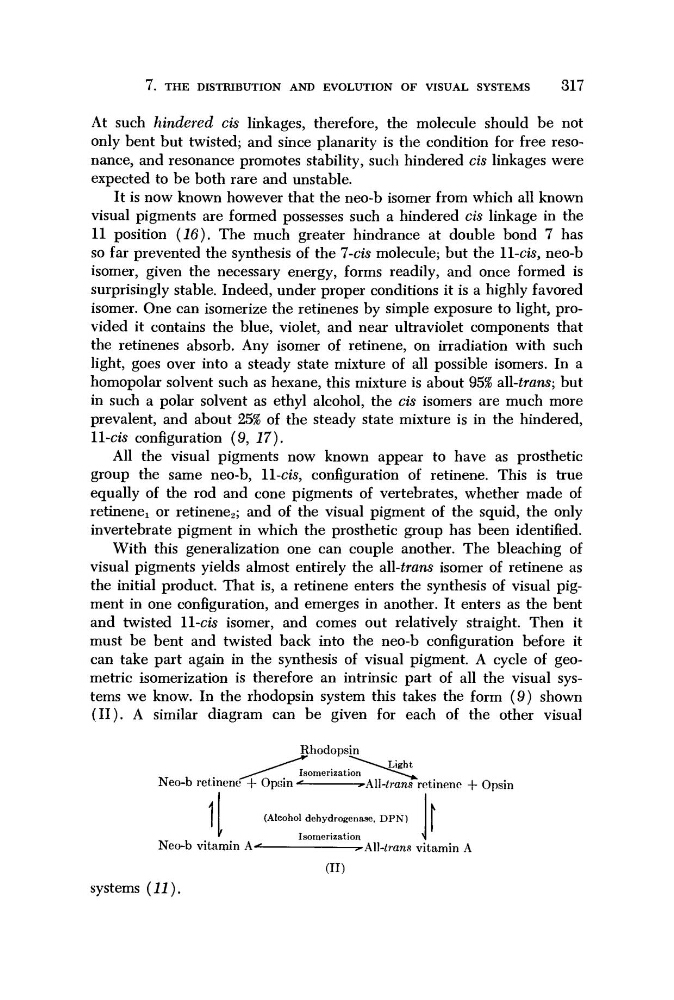
can take part again in the synthesis of visual pigment. A cycle of geometric isomerization is therefore an intrinsic part of all the visual systems we know. In the rhodopsin system this takes the form (9) shown
(II). A similar diagram can be given for each of the other visual
Rhodopsin
^*"—
Isomerization
^"
>>,,,
^-«^Ak
Neo-b retinene + Opdn <*
rAM-trans retinene + Opsin
(Alcohol dehydrogenase, DPN)
»
Isomerization
N
Neo-b vitamin A-*=
^AW-trans vitamin A
(II)
systems (11).
317
At such hindered eis linkages, therefore, the molecule should be not
only bent but twisted; and since planarity is the condition for free resonance, and resonance promotes stability, such hindered eis linkages were
expected to be both rare and unstable.
It is now known however that the neo-b isomer from which all known
visual pigments are formed possesses such a hindered eis linkage in the
11 position (16). The much greater hindrance at double bond 7 has
so far prevented the synthesis of the 7-eis molecule; but the 11-cis, neo-b
isomer, given the necessary energy, forms readily, and once formed is
surprisingly stable. Indeed, under proper conditions it is a highly favored
isomer. One can isomerize the retinenes by simple exposure to light, provided it contains the blue, violet, and near ultraviolet components that
the retinenes absorb. Any isomer of retinene, on irradiation with such
light, goes over into a steady state mixture of all possible isomers. In a
homopolar solvent such as hexane, this mixture is about 95% all-trans; but
in such a polar solvent as ethyl alcohol, the eis isomers are much more
prevalent, and about 25% of the steady state mixture is in the hindered,
11-cis configuration (9, 17).
All the visual pigments now known appear to have as prosthetic
group the same neo-b, 11-cis, configuration of retinene. This is true
equally of the rod and cone pigments of vertebrates, whether made of
retinenei or retinene 2 ; and of the visual pigment of the squid, the only
invertebrate pigment in which the prosthetic group has been identified.
With this generalization one can couple another. The bleaching of
visual pigments yields almost entirely the all-trans isomer of retinene as
the initial product. That is, a retinene enters the synthesis of visual pigment in one configuration, and emerges in another. It enters as the bent
and twisted 11-cis isomer, and comes out relatively straight. Then it
must be bent and twisted back into the neo-b configuration before it
can take part again in the synthesis of visual pigment. A cycle of geometric isomerization is therefore an intrinsic part of all the visual systems we know. In the rhodopsin system this takes the form (9) shown
(II). A similar diagram can be given for each of the other visual
Rhodopsin
^*"—
Isomerization
^"
>>,,,
^-«^Ak
Neo-b retinene + Opdn <*
rAM-trans retinene + Opsin
(Alcohol dehydrogenase, DPN)
»
Isomerization
N
Neo-b vitamin A-*=
^AW-trans vitamin A
(II)
systems (11).