

318
GEORGE WALD
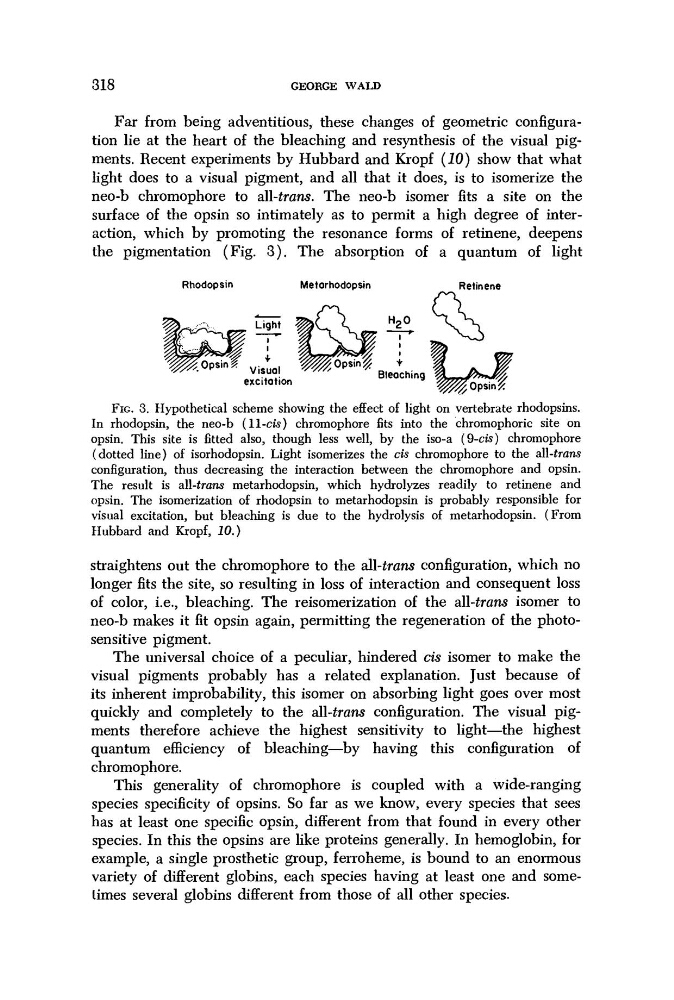
Far from being adventitious, these changes of geometric configuration lie at the heart of the bleaching and resynthesis of the visual pigments. Recent experiments by Hubbard and Kropf (10) show that what
light does to a visual pigment, and all that it does, is to isomerize the
neo-b chromophore to all-trans. The neo-b isomer fits a site on the
surface of the opsin so intimately as to permit a high degree of interaction, which by promoting the resonance forms of retinene, deepens
the pigmentation (Fig. 3). The absorption of a quantum of light
Rhodopsin
Metarhodopsin
Retinene
FIG. 3. Hypothetical scheme showing the effect of light on vertebrate rhodopsins.
In rhodopsin, the neo-b (11-cis) chromophore fits into the chromophoric site on
opsin. This site is fitted also, though less well, by the iso-a (9-cis) chromophore
(dotted line) of isorhodopsin. Light isomerizes the eis chromophore to the all-trans
configuration, thus decreasing the interaction between the chromophore and opsin.
The result is all-fran$ metarhodopsin, which hydrolyzes readily to retinene and
opsin. The isomerization of rhodopsin to metarhodopsin is probably responsible for
visual excitation, but bleaching is due to the hydrolysis of metarhodopsin. (From
Hubbard and Kropf, JO.)
straightens out the chromophore to the all-trans configuration, which no
longer fits the site, so resulting in loss of interaction and consequent loss
of color, i.e., bleaching. The reisomerization of the all-trans isomer to
neo-b makes it fit opsin again, permitting the regeneration of the photosensitive pigment.
The universal choice of a peculiar, hindered eis isomer to make the
visual pigments probably has a related explanation. Just because of
its inherent improbability, this isomer on absorbing light goes over most
quickly and completely to the all-trans configuration. The visual pigments therefore achieve the highest sensitivity to light—the highest
quantum efficiency of bleaching—by having this configuration of
chromophore.
This generality of chromophore is coupled with a wide-ranging
species specificity of opsins. So far as we know, every species that sees
has at least one specific opsin, different from that found in every other
species. In this the opsins are like proteins generally. In hemoglobin, for
example, a single prosthetic group, ferroheme, is bound to an enormous
variety of different globins, each species having at least one and sometimes several globins different from those of all other species.
GEORGE WALD
Far from being adventitious, these changes of geometric configuration lie at the heart of the bleaching and resynthesis of the visual pigments. Recent experiments by Hubbard and Kropf (10) show that what
light does to a visual pigment, and all that it does, is to isomerize the
neo-b chromophore to all-trans. The neo-b isomer fits a site on the
surface of the opsin so intimately as to permit a high degree of interaction, which by promoting the resonance forms of retinene, deepens
the pigmentation (Fig. 3). The absorption of a quantum of light
Rhodopsin
Metarhodopsin
Retinene
FIG. 3. Hypothetical scheme showing the effect of light on vertebrate rhodopsins.
In rhodopsin, the neo-b (11-cis) chromophore fits into the chromophoric site on
opsin. This site is fitted also, though less well, by the iso-a (9-cis) chromophore
(dotted line) of isorhodopsin. Light isomerizes the eis chromophore to the all-trans
configuration, thus decreasing the interaction between the chromophore and opsin.
The result is all-fran$ metarhodopsin, which hydrolyzes readily to retinene and
opsin. The isomerization of rhodopsin to metarhodopsin is probably responsible for
visual excitation, but bleaching is due to the hydrolysis of metarhodopsin. (From
Hubbard and Kropf, JO.)
straightens out the chromophore to the all-trans configuration, which no
longer fits the site, so resulting in loss of interaction and consequent loss
of color, i.e., bleaching. The reisomerization of the all-trans isomer to
neo-b makes it fit opsin again, permitting the regeneration of the photosensitive pigment.
The universal choice of a peculiar, hindered eis isomer to make the
visual pigments probably has a related explanation. Just because of
its inherent improbability, this isomer on absorbing light goes over most
quickly and completely to the all-trans configuration. The visual pigments therefore achieve the highest sensitivity to light—the highest
quantum efficiency of bleaching—by having this configuration of
chromophore.
This generality of chromophore is coupled with a wide-ranging
species specificity of opsins. So far as we know, every species that sees
has at least one specific opsin, different from that found in every other
species. In this the opsins are like proteins generally. In hemoglobin, for
example, a single prosthetic group, ferroheme, is bound to an enormous
variety of different globins, each species having at least one and sometimes several globins different from those of all other species.