

278
KENNETH V. ΊΉΙΜΑΝΝ AND GEORGE M. CURRY
absorption and action curves is outstanding. The features important for
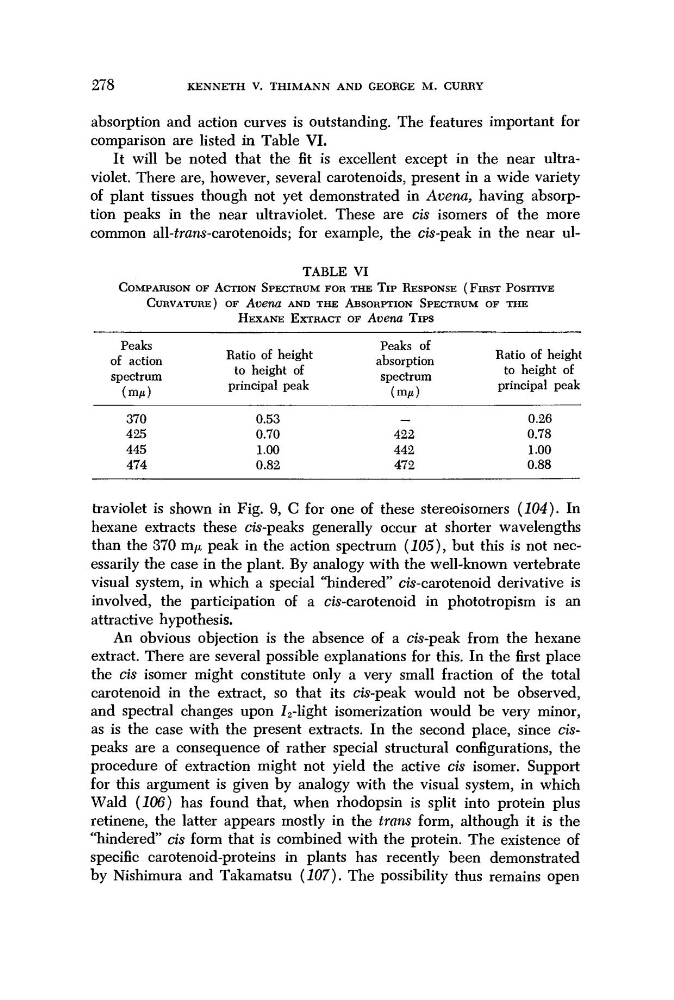
comparison are listed in Table VI.
It will be noted that the fit is excellent except in the near ultraviolet. There are, however, several carotenoids, present in a wide variety
of plant tissues though not yet demonstrated in Avena, having absorption peaks in the near ultraviolet. These are eis isomers of the more
common all-frans-carotenoids; for example, the cis-peak in the near ulTABLE VI
COMPARISON OF ACTION SPECTRUM FOR THE TIP RESPONSE ( FIRST PosmvE
CURVATURE) OF Avena AND THE ABSORPTION SPECTRUM OF THE
HEXANE EXTRACT OF Avena TIPS
Peaks
of action
spectrum
(πΐμ)
Ratio of height
to height of
principal peak
Peaks of
absorption
spectrum
(m/0
Ratio of height
to height of
principal peak
370
425
445
474
0.53
0.70
1.00
0.82
422
442
472
0.26
0.78
1.00
0.88
traviolet is shown in Fig. 9, C for one of these stereoisomers (104). In
hexane extracts these cis-peaks generally occur at shorter wavelengths
than the 370 πΐμ peak in the action spectrum (105), but this is not necessarily the case in the plant. By analogy with the well-known vertebrate
visual system, in which a special "hindered" cis-carotenoid derivative is
involved, the participation of a ds-carotenoid in phototropism is an
attractive hypothesis.
An obvious objection is the absence of a cw-peak from the hexane
extract. There are several possible explanations for this. In the first place
the eis isomer might constitute only a very small fraction of the total
carotenoid in the extract, so that its ds-peak would not be observed,
and spectral changes upon Z 2 -right isomerization would be very minor,
as is the case with the present extracts. In the second place, since eispeaks are a consequence of rather special structural configurations, the
procedure of extraction might not yield the active eis isomer. Support
for this argument is given by analogy with the visual system, in which
Wald (106) has found that, when rhodopsin is split into protein plus
retinene, the latter appears mostly in the trans form, although it is the
"hindered" eis form that is combined with the protein. The existence of
specific carotenoid-proteins in plants has recently been demonstrated
by Nishimura and Takamatsu (107). The possibility thus remains open
KENNETH V. ΊΉΙΜΑΝΝ AND GEORGE M. CURRY
absorption and action curves is outstanding. The features important for
comparison are listed in Table VI.
It will be noted that the fit is excellent except in the near ultraviolet. There are, however, several carotenoids, present in a wide variety
of plant tissues though not yet demonstrated in Avena, having absorption peaks in the near ultraviolet. These are eis isomers of the more
common all-frans-carotenoids; for example, the cis-peak in the near ulTABLE VI
COMPARISON OF ACTION SPECTRUM FOR THE TIP RESPONSE ( FIRST PosmvE
CURVATURE) OF Avena AND THE ABSORPTION SPECTRUM OF THE
HEXANE EXTRACT OF Avena TIPS
Peaks
of action
spectrum
(πΐμ)
Ratio of height
to height of
principal peak
Peaks of
absorption
spectrum
(m/0
Ratio of height
to height of
principal peak
370
425
445
474
0.53
0.70
1.00
0.82
422
442
472
0.26
0.78
1.00
0.88
traviolet is shown in Fig. 9, C for one of these stereoisomers (104). In
hexane extracts these cis-peaks generally occur at shorter wavelengths
than the 370 πΐμ peak in the action spectrum (105), but this is not necessarily the case in the plant. By analogy with the well-known vertebrate
visual system, in which a special "hindered" cis-carotenoid derivative is
involved, the participation of a ds-carotenoid in phototropism is an
attractive hypothesis.
An obvious objection is the absence of a cw-peak from the hexane
extract. There are several possible explanations for this. In the first place
the eis isomer might constitute only a very small fraction of the total
carotenoid in the extract, so that its ds-peak would not be observed,
and spectral changes upon Z 2 -right isomerization would be very minor,
as is the case with the present extracts. In the second place, since eispeaks are a consequence of rather special structural configurations, the
procedure of extraction might not yield the active eis isomer. Support
for this argument is given by analogy with the visual system, in which
Wald (106) has found that, when rhodopsin is split into protein plus
retinene, the latter appears mostly in the trans form, although it is the
"hindered" eis form that is combined with the protein. The existence of
specific carotenoid-proteins in plants has recently been demonstrated
by Nishimura and Takamatsu (107). The possibility thus remains open