

258
KENNETH V. THIMANN AND GEORGE M. CURRY
jected to a sudden increase in illumination, the curvature undergoes a
transient decrease, i.e., they temporarily reverse the sign of their phototropism. While the reversal is not large enough to cause a net negative
curvature, it does show that curvature away from visible light is possible
under some conditions.
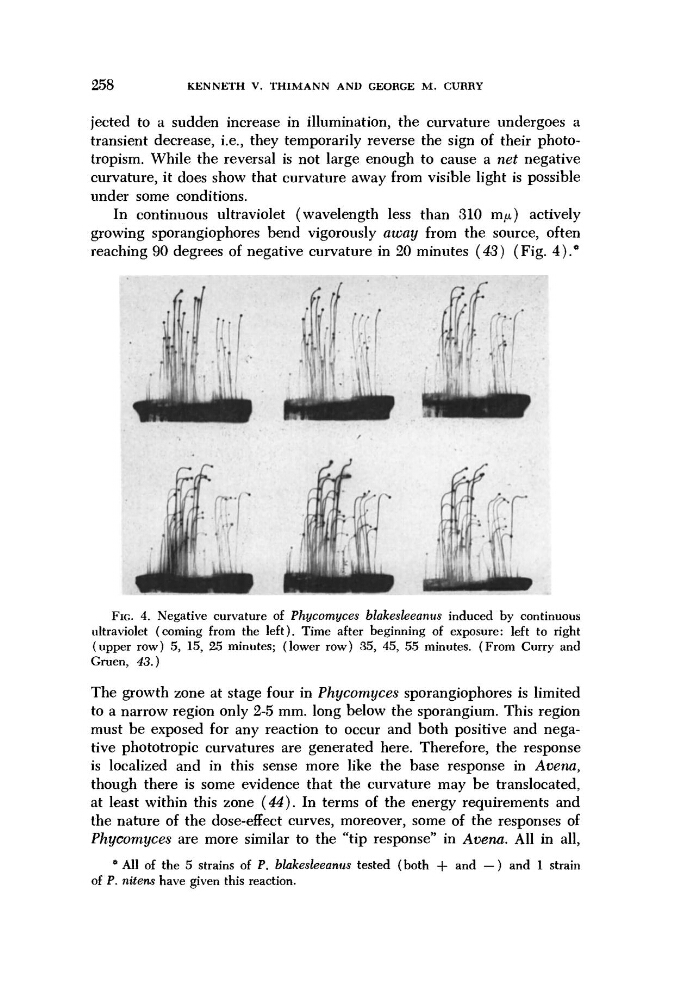
In continuous ultraviolet (wavelength less than 310 ηΐμ) actively
growing sporangiophores bend vigorously away from the source, often
reaching 90 degrees of negative curvature in 20 minutes (43) (Fig. 4).*
FIG. 4. Negative curvature of Phycomyces hlakesleeanus induced by continuous
ultraviolet (coming from the left). Time after beginning of exposure: left to right
(upper row) 5, 15, 25 minutes; (lower row) 35, 45, 55 minutes. (From Curry and
Gruen, 43.)
The growth zone at stage four in Phycomyces sporangiophores is limited
to a narrow region only 2-5 mm. long below the sporangium. This region
must be exposed for any reaction to occur and both positive and negative phototropic curvatures are generated here. Therefore, the response
is localized and in this sense more like the base response in Avena,
though there is some evidence that the curvature may be translocated,
at least within this zone (44). In terms of the energy requirements and
the nature of the dose-effect curves, moreover, some of the responses of
Phycomyces are more similar to the "tip response" in Avena. All in all,
* All of the 5 strains of P. hlakesleeanus tested (both + and —) and 1 strain
of P. nitens have given this reaction.
KENNETH V. THIMANN AND GEORGE M. CURRY
jected to a sudden increase in illumination, the curvature undergoes a
transient decrease, i.e., they temporarily reverse the sign of their phototropism. While the reversal is not large enough to cause a net negative
curvature, it does show that curvature away from visible light is possible
under some conditions.
In continuous ultraviolet (wavelength less than 310 ηΐμ) actively
growing sporangiophores bend vigorously away from the source, often
reaching 90 degrees of negative curvature in 20 minutes (43) (Fig. 4).*
FIG. 4. Negative curvature of Phycomyces hlakesleeanus induced by continuous
ultraviolet (coming from the left). Time after beginning of exposure: left to right
(upper row) 5, 15, 25 minutes; (lower row) 35, 45, 55 minutes. (From Curry and
Gruen, 43.)
The growth zone at stage four in Phycomyces sporangiophores is limited
to a narrow region only 2-5 mm. long below the sporangium. This region
must be exposed for any reaction to occur and both positive and negative phototropic curvatures are generated here. Therefore, the response
is localized and in this sense more like the base response in Avena,
though there is some evidence that the curvature may be translocated,
at least within this zone (44). In terms of the energy requirements and
the nature of the dose-effect curves, moreover, some of the responses of
Phycomyces are more similar to the "tip response" in Avena. All in all,
* All of the 5 strains of P. hlakesleeanus tested (both + and —) and 1 strain
of P. nitens have given this reaction.