

6. PHOTOTROPISM AND PHOTOTAXIS
257
work put the study of phototropism on a sound quantitative basis for
the first time. Most of his conclusions, however, were drawn from
threshold responses, and later workers have found it more accurate to
determine actual curvatures. In this way it has since been found, at
least in Avena (36), that the degree of phototropic curvature is determined by the incident light energy (Ιχί, Reciprocity Law, or
Bunsen-Roscoe Law) as long as t is small, just as found by Loeb for
the light responses of animals (Section II, above). However, as shown
in Table I, for longer exposures the response is mainly determined by t.
B. TYPES OF PHOTOTROPISM IN Phycomyces SPORANGIOPHORES
The sporangiophores of Phycomyces go through four distinct growth
stages (40) at the end of the third of which the sporangium is fully
formed and beginning to blacken. It is only in the ensuing fourth stage
that rapid growth and high phototropic sensitivity are found. Accordingly, virtually all of the discussion of phototropism in Phycomyces refers to sporangiophores in stage four.
In these organs, as in coleoptiles, the phototropism takes several
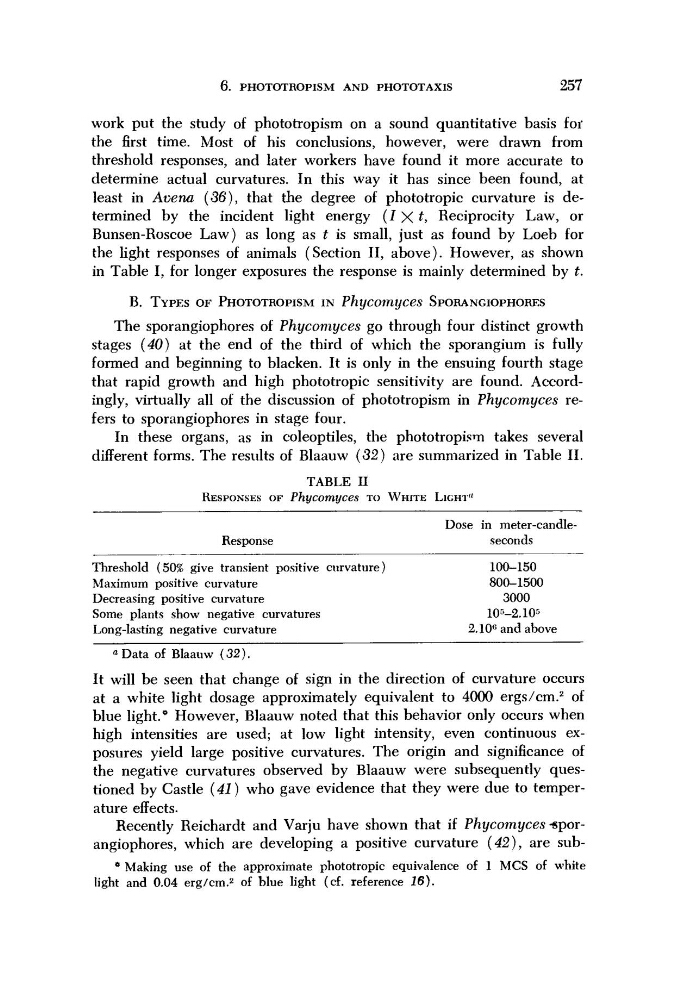
different forms. The results of Blaauw (32) are summarized in Table II.
TABLE II
RESPONSES OF Phycomyces
TO WHITE LIGHT«
Response
Threshold (50% give transient positive curvature)
Maximum positive curvature
Decreasing positive curvature
Some plants show negative curvatures
Long-lasting negative curvature
Dose in meter-candleseconds
100-150
800-1500
3000
105-2.10
5
2.10
6 and above
a Data of Blaauw (32).
It will be seen that change of sign in the direction of curvature occurs
at a white light dosage approximately equivalent to 4000 ergs/cm.
2 of
blue light.* However, Blaauw noted that this behavior only occurs when
high intensities are used; at low light intensity, even continuous exposures yield large positive curvatures. The origin and significance of
the negative curvatures observed by Blaauw were subsequently questioned by Castle (41) who gave evidence that they were due to temperature effects.
Recently Reichardt and Varju have shown that if Phycomyces -sporangiophores, which are developing a positive curvature (42), are sub* Making use of the approximate phototropic equivalence of 1 MCS of white
light and 0.04 erg/cm.
2 of blue light (cf. reference 16).
257
work put the study of phototropism on a sound quantitative basis for
the first time. Most of his conclusions, however, were drawn from
threshold responses, and later workers have found it more accurate to
determine actual curvatures. In this way it has since been found, at
least in Avena (36), that the degree of phototropic curvature is determined by the incident light energy (Ιχί, Reciprocity Law, or
Bunsen-Roscoe Law) as long as t is small, just as found by Loeb for
the light responses of animals (Section II, above). However, as shown
in Table I, for longer exposures the response is mainly determined by t.
B. TYPES OF PHOTOTROPISM IN Phycomyces SPORANGIOPHORES
The sporangiophores of Phycomyces go through four distinct growth
stages (40) at the end of the third of which the sporangium is fully
formed and beginning to blacken. It is only in the ensuing fourth stage
that rapid growth and high phototropic sensitivity are found. Accordingly, virtually all of the discussion of phototropism in Phycomyces refers to sporangiophores in stage four.
In these organs, as in coleoptiles, the phototropism takes several
different forms. The results of Blaauw (32) are summarized in Table II.
TABLE II
RESPONSES OF Phycomyces
TO WHITE LIGHT«
Response
Threshold (50% give transient positive curvature)
Maximum positive curvature
Decreasing positive curvature
Some plants show negative curvatures
Long-lasting negative curvature
Dose in meter-candleseconds
100-150
800-1500
3000
105-2.10
5
2.10
6 and above
a Data of Blaauw (32).
It will be seen that change of sign in the direction of curvature occurs
at a white light dosage approximately equivalent to 4000 ergs/cm.
2 of
blue light.* However, Blaauw noted that this behavior only occurs when
high intensities are used; at low light intensity, even continuous exposures yield large positive curvatures. The origin and significance of
the negative curvatures observed by Blaauw were subsequently questioned by Castle (41) who gave evidence that they were due to temperature effects.
Recently Reichardt and Varju have shown that if Phycomyces -sporangiophores, which are developing a positive curvature (42), are sub* Making use of the approximate phototropic equivalence of 1 MCS of white
light and 0.04 erg/cm.
2 of blue light (cf. reference 16).