

6. PHOTOTROPISM AND PHOTOTAXIS
259
there is an interesting semiquantitative parallel between the behavior of
Phycomyces and that of Avena.
C. THE RELATION BETWEEN CURVATURE AND THE LIGHT-GROWTH REACTION
It was the concept of Blaauw that phototropic curvature depended
on the difference between the "light-growth reactions" of the dark
and bright sides of a growing organ. These reactions, i.e., changes in
growth rate brought about by light, could be positive or negative,
simple or complex. They were considered as taking place quite independently on the two sides, and as a function of the light dosage, I X t,
on each side.
Z 10
t 5
< 10
5
(9
601*°2θ|
0
10 20 30 40 50
TIME (MINUTES)
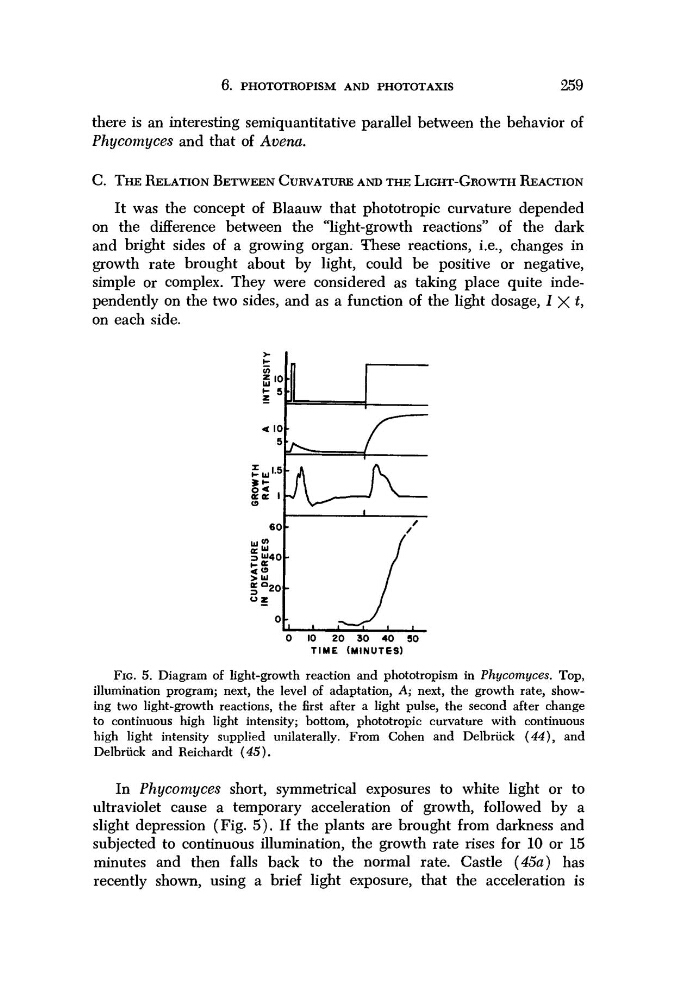
FIG. 5. Diagram of light-growth reaction and phototropism in Phycomyces. Top,
illumination program; next, the level of adaptation, A; next, the growth rate, showing two light-growth reactions, the first after a light pulse, the second after change
to continuous high light intensity; bottom, phototropic curvature with continuous
high light intensity supplied unilaterally. From Cohen and Delbrück (44), and
Delbriick and Reichardt (45).
In Phycomyces short, symmetrical exposures to white light or to
ultraviolet cause a temporary acceleration of growth, followed by a
slight depression (Fig. 5). If the plants are brought from darkness and
subjected to continuous illumination, the growth rate rises for 10 or 15
minutes and then falls back to the normal rate. Castle (45a) has
recently shown, using a brief light exposure, that the acceleration is
259
there is an interesting semiquantitative parallel between the behavior of
Phycomyces and that of Avena.
C. THE RELATION BETWEEN CURVATURE AND THE LIGHT-GROWTH REACTION
It was the concept of Blaauw that phototropic curvature depended
on the difference between the "light-growth reactions" of the dark
and bright sides of a growing organ. These reactions, i.e., changes in
growth rate brought about by light, could be positive or negative,
simple or complex. They were considered as taking place quite independently on the two sides, and as a function of the light dosage, I X t,
on each side.
Z 10
t 5
< 10
5
(9
601*°2θ|
0
10 20 30 40 50
TIME (MINUTES)
FIG. 5. Diagram of light-growth reaction and phototropism in Phycomyces. Top,
illumination program; next, the level of adaptation, A; next, the growth rate, showing two light-growth reactions, the first after a light pulse, the second after change
to continuous high light intensity; bottom, phototropic curvature with continuous
high light intensity supplied unilaterally. From Cohen and Delbrück (44), and
Delbriick and Reichardt (45).
In Phycomyces short, symmetrical exposures to white light or to
ultraviolet cause a temporary acceleration of growth, followed by a
slight depression (Fig. 5). If the plants are brought from darkness and
subjected to continuous illumination, the growth rate rises for 10 or 15
minutes and then falls back to the normal rate. Castle (45a) has
recently shown, using a brief light exposure, that the acceleration is