

5. ONIUM COMPOUNDS
213
maintain a constant and high intracellular methionine concentration.
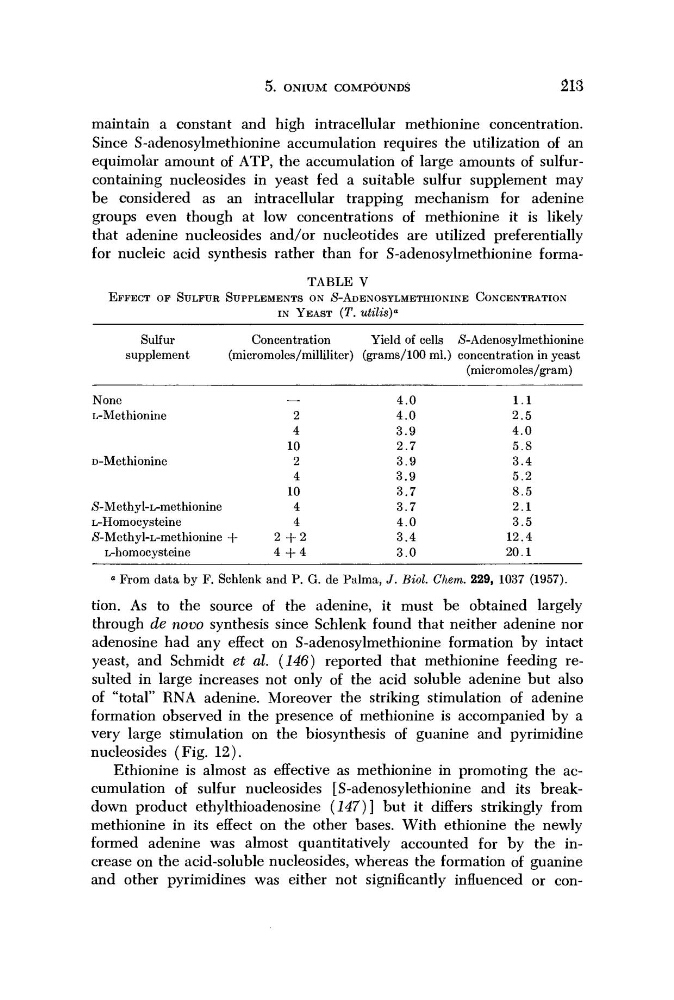
Since S-adenosylmethionine accumulation requires the utilization of an
equimolar amount of ATP, the accumulation of large amounts of sulfurcontaining nucleosides in yeast fed a suitable sulfur supplement may
be considered as an intracellular trapping mechanism for adenine
groups even though at low concentrations of methionine it is likely
that adenine nucleosides and/or nucleotides are utilized preferentially
for nucleic acid synthesis rather than for S-adenosylmethionine formaTABLE V
EFFECT OF SULFUR SUPPLEMENTS ON #-ADENOSYLMETHIONINE CONCENTRATION
IN YEAST (T. utilis)
a
Sulfur
supplement
None
L-Methionine
D-Methionine
*S-Methyl-L-methionine
L-Homocysteine
Concentration
(micromoles/milliliter)
/S-Methyl-L-methionine +
L-homocysteine
2
4
10
2
4
10
4
4
2 +2
4 +4
Yield of cells
(grams/100 ml.)
4.0
4.0
3.9
2.7
3.9
3.9
3.7
3.7
4.0
3.4
3.0
£-Adenosylmethionine
concentration in yeast
(micromoles/gram)
1.1
2.5
4.0
5.8
3.4
5.2
8.5
2.1
3.5
12.4
20.1
a From data by F. Schlenk and P. G. de Palma, /. Biol. Chem. 229, 1037 (1957).
tion. As to the source of the adenine, it must be obtained largely
through de novo synthesis since Schlenk found that neither adenine nor
adenosine had any effect on S-adenosylmethionine formation by intact
yeast, and Schmidt et al. (146) reported that methionine feeding resulted in large increases not only of the acid soluble adenine but also
of "total" RNA adenine. Moreover the striking stimulation of adenine
formation observed in the presence of methionine is accompanied by a
very large stimulation on the biosynthesis of guanine and pyrimidine
nucleosides (Fig. 12).
Ethionine is almost as effective as methionine in promoting the accumulation of sulfur nucleosides [S-adenosylethionine and its breakdown product ethylthioadenosine (147)] but it differs strikingly from
methionine in its effect on the other bases. With ethionine the newly
formed adenine was almost quantitatively accounted for by the increase on the acid-soluble nucleosides, whereas the formation of guanine
and other pyrimidines was either not significantly influenced or con-
213
maintain a constant and high intracellular methionine concentration.
Since S-adenosylmethionine accumulation requires the utilization of an
equimolar amount of ATP, the accumulation of large amounts of sulfurcontaining nucleosides in yeast fed a suitable sulfur supplement may
be considered as an intracellular trapping mechanism for adenine
groups even though at low concentrations of methionine it is likely
that adenine nucleosides and/or nucleotides are utilized preferentially
for nucleic acid synthesis rather than for S-adenosylmethionine formaTABLE V
EFFECT OF SULFUR SUPPLEMENTS ON #-ADENOSYLMETHIONINE CONCENTRATION
IN YEAST (T. utilis)
a
Sulfur
supplement
None
L-Methionine
D-Methionine
*S-Methyl-L-methionine
L-Homocysteine
Concentration
(micromoles/milliliter)
/S-Methyl-L-methionine +
L-homocysteine
2
4
10
2
4
10
4
4
2 +2
4 +4
Yield of cells
(grams/100 ml.)
4.0
4.0
3.9
2.7
3.9
3.9
3.7
3.7
4.0
3.4
3.0
£-Adenosylmethionine
concentration in yeast
(micromoles/gram)
1.1
2.5
4.0
5.8
3.4
5.2
8.5
2.1
3.5
12.4
20.1
a From data by F. Schlenk and P. G. de Palma, /. Biol. Chem. 229, 1037 (1957).
tion. As to the source of the adenine, it must be obtained largely
through de novo synthesis since Schlenk found that neither adenine nor
adenosine had any effect on S-adenosylmethionine formation by intact
yeast, and Schmidt et al. (146) reported that methionine feeding resulted in large increases not only of the acid soluble adenine but also
of "total" RNA adenine. Moreover the striking stimulation of adenine
formation observed in the presence of methionine is accompanied by a
very large stimulation on the biosynthesis of guanine and pyrimidine
nucleosides (Fig. 12).
Ethionine is almost as effective as methionine in promoting the accumulation of sulfur nucleosides [S-adenosylethionine and its breakdown product ethylthioadenosine (147)] but it differs strikingly from
methionine in its effect on the other bases. With ethionine the newly
formed adenine was almost quantitatively accounted for by the increase on the acid-soluble nucleosides, whereas the formation of guanine
and other pyrimidines was either not significantly influenced or con-