

212
G. L. CANTONI
This latter compound, however, is not exclusively a chemical artifact
for it can also arise biologically in yeast and other microorganisms
through the action of at least two types of enzyme systems: the propylaminepherase of Tabor et al. (143) which, after the decarboxylation
of adenosylmethionine catalyzed by a separate enzyme, transfers the
remaining propylamine moiety to a receptor polyamine; and the adenosylmethionine-cleaving enzyme studied by Mudd (144) and by Shapiro
and Mather (145).
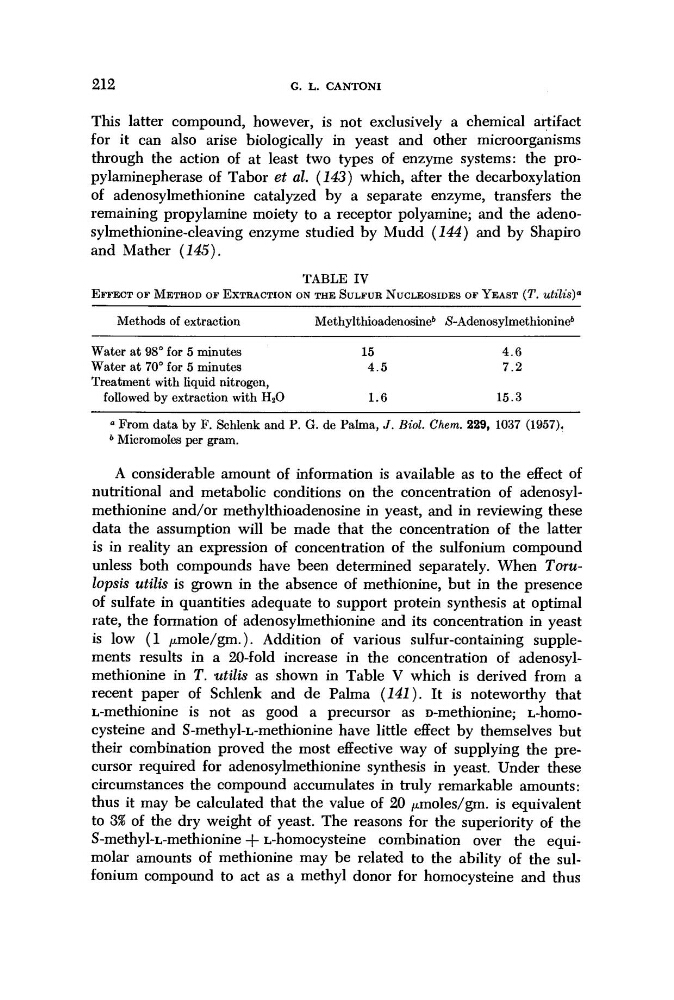
TABLE IV
EFFECT OF METHOD OF EXTRACTION ON THE SULFUR NUCLEOSIDES OF YEAST (T.
utilis)
a
Methods of extraction
Methylthioadenosine
6
S-Adenosylmethionine
6
Water at 98° for 5 minutes
15
4.6
Water at 70° for 5 minutes
4.5
7.2
Treatment with liquid nitrogen,
followed by extraction with H 2 0
1.6
15.3
a From data by F. Schlenk and P. G. de Palma, /. BioL Chem. 229, 1037 (1957),
6 Micromoles per gram.
A considerable amount of information is available as to the effect of
nutritional and metabolic conditions on the concentration of adenosylmethionine and/or methylthioadenosine in yeast, and in reviewing these
data the assumption will be made that the concentration of the latter
is in reality an expression of concentration of the sulfonium compound
unless both compounds have been determined separately. When Torulopsis utilis is grown in the absence of methionine, but in the presence
of sulfate in quantities adequate to support protein synthesis at optimal
rate, the formation of adenosylmethionine and its concentration in yeast
is low (1 /^mole/gm.). Addition of various sulfur-containing supplements results in a 20-fold increase in the concentration of adenosylmethionine in Γ. utilis as shown in Table V which is derived from a
recent paper of Schlenk and de Palma (141). It is noteworthy that
L-methionine is not as good a precursor as D-methionine; L-homocysteine and S-methyl-L-methionine have little effect by themselves but
their combination proved the most effective way of supplying the precursor required for adenosylmethionine synthesis in yeast. Under these
circumstances the compound accumulates in truly remarkable amounts:
thus it may be calculated that the value of 20 /mioles/gm. is equivalent
to 3% of the dry weight of yeast. The reasons for the superiority of the
S-methyl-L-methionine + L-homocysteine combination over the equimolar amounts of methionine may be related to the ability of the sulfonium compound to act as a methyl donor for homocysteine and thus
G. L. CANTONI
This latter compound, however, is not exclusively a chemical artifact
for it can also arise biologically in yeast and other microorganisms
through the action of at least two types of enzyme systems: the propylaminepherase of Tabor et al. (143) which, after the decarboxylation
of adenosylmethionine catalyzed by a separate enzyme, transfers the
remaining propylamine moiety to a receptor polyamine; and the adenosylmethionine-cleaving enzyme studied by Mudd (144) and by Shapiro
and Mather (145).
TABLE IV
EFFECT OF METHOD OF EXTRACTION ON THE SULFUR NUCLEOSIDES OF YEAST (T.
utilis)
a
Methods of extraction
Methylthioadenosine
6
S-Adenosylmethionine
6
Water at 98° for 5 minutes
15
4.6
Water at 70° for 5 minutes
4.5
7.2
Treatment with liquid nitrogen,
followed by extraction with H 2 0
1.6
15.3
a From data by F. Schlenk and P. G. de Palma, /. BioL Chem. 229, 1037 (1957),
6 Micromoles per gram.
A considerable amount of information is available as to the effect of
nutritional and metabolic conditions on the concentration of adenosylmethionine and/or methylthioadenosine in yeast, and in reviewing these
data the assumption will be made that the concentration of the latter
is in reality an expression of concentration of the sulfonium compound
unless both compounds have been determined separately. When Torulopsis utilis is grown in the absence of methionine, but in the presence
of sulfate in quantities adequate to support protein synthesis at optimal
rate, the formation of adenosylmethionine and its concentration in yeast
is low (1 /^mole/gm.). Addition of various sulfur-containing supplements results in a 20-fold increase in the concentration of adenosylmethionine in Γ. utilis as shown in Table V which is derived from a
recent paper of Schlenk and de Palma (141). It is noteworthy that
L-methionine is not as good a precursor as D-methionine; L-homocysteine and S-methyl-L-methionine have little effect by themselves but
their combination proved the most effective way of supplying the precursor required for adenosylmethionine synthesis in yeast. Under these
circumstances the compound accumulates in truly remarkable amounts:
thus it may be calculated that the value of 20 /mioles/gm. is equivalent
to 3% of the dry weight of yeast. The reasons for the superiority of the
S-methyl-L-methionine + L-homocysteine combination over the equimolar amounts of methionine may be related to the ability of the sulfonium compound to act as a methyl donor for homocysteine and thus