

214
G. L. CANTONI
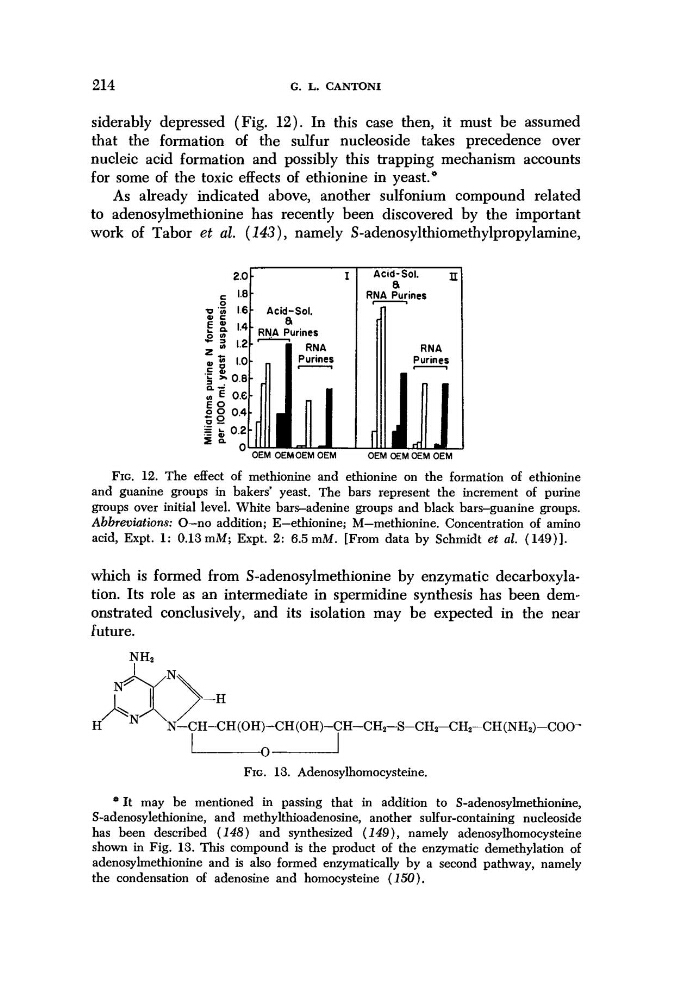
siderably depressed (Fig. 12). In this case then, it must be assumed
that the formation of the sulfur nucleoside takes precedence over
nucleic acid formation and possibly this trapping mechanism accounts
for some of the toxic effects of ethionine in yeast.*
As already indicated above, another sulfonium compound related
to adenosylmethionine has recently been discovered by the important
work of Tabor et al. (143), namely S-adenosylthiomethylpropylamine,
1i
l· r Acid-Sol.
1
a
[ RNA Purines
Γ
1
r
I
i
1
1 RNA
Purines
1 <
■
u iL
Acid-Sol.
i[|
a
RNA Purines
|
.
J
RNA
Purines
1
1
1 r
w W
OEM OEM OEM OEM
OEM OEM OEM OEM
c
o
Ό « C
E
φ
O Hi
Ϊ o
.E Φ
*i *
Q. "=
* t
F O
o O
5 a.
2.0
1.8
1.6
1.4
1.2
1.0
0.8
0.6
0.4
0.2
υ'
FIG. 12. The effect of methionine and ethionine on the formation of ethionine
and guanine groups in bakers' yeast. The bars represent the increment of purine
groups over initial level. White bars-adenine groups and black bars-guanine groups.
Abbreviations: O—no addition; E—ethionine; M—methionine. Concentration of amino
acid, Expt. 1: 0.13 mM; Expt. 2: 6.5 mM. [From data by Schmidt et al (149)].
which is formed from S-adenosylmethionine by enzymatic decarboxylation. Its role as an intermediate in spermidine synthesis has been demonstrated conclusively, and its isolation may be expected in the near
future.
NH 2
H
iN
N-CH-CH (OH)-CH (OH)-CH-CH 2 ~S-CH 2 -CH 2 -CH (NH 2 )-COO^
I
o
1
FIG. 13. Adenosylhomocysteine.
* It may be mentioned in passing that in addition to S-adenosylmethionine,
S-adenosylethionine, and methylthioadenosine, another sulfur-containing nucleoside
has been described (148) and synthesized (149), namely adenosylhomocysteine
shown in Fig. 13. This compound is the product of the enzymatic demethylation of
adenosylmethionine and is also formed enzymatically by a second pathway, namely
the condensation of adenosine and homocysteine (150).
G. L. CANTONI
siderably depressed (Fig. 12). In this case then, it must be assumed
that the formation of the sulfur nucleoside takes precedence over
nucleic acid formation and possibly this trapping mechanism accounts
for some of the toxic effects of ethionine in yeast.*
As already indicated above, another sulfonium compound related
to adenosylmethionine has recently been discovered by the important
work of Tabor et al. (143), namely S-adenosylthiomethylpropylamine,
1i
l· r Acid-Sol.
1
a
[ RNA Purines
Γ
1
r
I
i
1
1 RNA
Purines
1 <
■
u iL
Acid-Sol.
i[|
a
RNA Purines
|
.
J
RNA
Purines
1
1
1 r
w W
OEM OEM OEM OEM
OEM OEM OEM OEM
c
o
Ό « C
E
φ
O Hi
Ϊ o
.E Φ
*i *
Q. "=
* t
F O
o O
5 a.
2.0
1.8
1.6
1.4
1.2
1.0
0.8
0.6
0.4
0.2
υ'
FIG. 12. The effect of methionine and ethionine on the formation of ethionine
and guanine groups in bakers' yeast. The bars represent the increment of purine
groups over initial level. White bars-adenine groups and black bars-guanine groups.
Abbreviations: O—no addition; E—ethionine; M—methionine. Concentration of amino
acid, Expt. 1: 0.13 mM; Expt. 2: 6.5 mM. [From data by Schmidt et al (149)].
which is formed from S-adenosylmethionine by enzymatic decarboxylation. Its role as an intermediate in spermidine synthesis has been demonstrated conclusively, and its isolation may be expected in the near
future.
NH 2
H
iN
N-CH-CH (OH)-CH (OH)-CH-CH 2 ~S-CH 2 -CH 2 -CH (NH 2 )-COO^
I
o
1
FIG. 13. Adenosylhomocysteine.
* It may be mentioned in passing that in addition to S-adenosylmethionine,
S-adenosylethionine, and methylthioadenosine, another sulfur-containing nucleoside
has been described (148) and synthesized (149), namely adenosylhomocysteine
shown in Fig. 13. This compound is the product of the enzymatic demethylation of
adenosylmethionine and is also formed enzymatically by a second pathway, namely
the condensation of adenosine and homocysteine (150).